The secret to finding great indie films isn’t a better streaming service, but a fundamental shift from passive consumer to active curator.
- Mainstream algorithms create “epistemic bubbles” that limit your worldview by hiding diverse, non-commercial cinema.
- True discovery involves building a “curation stack,” engaging with film communities, and embracing physical media for its permanence and quality.
Recommendation: Your first step is to perform an audit of your own streaming recommendations to concretely identify the blind spots the algorithm creates for you.
You know the feeling. The endless, hypnotic scroll through a grid of familiar thumbnails on Netflix. The algorithm serves you another thriller that looks suspiciously like the last one you watched, or a comedy with the same three actors. There’s a nagging sense that a whole universe of vibrant, challenging, and personal cinema exists just beyond the borders of your screen, but you have no map to get there. You’re a cinephile trapped in a feedback loop, and the joy of discovery has been replaced by the fatigue of consumption.
Many seek refuge in niche platforms like Mubi or the Criterion Channel, and diligently follow critics on Letterboxd. These are valid steps, but they often treat the symptom, not the cause. The core issue isn’t just the tool you’re using; it’s the passive mindset that algorithmic platforms have conditioned us to adopt. They want you to be a consumer, easily satisfied and predictable. But the real thrill of cinema lies in active discovery, in becoming the curator of your own experience.
This guide offers a different path. It’s not about finding a magic-bullet platform that will solve your viewing woes. Instead, it’s about cultivating a “curatorial mindset”—a conscious, intentional practice of seeking out context, community, and material connection to films. It’s about dismantling the invisible walls of the algorithmic echo chamber and reclaiming your agency as a viewer. We’ll explore how to audit your own viewing habits, appreciate challenging cinematic forms, and connect with the very ecosystem that creates the films you’re looking for. It’s time to stop letting a formula dictate your taste and start building a cinematic world of your own.
To guide you on this journey from passive viewer to active curator, this article breaks down the essential strategies and mindset shifts. Explore the sections below to learn how to build your personal discovery engine, one that values human connection and artistic intent over algorithmic prediction.
Summary: A Cinephile’s Guide to Curating a Personal Film Universe
- The Hidden Risk of Algorithmic Curation That Limits Your Worldview
- Mubi or Criterion Channel: Which Subscription Suits Your Taste?
- Film Festival Networking: How to Get Industry Accreditation Without a Famous Name?
- Crowdfunding Cinema: Is It Safe to Back a Movie on Kickstarter?
- Joining a Film Club: How Discussing Movies Changes Your Perspective?
- Slow Cinema: How to Appreciate Movies Where “Nothing Happens”?
- Why Blu-Ray Audio Quality Is Superior to 4K Streaming?
- Can Digital Art Evoke the Same Emotion as Oil on Canvas?
The Hidden Risk of Algorithmic Curation That Limits Your Worldview
The primary function of a mainstream streaming algorithm isn’t to expand your horizons; it’s to minimize the risk of you closing the app. It achieves this by building a comfortable, self-reinforcing world around your established tastes. This creates what cultural analysts call an “epistemic bubble,” a space where you are simply not exposed to challenging, alternative, or non-commercial viewpoints. The algorithm learns you like American indie dramas and proceeds to hide the existence of a burgeoning Romanian New Wave or a groundbreaking Senegalese documentary. It’s not just limiting your entertainment options; it’s subtly narrowing your understanding of the world.
This effect is quantifiable. An analysis of streaming platforms reveals how they inadvertently create these bubbles, as viewers on algorithm-driven services are often unaware of major international films. In contrast, the study shows viewers who switch to curated platforms report discovering 3x more international films within their first month. This isn’t because the films weren’t available, but because the algorithm never deemed them relevant to your profile. The “risk” is a slow, invisible erosion of cultural curiosity, replacing the thrill of discovery with the comfort of predictability. Breaking free requires a conscious, manual override of this automated system, starting with a clear-eyed look at what it’s been hiding from you.
Your Action Plan: Conduct an Algorithmic Audit
- Points of contact: Document your last 20 Netflix/streaming recommendations. Note their genres, lead actors, and countries of origin.
- Collecte: Identify the dominant patterns. What percentage are from major Hollywood studios? Are there genres (e.g., experimental, silent film) or regions (e.g., Africa, Southeast Asia) that never appear?
- Cohérence: Confront these recommendations with your own stated values. Do you want to see more world cinema? More films by women? How does the algorithm’s output match your aspirations?
- Mémorabilité/émotion: Compare your list to a curated “best of the year” list from a source like Sight & Sound or Cahiers du Cinéma. Calculate your “discovery gap”—the number of critically acclaimed films the algorithm never showed you.
- Plan d’intégration: Deliberately watch three films from underrepresented categories you’ve identified. Observe how, or if, the algorithm adjusts its recommendations in the following weeks.
The first step toward a richer cinematic life is recognizing the limitations of your current tools and actively seeking to dismantle the invisible walls they have built.
Mubi or Criterion Channel: Which Subscription Suits Your Taste?
Once you’ve decided to break free from mainstream algorithms, the first port of call for many cinephiles are the two titans of curated streaming: Mubi and the Criterion Channel. However, choosing between them isn’t a simple matter of which has “better” movies. It’s a philosophical choice about the kind of curator you want to be. Mubi operates like a global film festival in your living room. With its “film of the day” model and a constantly rotating library, it emphasizes discovery and contemporaneity. It’s for the viewer who wants to stay on the pulse of modern arthouse cinema from around the world. The platform’s influence is undeniable, with over 15 million subscribers worldwide, positioning it as a major player in global film culture.
The Criterion Channel, on the other hand, is more akin to a definitive film museum. Its vast, largely permanent collection is built on the bedrock of cinema history, supplemented with deep-dive special features, interviews, and academic context. It’s for the cinephile who wants to build a foundational knowledge and understand the lineage of a director’s work or a film movement. The choice isn’t Mubi versus Criterion; it’s about what role you need them to play in your personal curation strategy: a source of new discoveries, or a library for deep study. The most effective approach is often to build a “curation stack,” using one as a base and supplementing it with other free or specialized services.
This comparative table breaks down the core differences in their offerings, helping you decide which service aligns best with your curatorial goals. As a film lover in the US or Canada, you have the luxury of choice, a privilege not extended to global audiences where Mubi is often the only curated option.
| Feature | Mubi | Criterion Channel |
|---|---|---|
| Monthly Price | $14.99 | $10.99 |
| Annual Price | $119.88 | $99.99 |
| Library Size | Under 1,000 films | Over 1,000 films |
| Content Focus | Contemporary arthouse & rotating selection | Classic cinema & permanent collection |
| New Additions | Daily new film | Monthly updates |
| Availability | 190+ countries | US & Canada only |
Ultimately, the best platform is the one that best serves your personal journey of discovery, whether that’s exploring the cutting edge or digging into the classics.
Film Festival Networking: How to Get Industry Accreditation Without a Famous Name?
Film festivals like Cannes, Sundance, and TIFF are the epicenters of film discovery, where the next wave of important cinema first makes its debut. For years, accessing this treasure trove of new work felt exclusive to industry insiders with expensive accreditations. However, the curatorial mindset reframes the challenge: you don’t need a physical badge to gain “festival intelligence.” In the digital age, you can become a remote festival networker, tracking discoveries in real-time from anywhere in the world.
The key is to follow the people, not just the premieres. Festival programmers, sales agents, and acquisitions executives are the true tastemakers. During major festivals, their activity on social media platforms like Twitter/X and Letterboxd becomes a live feed of what’s generating buzz. Following their posts and lists provides a curated signal amidst the noise, often months before a film gets a distribution deal or a public review. Furthermore, many festivals now have year-round digital presences, with YouTube channels featuring filmmaker panels and interviews. A case study from Raindance Festival even shows how volunteering can provide an unparalleled backstage pass, offering a six-month curatorial advantage on future hits.
By building a digital tracking strategy, you transform festivals from exclusive events into accessible, year-round sources of information. You learn to spot trends, identify emerging directors, and build a watchlist of exciting new films long before they ever appear on a streaming platform’s homepage. This proactive approach is a cornerstone of the active curatorial practice, turning you from a passive recipient of marketing into an informed, forward-looking cinephile.
- Follow key festival programmers on Letterboxd during Cannes, Sundance, and TIFF seasons.
- Set up Twitter/X lists for sales agents and distributors active during festivals.
- Monitor festival hashtags for real-time discoveries and acquisition announcements.
- Subscribe to festival YouTube channels for year-round filmmaker interviews and panels.
- Join festival Discord servers or online communities for insider recommendations.
- Track festival award winners as early indicators of future streaming releases.
This method doesn’t just help you find new films; it connects you to the very pulse of the independent film industry.
Crowdfunding Cinema: Is It Safe to Back a Movie on Kickstarter?
Engaging with crowdfunding platforms like Kickstarter or Indiegogo represents a profound shift in the curatorial mindset: from a consumer of finished products to a patron of the creative process itself. Backing a film is not like pre-ordering a DVD; it’s an investment in an artist’s vision and an act of faith in their ability to execute it. This carries inherent risks, as many crowdfunded projects face delays or fail to reach completion. So, is it safe? The answer depends entirely on your ability to perform due diligence as a curatorial backer.
Safety in this context means mitigating risk by learning to spot the hallmarks of a well-prepared project. A savvy backer looks beyond the flashy concept trailer. You should look for a strong proof-of-concept, such as a previous short film from the director that demonstrates their aesthetic and storytelling ability. Scrutinize the team: are there experienced crew members attached, like a director of photography or producer with a proven track record? A detailed and realistic budget breakdown is another critical sign of professionalism, as is a clear distribution strategy that outlines the filmmaker’s plan beyond simply finishing the movie. As one case study on indie filmmakers shows, those who successfully build audiences use platforms like YouTube to maintain transparency throughout production, treating backers as partners in the journey.
By approaching crowdfunding with a critical and investigative eye, you can make more informed decisions. The most valuable rewards are often not the physical items, but the non-monetary ones: access to production diaries, behind-the-scenes updates, and exclusive Q&As with the creative team. This access provides an unparalleled education in the filmmaking process, transforming you from a passive viewer into an engaged participant in the life of a film.
- Check for proof-of-concept: Look for a strong short film or previous work from the filmmaker.
- Verify key crew attachments: Ensure an experienced DP, producer, or editor is confirmed.
- Analyze the budget breakdown: Look for realistic, detailed cost allocations.
- Review the distribution strategy: Check if the filmmaker has plans beyond just making the film.
- Assess non-monetary rewards: Value access to production diaries and Q&As over physical items.
By backing a film, you’re not just helping to create art; you’re casting a vote for the kind of cinema you want to see in the world.
Joining a Film Club: How Discussing Movies Changes Your Perspective?
Watching a film in isolation is a monologue. Discussing it with others transforms it into a dialogue, and this is where the deepest level of cinematic appreciation often begins. Joining or starting a film club is one of the most powerful actions you can take to develop your curatorial mindset. It forces you to move beyond a simple “I liked it” or “I didn’t like it” and to articulate *why* a film works for you—or doesn’t. This process of articulation sharpens your critical thinking and provides you with a vocabulary to describe complex cinematic ideas.
The true value of a film club, however, lies in encountering perspectives that differ from your own. Hearing a fellow member passionately defend a film you disliked, or point out a subtle theme you completely missed, can be a revelatory experience. It teaches you to separate personal taste from critical analysis and expands your capacity to appreciate films that exist outside your comfort zone. This collaborative discovery is a potent antidote to the isolating nature of the algorithmic bubble, which is designed to only show you things it already knows you’ll like.
Film festival programmer Jeff Howard speaks directly to this transformation:
Hosting film discussions completely changed how I watch movies. Before, I was a passive consumer. Now, knowing I’ll discuss the film forces me to engage more critically. The best part is learning to articulate why something doesn’t work for me while respecting others who love it. These conversations have expanded my taste in ways solitary viewing never could.
– Jeff Howard, Discover Indie Film
Starting your own club is easier than ever with digital tools like Letterboxd for sharing lists and Discord for discussions. By choosing a thematic curation model, such as exploring the works of a specific director or a national film movement, you can create a structured learning experience for the entire group. This communal journey builds a shared context and a deeper, more nuanced appreciation for the art of cinema.
In a world of personalized feeds, the shared experience of discussing a film is a radical act of community building.
Slow Cinema: How to Appreciate Movies Where “Nothing Happens”?
In an media landscape optimized for constant stimulation, “slow cinema” can feel like a radical act of defiance. These are films characterized by long takes, minimal dialogue, and an emphasis on atmosphere over plot. To a viewer conditioned by the rapid-fire editing of mainstream blockbusters and TikTok videos, it can feel like “nothing is happening.” However, for the active curator, slow cinema offers a profound opportunity: a chance to retrain your attention and engage with film on a more contemplative, sensory level. Appreciating these films isn’t about passive endurance; it’s about practicing “active noticing.”
Directors like Kelly Reichardt have built careers on this form. As one analysis notes, her work is defined by a specific focus:
She is known for her minimalist films closely associated with slow cinema, many of which deal with working-class characters in small, rural communities.
– Wikipedia editors on Kelly Reichardt, Wikipedia – Kelly Reichardt
Instead of being guided by a plot, you are invited to immerse yourself in a world. Your attention shifts to the texture of the sound design, the subtle changes in light across a landscape, or the unspoken emotions conveyed by a character’s stillness. This viewing experience is less about decoding a narrative and more about inhabiting a space and a mood. It’s a meditative practice that challenges the very notion of what a “story” has to be.
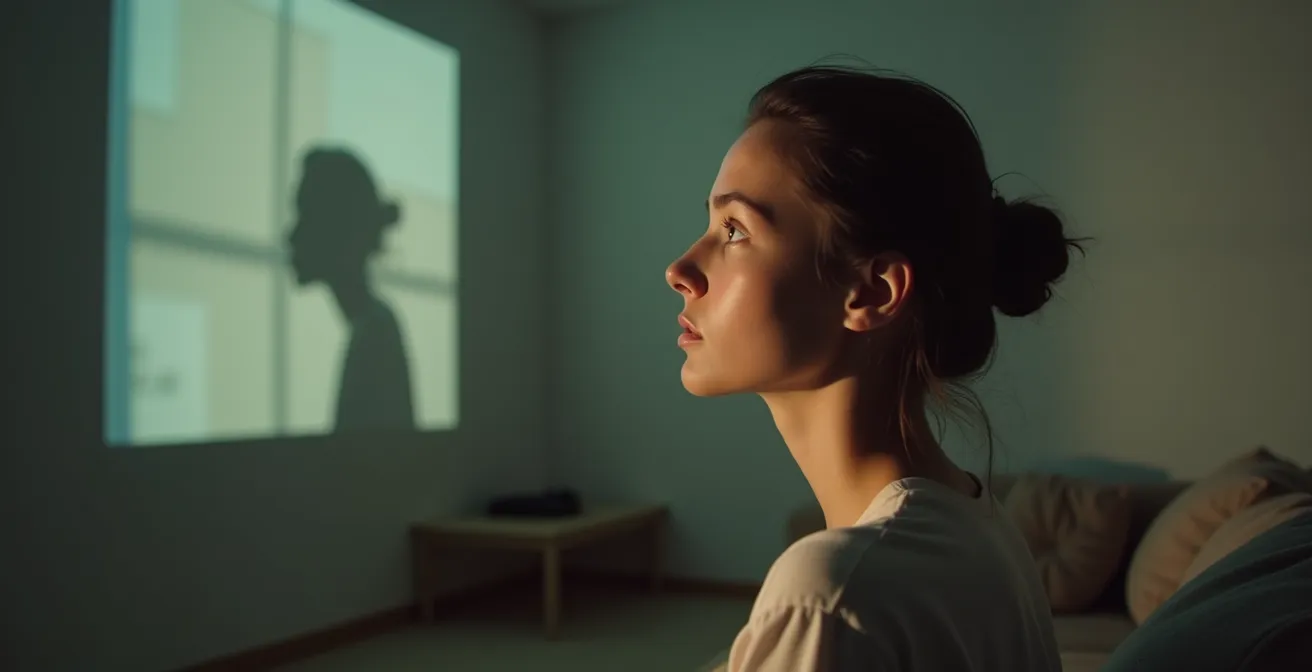
This image captures the essence of the experience: it is an internal, emotional journey. To get there, you must consciously shift your viewing habits. By focusing on ambient sounds, tracking the duration of shots, and allowing yourself to sit with narrative ambiguity, you develop a new kind of cinematic literacy. You learn to find meaning in the quiet moments that algorithms are programmed to edit out, discovering a rich, emotional landscape hidden in plain sight.
- Focus on ambient sound design: Notice how natural sounds, or even silence, replace dialogue and score to build the world.
- Track shot duration: Consciously count the seconds during a static shot to become aware of how the filmmaker is manipulating cinematic time.
- Observe micro-movements: In the absence of grand action, watch for subtle changes in a character’s facial expression or the way wind moves through trees.
- Practice patience with narrative gaps: Allow yourself to fill the silences with your own contemplation and interpretation. Don’t demand answers.
- Connect to the Slow Movement philosophy: View the experience as a form of mindfulness training, a deliberate deceleration in a fast-paced world.
This is not about watching “boring” movies; it’s about discovering the profound beauty in stillness and observation.
Why Blu-Ray Audio Quality Is Superior to 4K Streaming?
In the quest for curatorial control, the conversation often centers on visual quality—4K, HDR, and bitrates. Yet, one of the most significant compromises of the streaming era has been in audio. While streaming services deliver a visually impressive picture, the audio is almost always heavily compressed. A 4K Blu-ray, on the other hand, offers uncompressed audio formats like Dolby TrueHD or DTS-HD Master Audio. This isn’t just a minor technical detail for audiophiles; it’s fundamental to experiencing a film as its creators intended. Sound design is a crucial storytelling tool, and compression strips away its nuance, dynamic range, and spatial detail.
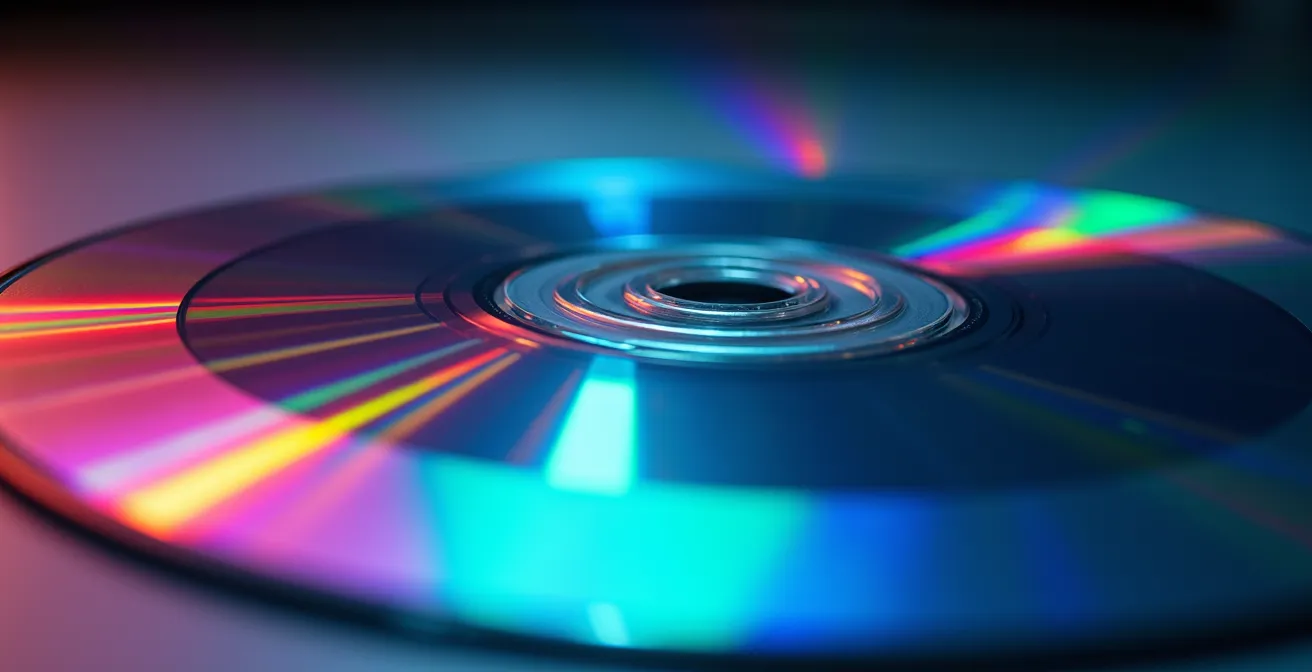
The image above captures the tangible, almost alien beauty of the physical medium. Beyond the superior quality, embracing physical media like Blu-ray is a statement of intent. It’s an act of building a permanent, personal library in an age where digital titles can vanish from a service overnight due to licensing changes. This concept, often called “curatorial permanence,” is a direct rejection of the ephemeral nature of streaming. Owning a physical copy is the only way to guarantee that a film you love will remain part of your collection forever, immune to the whims of corporate contracts.
Frame the act of buying physical media as an act of ‘curatorial permanence’. In an era where streaming titles disappear, building a physical library is the only way to truly own your collection.
– Film preservation advocates, Physical Media Collectors Community
Collecting physical media also reintroduces a tactile element of discovery—browsing shelves, appreciating cover art, and reading liner notes—that has been lost in the digital interface. It slows down the process of selection, encouraging more deliberate and thoughtful choices. For the active curator, a Blu-ray is not just a disc; it’s a commitment to a film and a declaration of its importance, ensuring both the highest fidelity presentation and its permanent place in your personal cinematic canon.
By building a physical library, you are not just collecting movies; you are preserving your own personal film culture.
Key takeaways
- Algorithmic Curation Is a Trap: Mainstream platforms are designed to create comfortable “bubbles” that limit your worldview, not expand it.
- Curation Is an Active Mindset: True discovery requires a shift from being a passive consumer to an active curator who seeks out context, community, and alternative formats.
- Ownership Matters: In an era of ephemeral streaming, building a physical media collection and participating in film communities are acts of cultural preservation and personal investment.
Can Digital Art Evoke the Same Emotion as Oil on Canvas?
As we push the boundaries of our curatorial mindset, we must also be willing to question our definition of “cinema.” Is a film only what we see in a traditional movie theater or on a subscription service? Or can the same emotional power be found in new, digitally native forms? This question, paralleling the art world’s debate over digital art versus physical painting, is crucial for the modern cinephile. Video art, experimental shorts, and even cinematic video games are pushing the language of moving images in directions that mainstream cinema rarely explores.
For the curator dedicated to discovery, these alternative forms represent a vibrant and often overlooked frontier. Platforms like Vimeo Staff Picks, UbuWeb, and dedicated sections on Mubi and Criterion Channel serve as galleries for this work. Here, artists are free from the commercial constraints of feature filmmaking, allowing for radical experimentation with form, rhythm, and narrative. A five-minute video art piece might convey a more potent emotional charge or a more complex political idea than a two-hour feature film.
The challenge, and the reward, is to approach these works with the same critical openness as you would a classic film. It requires adjusting your expectations. You may not find a traditional three-act structure, but you might discover a purely visual or auditory experience that evokes a feeling you’ve never encountered before. By actively seeking out these works, you are not only supporting emerging artists but also expanding your own emotional and intellectual palette. The most exciting indie discoveries are often not hidden on Netflix; they’re thriving in these alternative digital spaces, waiting for a curious curator to find them.
- Vimeo Staff Picks: A highly curated selection of innovative short films and video art, updated weekly.
- Criterion Channel’s Experimental Shorts: A dedicated section for avant-garde and experimental works from film history.
- UbuWeb: A massive, free archive of historical and contemporary experimental film and video art.
- MUBI’s Experimental Section: A rotating selection of boundary-pushing digital cinema from around the globe.
- Platform-specific discovery: Follow the hashtags #experimentalfilm and #videoart on platforms like Instagram and TikTok to find emerging artists.
The future of independent visual storytelling may not look like a movie at all, and the dedicated curator will be the first to see it.