
Contrary to popular belief, effective networking at art galleries has little to do with your opinion on the art.
- The art is the ‘game board,’ not the main event; the real focus is the flow and interaction of the people around it.
- Strategic observation of the room’s ‘social geography’ is far more powerful than forcing conversations.
Recommendation: Shift your focus from interpreting the art to analyzing the room. Use informed, technique-based questions as your strategic entry point into meaningful conversations.
You’re standing in a clean, white-walled gallery, a glass of surprisingly decent wine in hand. The low hum of sophisticated chatter surrounds you, but you feel like you’re behind an invisible barrier. You came here to meet interesting, creative people—to expand your circle beyond the usual bars and apps. Yet, you find yourself drifting from painting to painting, reading the little white cards, and checking your phone. The standard advice feels useless: “Just be confident,” “Bring business cards,” “Talk about the art.” But how? What do you even say about a canvas that’s just a single, giant red square?
This feeling of social paralysis is common because the premise is flawed. Most people treat a gallery opening like an exam on art appreciation, creating immense pressure to have a “smart” opinion. This approach is a trap. It leads to generic, dead-end conversations about whether you “like” a piece or what it “means.” You’re playing the wrong game. An art gallery isn’t a library for the eyes; it’s a dynamic social ecosystem, a living map of influence, curiosity, and connection. The art isn’t the subject; it’s the pretext. It’s the watering hole around which the entire social ballet unfolds.
But what if you shifted your perspective from art critic to social strategist? What if the key wasn’t having the right opinion, but asking the right questions and choosing the right position in the room? This guide is your new playbook. We will deconstruct the gallery environment to reveal the underlying social dynamics at play. You will learn how to read the room, use the art as a strategic tool for engagement, manage your energy for peak performance, and ultimately transform these cultural spaces from intimidating halls into your most effective networking arenas. Forget what you think you know about networking; it’s time to learn the art of social connection.
This article provides a complete strategic framework for turning art galleries into powerful networking venues. Explore the sections below to master each component, from initiating conversations to making a lasting impact.
Summary: Beyond the Canvas: The Social Strategist’s Guide to Art Gallery Networking
- 3 Questions to Ask About Abstract Art That Make You Sound Smart
- Museum Dates: Why They Are Better Than Dinner for First Meetings?
- The “Museum Legs” Cure: Preventing Fatigue During Long Visits
- Annual Pass vs. Single Tickets: When Does Membership Pay Off?
- Visiting Alone: How to Use Audio Guides for a Meditative Experience?
- The Alumni Network: When the School Name Matters More Than the Curriculum?
- How to Say “No” to Exposure Gigs Without Burning Bridges?
- Investing in Art: How to Buy Your First Piece for Under $1,000?
3 Questions to Ask About Abstract Art That Make You Sound Smart
The greatest mistake people make when faced with abstract art is trying to “get it.” This frames the conversation as a test with right or wrong answers. The strategic play is to sidestep interpretation entirely and focus on process, context, and shared experience. This demonstrates a higher level of engagement and invites collaboration rather than judgment. It’s not about what you see; it’s about signaling that you know how to see. This shift is crucial because, in sophisticated circles, your network is your most valuable asset. A compelling study by Columbia University and HEC Paris found that for pioneering abstract artists, success had no correlation with creativity but was directly tied to the diversity of their network. Your ability to connect, therefore, is more critical than your artistic critique.
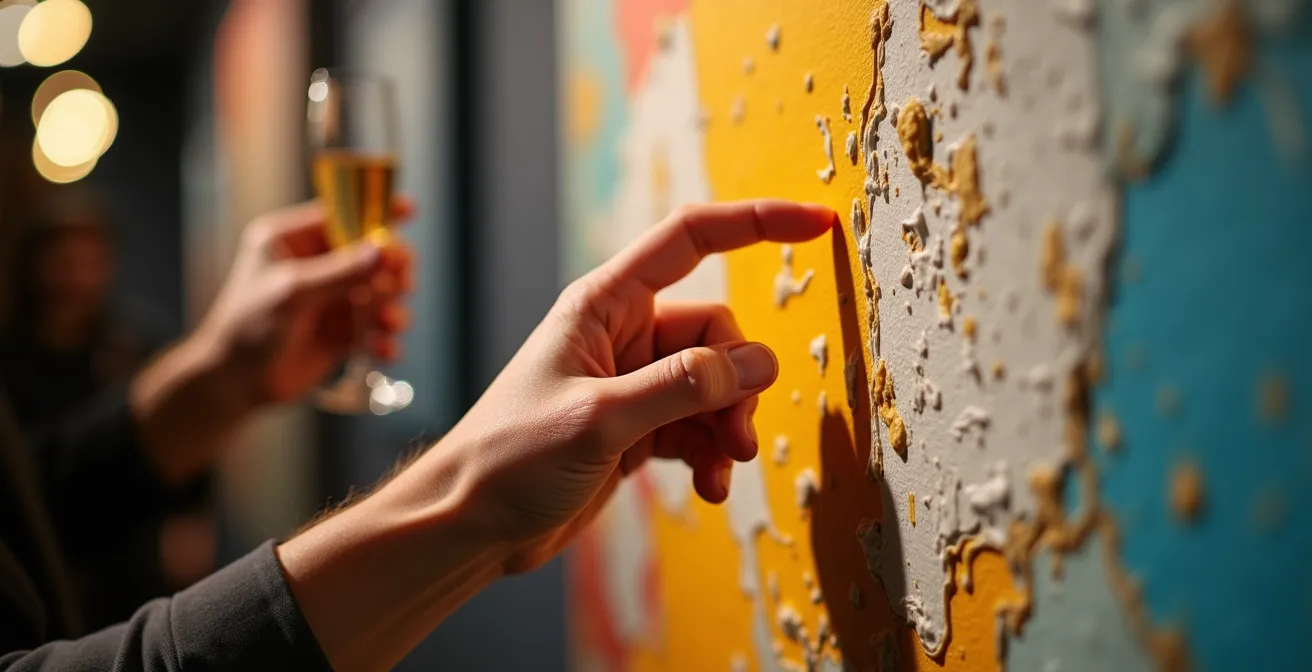
To implement this, you need conversation starters that open doors instead of closing them. These questions shift the focus from a subjective “I like it” to an objective “I’m curious about it.” They are designed to be inclusive and make the other person feel intelligent for engaging with you. This is a form of value-signaling; you’re not showing off your knowledge, but your sophisticated curiosity. This approach creates a “conversation pretext” that feels natural and unforced. The following questions are your toolkit for turning any abstract piece into a social opportunity.
3 Strategic Questions for Abstract Art Discussions
- “I’m fascinated by the texture here. What was the decision-making process behind using these specific materials?” This question bypasses subjective opinion and focuses on the artist’s technique, showing a deeper level of engagement.
- “How do you feel this piece speaks to the one at the entrance? There seems to be a deliberate dialogue between the two.” This demonstrates you are observing the entire curated experience, not just isolated works. It shows you’re paying attention to the gallery’s own “social geography.”
- “This piece gives me a real sense of [energy/calm]. What’s the first feeling or word that comes to your mind?” This creates a shared emotional experience rather than a debate, making the interaction collaborative and personal.
Museum Dates: Why They Are Better Than Dinner for First Meetings?
A dinner date is a social pressure cooker. You’re locked into a face-to-face interrogation under fluorescent lights, where any lull in conversation feels like a failure. A museum or gallery date, by contrast, is a strategic masterpiece for a first meeting. It externalizes the focus onto the art and the space, instantly relieving the pressure to constantly perform. The environment itself provides an endless supply of “conversation pretexts.” More importantly, it allows for moments of shared silence that are comfortable, not awkward. Observing a piece together creates a joint experience without a word needing to be spoken. This dynamic is incredibly valuable for gauging genuine chemistry through non-verbal cues. While many creatives prefer to network online, research from Format Magazine highlights that 95 percent of people say a face-to-face meeting is essential for building long-term relationships.
Case Study: The Psychology of Shared Silence
Interaction experts note that in gallery settings, you can assume everyone knows little about the art. This removes the ego and allows for what is known as the ‘vulnerability-as-connector’ effect. When one person admits, “I’m not quite sure what to make of this one,” it creates an authentic opening for the other to agree or offer a thought without pressure. These moments of shared observation and quiet contemplation build a subtle rapport that is impossible to manufacture over a noisy dinner table. The silence isn’t empty; it’s a shared activity.
The structure of a gallery visit also allows for natural pacing and easy exits. You can spend five minutes on a piece or thirty. If the connection isn’t there, the tour of the exhibition has a natural end point, providing a graceful conclusion. If the spark is real, the experience provides a rich foundation of shared memories and inside jokes to carry into a coffee or drink afterward. You’re not just learning about the person; you’re co-creating an experience, observing how they think, what captures their curiosity, and how they navigate a physical and intellectual space. It is the ultimate, low-pressure litmus test for compatibility.
The “Museum Legs” Cure: Preventing Fatigue During Long Visits
“Museum legs”—that all-too-familiar feeling of physical and mental exhaustion during a long gallery visit—is the enemy of effective networking. When you’re tired, you project closed-off body language and your social battery plummets. The amateur’s mistake is to wander aimlessly until fatigue sets in. The strategist’s move is to manage energy with intention, treating a gallery opening like a series of sprints, not a marathon. This means actively pacing yourself, taking deliberate breaks, and using those pauses for strategic observation. As gallery professionals advise, keeping conversations short and being prepared to politely disengage is crucial during busy events. Your stamina is a finite resource; protecting it is paramount to staying sharp and approachable for the entire duration.

Your posture during these breaks is critical. Slumping over your phone on a bench sends a clear “do not disturb” signal. Instead, practice “open resting.” Lean against a wall or sit upright on a bench with an open posture, slowly scanning the room. This reframes your rest as an act of thoughtful observation, making you appear engaged and approachable. A bench isn’t just a place to sit; it’s an observation post. From here, you can map the room’s social geography: identify who is talking to the artist, where the influential curator is holding court, and where conversations are naturally forming. This allows you to re-enter the social fray with a clear target and a full battery, rather than randomly stumbling into interactions.
Your Action Plan for Gallery Networking Endurance
- Pre-Event Reconnaissance: Before you go, research the artist and exhibiting gallery. Scan the event’s social media for a potential guest list to identify key people (curators, collectors, other artists).
- Define Your Mission: Set one clear, achievable goal. Is it to meet one new person in your field? To introduce yourself to the gallery director? A clear objective prevents aimless wandering.
- Map the Social Geography: Upon arrival, take five minutes to identify high-traffic zones (like the bar), quiet corners for deeper conversation, and the room’s power center (often around the artist or curator).
- Prepare Conversation Openers: Arm yourself with two or three non-interpretive questions about the art’s process or the exhibition’s curation. This is your toolkit for initiating contact.
- Plan Your Exit Strategy: Have a polite line ready to disengage from a conversation. “It was a pleasure speaking with you, I’m going to take another look at that piece over there” works perfectly.
Annual Pass vs. Single Tickets: When Does Membership Pay Off?
Viewing a museum membership as merely a way to save money on tickets is a tactical error; it’s a strategic investment in your social life. For a young professional, a membership is a subscription to a curated community. The real value isn’t in the free entry; it’s in the exclusive access it provides—to members-only previews, artist talks, and evening events. These are high-quality, self-selecting networking environments, far removed from the general-admission crowds. The financial break-even point is often reached in just three or four visits, but the social ROI is immediate. Furthermore, the perceived value of these cultural institutions is immense. A comprehensive study of 11 major U.S. art museums found that a single visit generates an average of $905 per person in well-being economic value.
Becoming a member transforms you from a transient visitor into a recognized patron. You begin to see the same faces—staff, fellow members, and art enthusiasts—at different events, creating a powerful sense of familiarity and belonging. This consistency is the foundation of building a genuine network. It allows relationships to develop organically over time, rather than being forced in a single, high-stakes interaction. As Stephen Reily, the Founding Director of Remuseum, notes, memberships create a sustainable relationship between the institution and its supporters. It signals you’re a serious participant in the cultural scene, not just a tourist.
The table below breaks down the typical financial calculus, but remember to weigh the intangible benefits—like access to exclusive networking circles—which often far exceed the monetary value.
| Visitor Type | Single Ticket Cost | Annual Membership | Break-Even Visits | Additional Benefits Value |
|---|---|---|---|---|
| Individual Adult | $25-30 | $85-120 | 3-4 visits | Guest passes, member events ($200+) |
| Couple/Dual | $50-60 | $150-195 | 3 visits | Member previews, reciprocal access ($400+) |
Visiting Alone: How to Use Audio Guides for a Meditative Experience?
Attending a gallery opening alone can feel intimidating, but it’s actually a strategic advantage. You are a free agent, unburdened by a companion’s agenda. Your most powerful tool in this scenario is the humble audio guide. Most people see it as an educational device; the strategist sees it as the ultimate social accessory. Wearing headphones accomplishes two critical goals simultaneously: it makes you look engaged and focused, which is inherently attractive, and it provides a perfect, built-in “conversation pretext.” It creates a subtle barrier that prevents unwanted, low-value interactions while offering a legitimate reason to initiate or be drawn into a high-value one. Removing a headphone to say, “Sorry, I didn’t catch that, the guide was just pointing out something fascinating,” is a smooth and natural entry into any conversation.
The audio guide also provides you with a script. It arms you with unique facts, artist quotes, and technical details. This is your source of informational arbitrage. While others are offering generic opinions, you can drop a specific, interesting tidbit: “The guide just mentioned the artist used a specific volcanic ash to get this texture.” This instantly elevates your status from a casual observer to an informed participant. Successful solo networkers consistently prepare talking points, and the audio guide does the work for you. It gives you a reason to be looking intently at a piece, a reason to be moving through the gallery, and a reason to engage with someone who sparks your interest.
This strategy also allows you to control the rhythm of your experience. You can use the guide to create moments of meditative focus, tuning out the surrounding noise to recharge your social battery. Then, when you spot an interesting person or group, you can strategically pause the guide and open yourself to interaction. It turns a potentially awkward solo visit into a focused, confident, and highly effective networking mission where you are in complete control of the social dynamics.
The Alumni Network: When the School Name Matters More Than the Curriculum?
In the art world, as in many elite fields, your network’s prestige can be a more powerful career accelerant than your individual talent. It’s a hard truth, but a strategic one. Research by network scientist Albert-László Barabási is stark: an artist’s first five exhibitions can determine their entire career trajectory. He suggests that if those initial shows are held in venues associated with highly prestigious organizations, their odds of enduring fame increase exponentially. This highlights the immense power of “proxy” credentials. The name of the school on your diploma or the gallery on your resume acts as a cognitive shortcut for others, signaling a pre-vetted level of quality and access. It’s less about what you learned and more about the network you were granted access to.
But what if you don’t have an Ivy League or a top art school on your CV? The strategist doesn’t despair; they manufacture their own prestige network. This is where the concept of the “proxy alumni” comes into play. You can achieve this by strategically associating yourself with the right people and places. Instead of aiming for a top-tier New York gallery from the start, target the best entry-level galleries in medium-sized, respected art cities. Identify artists from your generation who are one or two steps ahead of you career-wise and build genuine relationships. As they rise, they will pull their network up with them.
Strategy: Manufacturing ‘Proxy Alumni’ Status
An effective strategy for emerging professionals is to create a highly targeted outreach list. This list shouldn’t just include top-tier names but focus on local press writers, curators at regional museums, and junior staff at aspirational galleries. The goal is to build a foundational network in a manageable ecosystem. One can initiate contact and build rapport through consistent, thoughtful engagement on social media, then solidify these connections by attending openings in person. By becoming a known and respected entity within a specific, high-potential scene, you create your own “alumni network” that provides credibility by association.
How to Say “No” to Exposure Gigs Without Burning Bridges?
As you become a more visible and connected professional, you will inevitably be approached with requests to work for “exposure.” Learning to decline these offers gracefully is a critical skill. A flat “no” can seem abrasive, but accepting unpaid work devalues your skills and sets a dangerous precedent. The strategic response is to frame your refusal not around a lack of interest, but around a commitment to a standard of quality. The gallery setting itself provides the perfect justification. Standing in a room filled with high-value art, you can say, “My professional goal is to produce work at this level of quality, and to do that, I have to focus on projects with budgets that reflect that value.” This transforms your “no” into a statement of ambition and professionalism.
An even more powerful play is the “Connector’s Pivot.” Instead of simply declining, you re-position yourself as a valuable resource. If the project isn’t right for you, it might be a perfect opportunity for someone earlier in their career. By saying, “This isn’t the right fit for me at the moment, but I know a very talented emerging [designer/writer/artist] who would be great for this. May I connect you?” you do three things: you politely decline, you help the person who asked, and you build goodwill with an emerging professional. You have now become a valuable node in the network, a broker of opportunities. This move significantly increases your social capital and ensures you don’t burn a bridge. This is especially important when research shows that nearly 50 percent of jobs are found through traditional networking methods.
You can also pre-qualify your contacts by listening to how they talk about others. People who focus on “buzz” and “exposure” over sales and project rates are more likely to offer unpaid gigs. By identifying these patterns early, you can manage your interactions and preserve your energy for more fruitful connections, positioning yourself as a peer to be compensated, not a fan to be exploited.
Key Takeaways
- Shift Your Mindset: The art gallery is a social arena. The art is a tool for connection, not an exam to be passed.
- Observe Before Acting: Map the room’s ‘social geography’ to identify key players and conversation opportunities before you engage.
- Ask, Don’t Tell: Use questions about process, materials, and curation to start intelligent conversations that bypass subjective “likes” and “dislikes.”
Investing in Art: How to Buy Your First Piece for Under $1,000?
The final, most powerful move in the social strategist’s playbook is to transition from observer to patron. Buying art, even a small piece, is the ultimate statement of serious engagement. It fundamentally changes your relationship with the artist, the gallery, and the entire ecosystem. You are no longer just a spectator; you are a direct supporter of the culture you admire. This act immediately elevates your status and opens doors that are closed to casual viewers. The goal isn’t necessarily financial return, but the social and intellectual ROI of being an active participant. Starting small is key. Many galleries have smaller studies, prints, or works on paper by their top artists available for under $1,000. These are your entry point.
The purchase itself should be separated from the social event. The opening is for research and relationship-building. Identify artists whose work resonates with you, talk to the junior gallerists (who are often more accessible and knowledgeable about emerging talent), and collect information. Then, follow up. Request a studio visit or ask to be notified about charity auctions and MFA shows, which are prime venues for acquiring affordable pieces. Building rapport first is crucial. The ‘Patron-in-Training’ strategy involves having multiple conversations with a gallery director over several events. Once they recognize you as a thoughtful and consistent presence, expressing interest in collecting becomes a natural next step.
This positions you as a peer and a patron, a highly desirable combination in the art world. Remember also that in many places, there can be financial incentives; for example, it’s an important consideration for investors that museum memberships are often tax-deductible, which aligns with a strategy of deep cultural engagement. Your first purchase is a powerful move that solidifies your place in the community, giving you a tangible stake in the world you wish to be a part of. It’s the beginning of a new, more meaningful level of connection.
Your journey from a passive observer to an active, connected participant starts with a single, strategic step. Instead of waiting for the perfect moment to happen, begin by applying one of these techniques at your next cultural outing. Start by mapping the room’s social geography or preparing a single, process-oriented question. This is how you begin to play the game with intention and build the sophisticated social circle you desire.