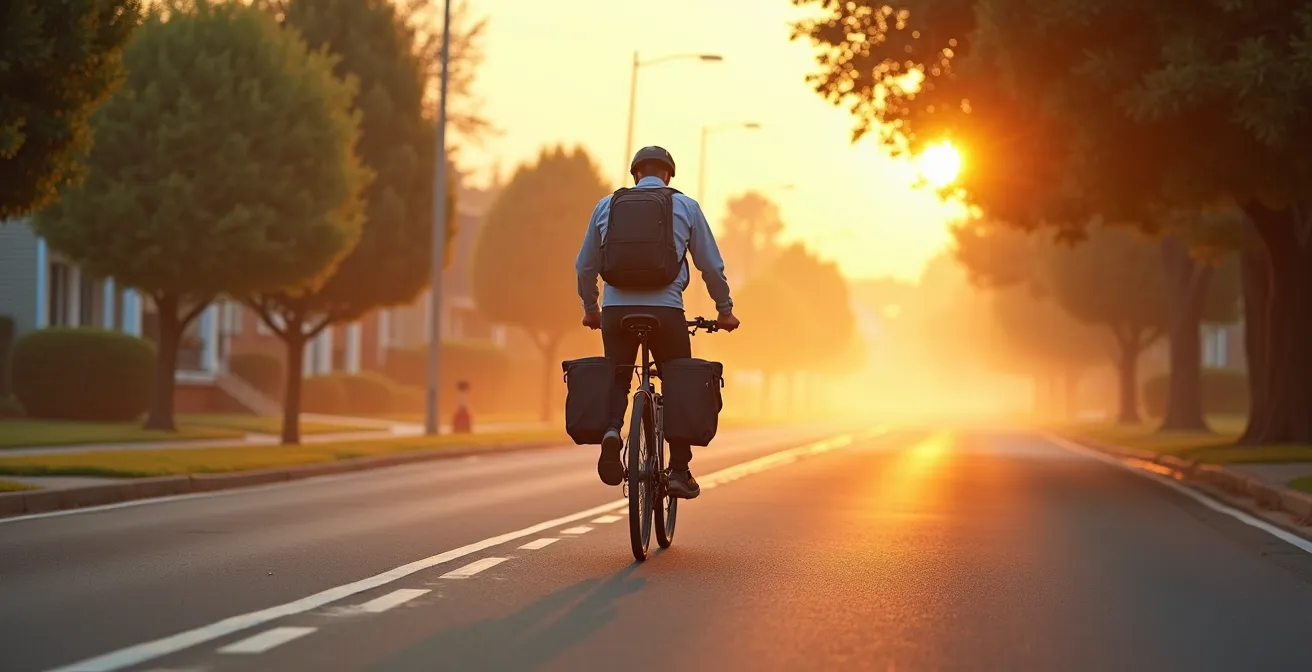
Successfully going car-free in the suburbs depends less on willpower and more on building a resilient, multi-modal transportation system.
- Choosing the right e-bike motor for local hills is a crucial first step for consistency.
- A layered clothing system and robust, multi-tiered lighting are non-negotiable for all-weather, all-season riding.
- Combining folding bikes with public transit or using car-sharing services solves the “last mile” and occasional-use problems.
Recommendation: Start by auditing your most common trips and identify one you can replace with a non-car alternative this week.
The daily grind of suburban commuting can feel like a trap. Stuck in traffic, watching the gas pump price spin higher, you know there has to be a better way. Many guides offer simple advice like “just ride a bike” or “take the bus,” but they often ignore the complex realities of suburban life: sprawling distances, steep hills, unpredictable weather, and the infamous “last mile” gap between the train station and your office.
This isn’t about finding a single, perfect replacement for your car. That’s a recipe for frustration. Instead, the key to truly breaking free from car dependency is to think like a logistician. It’s about building a flexible, personal transportation system tailored to your specific needs. This means anticipating the points of failure—a sudden downpour, a challenging hill, the need to carry groceries—and having the right tools and strategies in place before they become deal-breakers.
This guide will equip you with that logistical mindset. We will move beyond the basics and dive into the critical details: selecting the right e-bike technology for your terrain, mastering all-weather riding with professional-grade gear, calculating the economic break-even point of car-sharing versus owning, and implementing advanced safety strategies that go far beyond just wearing a bright jacket. By the end, you won’t just have a collection of tips; you’ll have a blueprint for your own resilient, car-free commuting system.
To help you navigate these crucial logistical decisions, we’ve broken down the core components of building a successful car-free commuting plan. This structure will guide you from foundational technology choices to the daily practicalities of your new routine.
Summary: A Practical Guide to Car-Free Commuting from the Suburbs
- Hub Motor vs. Mid-Drive: Which E-Bike Handles Hills Better?
- Cycling in Rain and Snow: Gear Essentials to Arrive Dry at the Office?
- The “Last Mile” Problem: Combining Foldable Bikes with Trains?
- Zipcar vs. Owning: At How Many Trips Per Month Does Owning Become Cheaper?
- Being Seen: Why High-Vis Is Not Enough for Night Riding?
- Road Cycling or Trail Running: Which Is Better for Knees Over 40?
- The No-Sweat Cardio Routine: Is It Possible to Train Without Showering?
- Zero Waste in Apartments: Reducing Household Trash Without a Backyard Compost?
Hub Motor vs. Mid-Drive: Which E-Bike Handles Hills Better?
The first major hurdle in many suburban commutes is topography. A flat route is one thing, but a series of rolling hills can quickly sap your energy and motivation. This is where choosing the right e-bike motor becomes the most critical decision in building your transportation system. The two dominant technologies, hub motors and mid-drive motors, offer vastly different experiences, especially when the road tilts upward. A hub motor is located in the center of the front or rear wheel, directly powering it. This design is simpler, often more affordable, and requires less maintenance. However, it operates independently of the bike’s gears, which can be a significant disadvantage on inclines.
A mid-drive motor, by contrast, is positioned at the bike’s crankset, applying power to the chain. This allows the motor to leverage the bike’s existing gear system. Just as you would shift to an easier gear to pedal up a hill, the mid-drive motor can do the same, operating at its most efficient RPM range. This results in superior torque for climbing, better weight distribution for a more natural riding feel, and greater overall battery efficiency on varied terrain. Performance tests reveal that hub motors can experience a 25% increase in battery drain on steep hills compared to their performance on flat ground, making a mid-drive a more reliable choice for hilly commutes.
To make an informed decision, it’s essential to compare the key characteristics of each motor type directly. The following table breaks down their performance across several crucial metrics for a commuter.
| Feature | Hub Motor | Mid-Drive Motor |
|---|---|---|
| Hill Climbing Torque | 40-60 Nm typical | 50-90 Nm typical |
| Weight Distribution | Rear or front heavy | Centrally balanced |
| Battery Efficiency on Hills | Lower efficiency | Higher efficiency using gears |
| Maintenance | Lower maintenance | Higher chain/drivetrain wear |
| Cost | $1000-2000 typical | $2500-5000 typical |
| Roadside Repairs | More complex wheel removal | Standard wheel removal |
Ultimately, for suburban commuters facing anything more than gentle slopes, the mid-drive motor is the superior choice for hill climbing. While the initial cost is higher, the enhanced efficiency, torque, and natural ride feel provide the logistical resilience needed to ensure you can tackle your route every day, not just on the easy days.
Cycling in Rain and Snow: Gear Essentials to Arrive Dry at the Office?
The second major point of failure for aspiring bike commuters is weather. A beautiful sunny morning can give way to a sudden afternoon downpour, and the prospect of arriving at the office soaked and shivering is a powerful deterrent. However, with the right gear strategy, cycling in rain and even light snow is not only possible but can be perfectly comfortable. The secret is not a single “magic” jacket, but a three-layer system that manages moisture from both the outside and the inside.
This system consists of a base layer, a mid-layer, and a shell layer. The base layer, made of merino wool or a synthetic fabric, wicks sweat away from your skin to keep you dry from the inside. The mid-layer provides insulation; a fleece is great for cold days, while a lighter thermal might be sufficient for cool, rainy conditions. Finally, the shell layer is your defense against the elements. A high-quality waterproof and breathable jacket and pants are non-negotiable. Look for features like sealed seams, waterproof zippers, and a hood that can fit over your helmet.

As this image highlights, the texture and construction of the outer shell are designed to repel water while allowing vapor to escape. Beyond clothing, your gear list must include accessories to cover extremities. Waterproof gloves, shoe covers (or “booties”), and clear-lensed glasses are essential for comfort and visibility. Having a “desk-side drying kit” with a towel and spare socks completes your all-weather strategy, ensuring you have logistical resilience no matter what the forecast holds.
- Base Layer: Moisture-wicking synthetic or merino wool to keep sweat away from skin.
- Mid-Layer: Thermal insulation adjusted for temperature (e.g., fleece for 0-5°C).
- Shell Layer: Waterproof/breathable jacket and pants with a hood that fits over a helmet.
- Accessories: Waterproof gloves, shoe covers, and clear safety glasses.
- Office Kit: Packable microfiber towel, compact shoe dryer, and spare socks.
The “Last Mile” Problem: Combining Foldable Bikes with Trains?
For many suburbanites, the commute is too long for a bike alone, but the local train or bus station is just a bit too far to walk from home or the office. This is the classic “last mile problem,” a logistical gap that often forces people back into their cars. This is where a multi-modal approach becomes a game-changer. By combining different forms of transport, you create a seamless system that is often faster and less stressful than driving. The trend is already well underway, as statistics show that 24-28% of Americans already choose car-free commuting methods.
The folding bike is perhaps the most powerful tool for solving the last mile problem. These compact machines can be ridden from your home to the train station, quickly folded, and carried aboard. Upon arrival at your destination city, you simply unfold it and ride the final mile or two to your office, bypassing traffic and crowded buses. This strategy gives you door-to-door convenience without the costs and hassles of parking. Many modern folding bikes, including electric models, offer a surprisingly robust and comfortable ride suitable for daily use.
Before fully committing to a multi-modal commute, it is essential to research the rules of your local transit authority. As Amy Bergen notes in the Idealist Career Guide, this simple check is a crucial step in your logistical planning. Some systems have restrictions on the number of bikes per car or have blackout periods during peak rush hour. As she advises:
Many city buses have bike racks if you want to bike only part of the way—but make sure you know your location’s guidelines for accommodating bicycles on public transit.
– Amy Bergen, Idealist Career Guide
By understanding these rules, you build resilience into your system, ensuring a smooth and predictable journey every day. A folding bike combined with public transit transforms your commute from a single, rigid trip into a flexible, efficient, and even enjoyable part of your day.
Zipcar vs. Owning: At How Many Trips Per Month Does Owning Become Cheaper?
Ditching your primary commuter vehicle doesn’t necessarily mean living without access to a car entirely. For many suburban households, a second car sits idle most of the week, used only for occasional errands or appointments. This is where car-sharing services like Zipcar or ride-hailing services like Uber and Lyft can create massive economic efficiencies. The question is, at what point does owning that second car become more expensive than simply using on-demand services? Calculating this economic break-even point is a key logistical exercise.
The true cost of car ownership goes far beyond the monthly payment. It includes insurance, gas, parking, and a significant, often underestimated, budget for maintenance and repairs. When you add up these “hidden” costs, the financial case for a car-sharing mix becomes compelling for many. You pay only for the trips you actually need, and all maintenance, insurance, and parking costs are handled by the service provider.
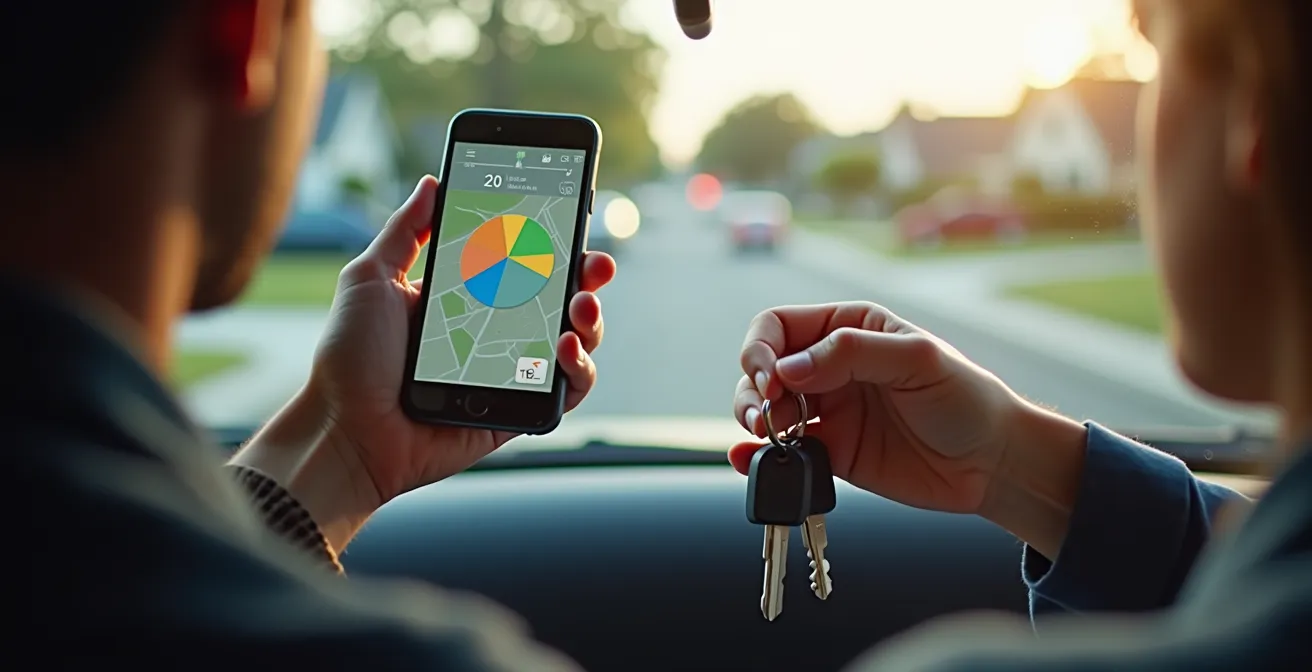
To determine your personal break-even point, you must first calculate the total monthly cost of your current vehicle. A detailed cost analysis of car ownership provides a clear framework for this calculation. The table below offers a generalized comparison, which you can adjust with your own specific figures.
| Cost Factor | Car Ownership (Monthly) | Car-Sharing Mix |
|---|---|---|
| Vehicle Payment | $400-600 | $0 |
| Insurance | $150-250 | $0 |
| Maintenance/Repairs | $100-200 | $0 |
| Parking | $100-300 | $0 |
| Gas | $150-250 | $0 |
| Car-share/Rideshare | $0 | $200-400 (variable) |
| Public Transit Pass | $0 | $100-150 |
| Total Monthly | $900-1600 | $300-550 |
As the comparison shows, if your occasional car trips cost less than the fixed monthly expense of owning, you’ve found a major cost saving. For most people who only need a car a few times a month, shedding the burden of ownership in favor of a strategic mix of car-sharing and public transit results in substantial savings and simplified personal logistics.
Being Seen: Why High-Vis Is Not Enough for Night Riding?
When you transition to cycling or walking for your commute, especially during the shorter days of fall and winter, safety becomes paramount. The common advice is to wear high-visibility or fluorescent clothing. While a bright yellow jacket is helpful during the daytime, it does very little under the cover of darkness. At night, what matters is not color, but light. Relying solely on high-vis gear for night riding is a common and dangerous mistake. To be safe, you must shift your mindset from passive visibility to active visibility—a system of lights and reflective materials that broadcasts your presence to drivers.
Effective active visibility relies on two principles: illumination and biomotion. Illumination is achieved with a robust set of lights. A basic setup includes a steady white front light and a flashing red rear light. However, for unlit suburban roads and bike paths, you need more. A powerful front light of 800 lumens or more is necessary “to see” the path ahead, not just “to be seen.” Redundancy is also key; a helmet-mounted light acts as a backup and allows you to point light where you are looking.
Biomotion is the second critical component. The human eye is exceptionally good at recognizing human movement. By placing reflective materials on your moving parts—specifically your ankles, feet, and pedals—you create a distinct, eye-catching motion that drivers can immediately identify as a cyclist, even from a distance. Simple reflective ankle bands are one of the most effective safety investments you can make, far more impactful at night than a non-reflective bright jacket. This tiered lighting and biomotion strategy forms a resilient safety system.
Action Plan: Implementing Your Tiered Lighting Strategy
- Tier 1 – To Be Seen: Install a front white light (minimum 200 lumens, flashing or steady) and a rear red flashing light (minimum 40 lumens) for basic visibility in all conditions.
- Tier 2 – To See: For routes with unlit sections, upgrade your primary front light to a powerful beam of 800+ lumens to illuminate the path and identify hazards.
- Tier 3 – Redundancy & Positioning: Add a secondary light set, such as helmet-mounted lights, and always carry spare batteries or a power bank for long commutes. This provides a backup in case of primary light failure.
- Biomotion Enhancement: Equip your ankles with reflective bands and ensure your pedals have reflectors. This creates a recognizable human motion that is highly visible to drivers.
- Defensive Positioning Practice: Ride in a way that makes you visible and predictable. Take the lane when necessary to avoid being squeezed by traffic, especially when approaching intersections or turning.
By adopting a comprehensive active visibility strategy, you take control of your safety. You are no longer passively hoping to be seen; you are actively broadcasting your presence in a way that is impossible to ignore.
Road Cycling or Trail Running: Which Is Better for Knees Over 40?
One of the most celebrated benefits of an active commute is the built-in daily exercise. However, for those over 40, concerns about joint health, particularly knee pain, can be a major consideration. High-impact activities like running on pavement can exacerbate existing issues or create new ones. This leads many to weigh the benefits of different forms of cardio. While trail running on softer surfaces is less jarring than road running, road cycling emerges as the superior choice for a daily commute that protects and even strengthens your knees over the long term.
The key difference is impact. Cycling is a non-weight-bearing activity. Your body is supported by the saddle, and the smooth, circular motion of pedaling avoids the repetitive, jarring impact that running places on your knee, hip, and ankle joints. This makes it an ideal form of exercise for maintaining cardiovascular health without stressing your cartilage. In fact, when done correctly, it can be therapeutic.
Case Study: Low-Impact Commuting for Joint Health
A forum analysis of daily bike commuters over 40 consistently reveals a crucial factor for joint health: proper bike fit. Commuters who invested in a professional bike fitting reported that their commute transformed into a form of therapeutic exercise. By adjusting the saddle height, handlebar reach, and cleat position, they eliminated knee strain and instead strengthened the supporting muscles around the joint (quadriceps, hamstrings, glutes). This muscle development provides better support for the knee, reducing pain and improving stability over time, a benefit not as easily achieved through running.
The therapeutic benefits, however, are entirely dependent on having your bike set up correctly. An improperly fitted bike, with a saddle that is too low or too high, can create new knee problems. Therefore, the single most important investment you can make for your joint health as a bike commuter is a professional bike fit. This small, one-time expense ensures that every mile you ride contributes positively to your health, turning your daily commute into a sustainable, low-impact fitness routine for decades to come.
The No-Sweat Cardio Routine: Is It Possible to Train Without Showering?
We’ve addressed hills and weather, but one of the most persistent logistical barriers to a bike commute is the sweat factor. The prospect of arriving at work needing a shower is a non-starter for most people, especially if their workplace doesn’t have facilities. For years, this seemed like an unsolvable problem. However, the rise of modern e-bikes has completely changed the equation, making a “no-sweat” cardio commute a practical reality. It’s not about avoiding effort entirely, but about precisely controlling that effort.
The magic lies in the electric assist. Modern e-bike motors provide between 250-750W of continuous power assistance, which you can adjust on the fly. On flat sections, you can keep the assist low or off to get a gentle workout. When you approach a hill or a headwind, you simply increase the assist level. This allows you to maintain a consistent speed while keeping your heart rate and body temperature in a zone that doesn’t produce heavy perspiration. You’re still moving and getting the health benefits of light cardio, but you’re managing your exertion level to match your goal: arriving fresh, not flushed.
Of course, even with minimal exertion, you may want a quick refresh upon arrival. This is where a simple, pre-packed “Office Refresh Kit” comes into play. It’s the final piece of your no-sweat logistical puzzle.
- High-quality body wipes: For a quick and effective freshening up.
- Dry shampoo: Instantly refreshes hair without water.
- Travel-size deodorant: For a quick reapplication.
- Wrinkle-release spray: To smooth out any creases in your work clothes.
- A fresh shirt: Stored at your desk for peace of mind or emergencies.
- Comfortable office shoes: Kept in a desk drawer to change into.
By combining the smart use of e-bike assistance with a simple refresh kit, the sweat problem is effectively solved. This removes one of the biggest and most common excuses, making the active commute accessible to everyone, regardless of workplace amenities.
Key Takeaways
- E-bike choice (mid-drive for hills) and proper gear (layering, lighting) are foundational to your commuting system’s resilience.
- A car-free life doesn’t mean no car at all; it means strategically using transit, car-sharing, and folding bikes to cover different needs.
- The benefits extend beyond cost savings to include improved health, less stress, and a significant reduction in your personal waste stream.
Zero Waste in Apartments: Reducing Household Trash Without a Backyard Compost?
The primary motivations for ditching the car are often financial and logistical, but the environmental benefits are a powerful and rewarding side effect. Most people think of this purely in terms of tailpipe emissions. However, shifting to a car-free or “car-lite” lifestyle triggers a cascade of waste reduction that extends far beyond the air you breathe, aligning perfectly with a zero-waste mindset, even for those living in apartments without access to composting or large recycling bins.
Car ownership generates a surprising amount of physical, often toxic, waste that we rarely consider. An active commute simply eliminates these waste streams from your life. You no longer have to dispose of used motor oil, old tires, worn-out brake pads, or containers of coolant and other fluids. This is a significant, yet often invisible, reduction in your household’s contribution to landfill and hazardous waste.
The Hidden Waste Reduction of Car-Free Living
An analysis of the lifecycle of car ownership highlights the profound, often overlooked, waste streams that are eliminated by going car-free. Over the lifetime of a typical vehicle, a commuter avoids the disposal of: multiple sets of brake pads, dozens of quarts of used motor oil from regular changes, several sets of tires that end up in landfills, and various toxic fluids like coolant and transmission fluid. By choosing to bike or walk, you are not just reducing emissions; you are opting out of an entire system of consumption and disposal, a major step towards a zero-waste lifestyle that requires no extra effort.
This mindset can also extend to your daily commuting habits. When you travel by bike or on foot, you are more conscious of what you carry. This naturally encourages the use of a “Zero-Waste Commuter’s Kit,” which fits easily into a backpack or pannier. This simple kit, consisting of a reusable coffee mug, a water bottle, a lunch container, and a packable shopping bag, eliminates the daily stream of disposable cups, plastic bottles, and takeout containers. It’s a small change that, compounded over a year, results in a massive reduction in personal trash—a tangible victory for both your wallet and the planet.
Your journey to a less car-dependent life is a powerful act of personal optimization. It saves money, improves health, and reduces stress. By building a resilient system with the right tools and strategies, you are not just changing your commute; you are upgrading your entire lifestyle. Your next step is to start small. Analyze your route, check the weather, and take that first car-free trip today.