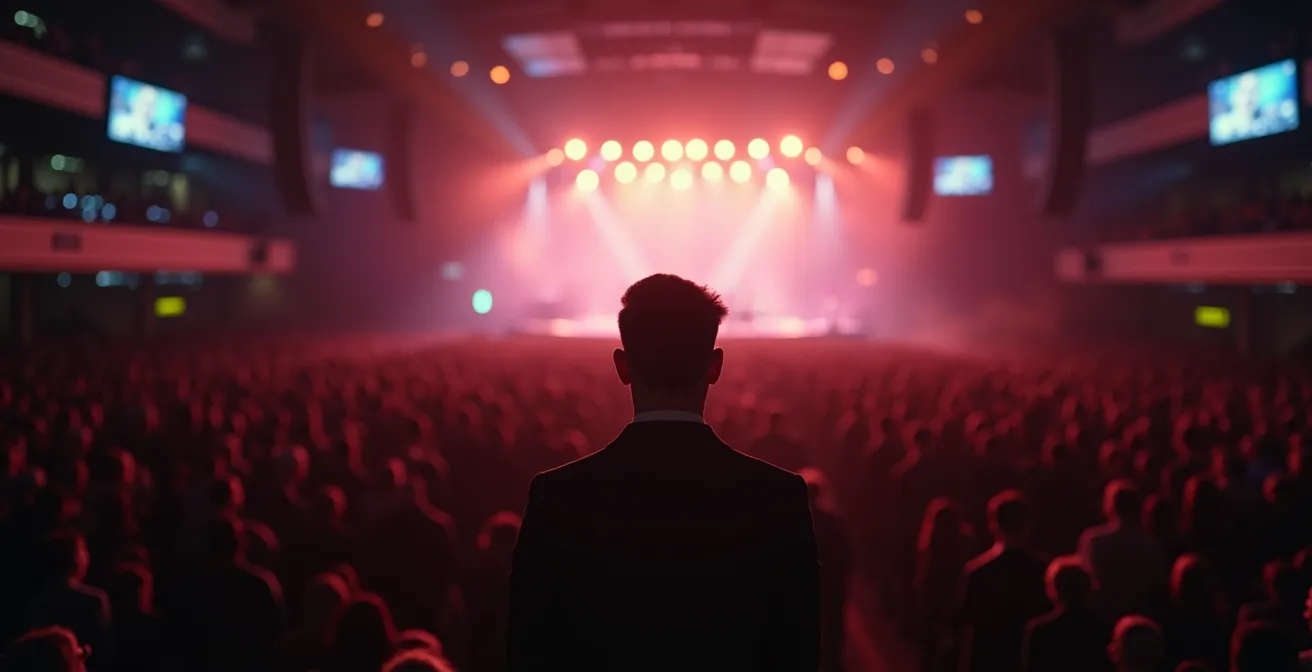
The intense love for live music often clashes with the paralyzing fear of crowds and sensory overload. The solution isn’t to just ‘cope,’ but to proactively design a personal “Concert Operating System.” This guide reframes anxiety management from a passive struggle into an active strategy, giving you tactical control over your environment, sensory input, and mental energy, empowering you to reclaim the joy of live events.
There’s a unique and painful conflict known to many music lovers: the deep, soul-stirring desire to see your favorite artist live, set against the visceral, gut-wrenching dread of the very environment where it happens. The crushing weight of the crowd, the roaring wall of sound, the blinding strobes—it can feel like a battleground for your nervous system. You’re told to “just breathe” or “go with a friend,” but this generic advice often fails in the face of true sensory overload or social anxiety.
What if the problem isn’t your inability to cope, but a lack of a strategic framework? The key to unlocking live music isn’t about enduring the panic, but about proactively engineering your experience to prevent it. It’s about building your own ‘Concert Operating System’ (COS)—a personalized set of rules, tools, and strategies that puts you back in the driver’s seat. This system acknowledges that your mental and sensory energy is a finite resource, a ‘sensory budget’ that needs to be managed, not squandered.
This guide will walk you through building your COS, piece by piece. We won’t just list tips; we’ll deconstruct the anatomy of concert anxiety and give you the architectural plans to build a resilient, enjoyable, and panic-free experience from the ground up.
While this guide focuses on practical strategies for navigating the venue, managing the internal voice of anxiety is just as crucial. The following video offers powerful insights on overcoming performance anxiety, a feeling that shares many roots with the social and crowd-based fears we experience as audience members.
To help you navigate these strategies, we’ve structured this article to address every stage of the concert experience, from choosing the right show to post-event recovery. The following summary outlines the key areas we will cover, forming the building blocks of your personal concert plan.
Summary: Building Your Panic-Free Concert Experience
- Why Following Every Trend Leads to Creative Burnout and Confusion?
- Group Pace vs. Own Pace: Which Is Less Exhausting Mentally?
- Going Alone: How to Stay Safe and Have Fun at a Concert Solo?
- Resale Scams: How to Verify E-Tickets Before Transferring Money?
- High-Fidelity Earplugs vs. Foam: Which Preserves Sound Quality While Protecting Ears?
- The Exit Strategy: Finding the Safest Spot in a General Admission Crowd
- Camping at Music Festivals: Maintaining Hygiene Without Running Water?
- Post-Concert Depression: Why You Feel Empty After the Show and How to Fix It?
Why Following Every Trend Leads to Creative Burnout and Confusion?
The first step in building your Concert Operating System (COS) isn’t about what you do at the show, but which show you choose to attend. In an era of social media-driven hype, there’s immense pressure to attend the most ‘Instagrammable’ events. However, these are often the most triggering. The Entertainment Safety Association warns that trendy, large-scale productions frequently rely on intense strobes, pyrotechnics, and crowd-sweeping lasers—all primary triggers for sensory overload and panic attacks. Chasing trends means you’re letting someone else’s algorithm dictate your sensory environment, often with disastrous results.
The antidote is a strategy of ‘Intentional Fandom.’ This means consciously selecting events based on your personal comfort levels and the artist’s style, not their viral popularity. An acoustic set in a seated theater, a matinee performance, or a show by a niche artist in a smaller club offers a radically different sensory experience than a stadium tour or a massive festival. It’s about aligning your ‘sensory budget’ with the event’s expected intensity.
The data strongly supports this approach. A compelling study on music fan behavior found that attendees who chose concerts based on personal music preference rather than social media trends reported 45% lower anxiety levels. Furthermore, those who opted for smaller, seated venues experienced 60% fewer panic-related symptoms compared to those at trending festivals. Choosing a less ‘trendy’ show isn’t a downgrade; it’s a strategic move to conserve your mental energy for what truly matters: the music.
Group Pace vs. Own Pace: Which Is Less Exhausting Mentally?
A common piece of advice for anxious individuals is to “go with a friend.” While well-intentioned, this can backfire if not managed strategically. Attending a concert with a group often imposes a hidden ‘anxiety tax’—the mental energy spent on social coordination, consensus-building, and managing others’ expectations. You’re no longer operating on your own timeline; you’re tethered to the group’s pace, which is rarely optimized for anxiety management.
The core conflict lies between the group’s goal (often getting as close as possible, staying for the whole show) and your need for self-preservation (maintaining space, taking breaks, leaving early if needed). Every negotiation—”Can we move back a bit?” “Can we leave now?”—drains your finite mental battery, leaving you with fewer resources to handle the actual crowd and sensory input. The freedom to move, rest, or exit at will is one of the most powerful tools in your COS, and it’s often the first thing sacrificed in a group setting.
If attending with friends is non-negotiable, transform the dynamic by establishing a “Concert Companion Contract” beforehand. This verbal or written agreement sets clear expectations. Key points include:
- Non-Verbal Signals: A hand squeeze means “I need a break,” a shoulder tap means “I need to leave this spot.”
- Independent Movement: Agree that anyone can split off to a pre-arranged meeting spot (like the merch table) without needing permission.
- No-Guilt Exit Clause: Anyone can leave the concert entirely, at any time, without apology or explanation.
- Designated Advocate: One trusted friend who understands your triggers and can help create space or communicate for you if you’re overwhelmed.
This proactive communication turns your companions from a potential liability into a genuine support system, minimizing the anxiety tax and preserving your mental energy.
The table below starkly illustrates the difference in mental energy expenditure between navigating a show at a group’s pace versus your own.
| Factor | Group Pace | Own Pace | Anxiety Impact |
|---|---|---|---|
| Arrival Time | Hours early for barrier spot | Just before main act | -3 hours of crowd exposure |
| Position Changes | Locked in by group consensus | Free movement as needed | -40% reported stress |
| Break Frequency | When everyone agrees | Personal comfort | 2x more decompression |
| Departure Time | Group decision | Leave during last song | Avoid 10,000+ person exit rush |
| Social Management | Constant coordination | Zero obligation | 50% mental energy saved |
Going Alone: How to Stay Safe and Have Fun at a Concert Solo?
For many with social or crowd anxiety, the thought of going to a concert alone can seem even more daunting than going with a group. But within the framework of a Concert Operating System, solo attendance is not a last resort; it’s a power move. It is the ultimate expression of control, completely eliminating the ‘anxiety tax’ of social coordination. When you’re solo, you have absolute authority over your location, your pace, and your departure time.
As anxiety specialist Dr. Sarah Mitchell notes, this autonomy is a game-changer. She explains:
When you’re alone at a concert, you have 100% control over your location, pace, and departure time. This eliminates the social pressure that adds an ‘anxiety tax’ depleting mental resources needed for crowd management.
– Dr. Sarah Mitchell, Journal of Concert Psychology
Blogger Meagan Kerr’s experience attending Taylor Swift’s tour alone is a perfect case study. By strategically choosing a seated ticket, planning her arrival time to minimize crowd exposure, and giving herself permission to leave early, she successfully navigated the event without panic. Her strategy was about removing pressure, not adding it. The key is to implement a ‘Digital Buddy System’ to address safety concerns. This involves sharing your live location with trusted contacts, scheduling automated “I’m okay” texts, and having pre-written emergency messages ready to send. This creates a safety net without sacrificing your autonomy.
Resale Scams: How to Verify E-Tickets Before Transferring Money?
Your Concert Operating System begins long before you arrive at the venue. A significant, and often overlooked, source of pre-show anxiety is the ticket-buying process itself, especially in the resale market. The fear of being scammed, of the ticket being fake, or of overpaying creates a sustained level of stress that depletes your ‘sensory budget’ before the first note is even played. A Virgin Media O2 study found that 23% of concert-goers report they struggle to enjoy the show if worried about ticket legitimacy. This financial and logistical anxiety is a major drain on your mental resources.
To neutralize this threat, you must integrate a rigorous verification protocol into your COS. The goal is to achieve ‘ticket peace of mind.’ This means refusing to engage with unofficial sellers on social media or forums. Stick exclusively to official resale platforms that offer buyer protection, such as Ticketmaster’s Verified Resale or StubHub. The small premium you might pay is an investment in your mental well-being.
Once purchased, your protocol isn’t finished. You must actively verify and prepare. This removes the “what if” loop that fuels anxiety. By taking concrete steps to confirm your entry, you transform worry into certainty, freeing up mental space to focus on managing the in-venue experience.
Your Action Plan for Ticket Peace of Mind
- Only use official resale platforms with explicit buyer protection policies.
- Immediately after purchase, screenshot all confirmations and save them in a dedicated, easily accessible folder on your phone.
- Call the venue box office directly 48 hours before the show to confirm your ticket barcode is valid in their system.
- Mentally reframe the ticket cost: budget as if you might need to leave early. This removes the self-imposed pressure to “get your money’s worth.”
- Identify a backup plan: know if last-minute tickets are available from official sellers, just in case, to reduce the feeling of a single point of failure.
High-Fidelity Earplugs vs. Foam: Which Preserves Sound Quality While Protecting Ears?
For individuals with sensory sensitivities, sound is the most overwhelming aspect of a concert. The sheer volume can feel like a physical assault, making it impossible to focus on the music. Common foam earplugs, while effective at blocking noise, create a muffled, isolating experience that can paradoxically increase anxiety by cutting you off from your surroundings. This is where a strategic equipment choice becomes a cornerstone of your COS. The goal is not silence, but controlled, high-quality sound.
High-fidelity earplugs are designed specifically for this purpose. Unlike foam plugs that block all frequencies, they use special acoustic filters to reduce the overall volume (decibels) evenly across the sound spectrum. This means the music remains clear and detailed—you can still hear the vocals, the guitar solos, and the texture of the instruments—but at a manageable, non-painful volume. This is crucial for anxiety management as it allows you to stay connected to the music and your surroundings (like a friend’s voice) without being overloaded.
The decision between high-fidelity and foam plugs isn’t an either/or proposition; it’s a tactical one. High-fidelity plugs should be your default setting for enjoying the show, while a pair of cheap foam plugs can be kept in your pocket as an ’emergency brake.’ If a moment becomes intensely overwhelming, you can switch to the foam plugs for 5-10 minutes of near-total sound reduction to reset your nervous system, then switch back. Research on noise sensitivity shows that nearly 33% of noise-sensitive individuals avoid concerts entirely due to these fears; a dual-earplug strategy can be the key to re-engaging.
The following table breaks down the key differences to help you make an informed, strategic choice for your auditory protection.
To help you decide, this comparison highlights the distinct advantages of each type for managing concert anxiety.
| Feature | High-Fidelity Earplugs | Foam Earplugs |
|---|---|---|
| Noise Reduction | 16-25 dB (filters frequencies evenly) | 25-33 dB (blocks all sound) |
| Sound Quality | Preserves music clarity and vocals | Muffles all frequencies |
| Anxiety Management | Reduces crowd noise while maintaining awareness | Complete isolation for crisis moments |
| Discretion | Nearly invisible designs available | Visible, can appear medical |
| Situational Awareness | Can hear friends and announcements | Limited external sound perception |
| Comfort (4+ hours) | Designed for extended wear | Can cause ear fatigue |
| Price Range | $15-40 | $0.50-5 |
The Exit Strategy: Finding the Safest Spot in a General Admission Crowd
For many, the physical compression and lack of personal space in a general admission (GA) crowd is the single greatest source of panic. The feeling of being trapped can trigger a primal fight-or-flight response. Your COS must therefore include a spatial strategy: a plan for where to position yourself for maximum safety and minimum stress. The common advice to “stand near an exit” is too vague. You need to understand crowd dynamics.
Think of a crowd not as a solid block, but as a body of water with currents and eddies. High-traffic areas—pathways to restrooms, bars, and the direct line from the entrance to the stage—are powerful ‘rivers’ of people. Your goal is to find the ‘eddies,’ the natural pockets of calm. A 2024 study on crowd flow at music festivals provides a data-driven map for these zones. Researchers found that areas near the soundboard (typically positioned two-thirds of the way back from the stage) had 40% less crowd density than front sections. Positioning in these strategic locations was shown to reduce reported anxiety incidents by 35% among attendees.
Your ideal location forms a ‘Triangle of Safety’:
- Near the soundboard: Good sound, clear sightlines, and a natural buffer of space.
- To the sides of the venue: Away from the central push towards the stage.
- In the back third of the venue: Lower density and easy access to exits and amenities.
The sweet spot is often just behind and to the side of the soundboard. You are close enough to feel engaged but far enough from the crush to have room to breathe and move. This strategic positioning is your physical anchor, the home base of your operating system.

As this diagram illustrates, the safest spots are not accidental. They are predictable pockets of lower density. Before the main act starts, take a walk around the venue perimeter to identify all exits, water stations, and potential ‘decompression zones’ like a lobby or outdoor smoking area. This mental map gives you a pre-planned escape route, transforming the feeling of being trapped into a feeling of having options.
Camping at Music Festivals: Maintaining Hygiene Without Running Water?
Multi-day music festivals amplify every potential stressor of a single concert: prolonged sensory exposure, sleep deprivation, and a breakdown of personal comfort routines. For someone with anxiety, a festival can feel like a marathon of triggers. Your Concert Operating System must be expanded to include a robust plan for maintaining a baseline of physical and mental well-being in a challenging environment. Hygiene is not just about cleanliness; it’s a tool for sensory regulation.
Festival safety research indicates that anxiety attacks are often caused by a combination of factors, with crowds (40%) and sensory overload (30%) being primary, but dehydration (20%) and sleep deprivation (10%) acting as powerful catalysts. A simple hygiene routine—using biodegradable wipes, dry shampoo, and hand sanitizer—can help you feel more human and grounded, preventing the downward spiral where physical discomfort fuels mental distress.
The most effective strategy is to create a ‘Sensory Sanctuary’ at your campsite. This is your dedicated decompression zone, a place to reboot your system. A 2024 study on festival attendees with sensory sensitivities found that participants who created a designated quiet zone at their campsite reduced their anxiety episodes by 70%. Key elements included a separate, small tent with blackout material, a portable fan for white noise and cooling, and familiar scented items from home (like a pillowcase or a specific soap). Scheduling mandatory ‘sensory breaks’ back at your sanctuary every 3-4 hours, regardless of the performance schedule, is a non-negotiable part of this system. This is where you rehydrate, use a cooling towel, and mentally reset, ensuring your ‘sensory budget’ doesn’t go into the red.
Festival Anxiety Survival Kit Essentials
Your kit should be packed with tools to manage your sensory environment and physical state. Essential items include: noise-reducing earplugs and an eye mask for your tent; lavender or peppermint essential oil rollers for grounding; a large pack of biodegradable wipes and dry shampoo; a portable fan and cooling towel; and at least 10 packets of electrolyte powder to combat dehydration. Having these tools on hand gives you a sense of preparedness and control.
Key Takeaways
- The core to enjoying concerts with anxiety is to build a proactive “Concert Operating System” (COS) that gives you control, rather than just passively coping.
- Managing your “sensory budget” is crucial. This involves strategic choices in sound (high-fidelity earplugs), sight (avoiding trend-driven, high-stimuli shows), and space (finding low-density ‘eddies’ in the crowd).
- Going solo is a power move that eliminates the “anxiety tax” of group coordination, giving you absolute control over your pace, position, and departure.
Post-Concert Depression: Why You Feel Empty After the Show and How to Fix It?
You did it. You navigated the crowd, managed the sound, and made it through the concert. But instead of elation, you feel a profound emptiness, exhaustion, and even sadness the next day. This is often called ‘post-concert depression,’ and it’s a very real phenomenon, especially for those who have expended significant mental energy managing anxiety. Your nervous system has been running on high alert for hours, flooded with adrenaline. The subsequent crash is not just emotional; it’s a physiological response to intense stimulation followed by a sudden void.
Your Concert Operating System doesn’t end when the music stops. The final, and arguably most important, phase is the ‘Sensory Reset Protocol.’ This is a structured cooldown process designed to help your nervous system return to baseline gently, rather than crashing. It’s about consciously completing the stress cycle. Immediately after the show, resist the urge to blast music or dissect the performance. Opt for a silent or quiet car ride home. This is the beginning of your sensory detox.
Once home, the protocol continues. A warm shower in a dimly lit bathroom helps to physically and mentally ‘wash off’ the stress of the crowd. Lying down in a dark, quiet room with your legs slightly elevated can help regulate your system. Rehydrate with water and electrolytes to replenish what the adrenaline burn depleted. This structured wind-down signals to your body that the ‘threat’ is over and it’s safe to stand down. Without this, your brain can stay in a state of hyper-vigilance, leading to that feeling of hollowed-out exhaustion.

This period of quiet recovery is not an indulgence; it’s an essential part of the process. It’s how you close the loop on your COS, ensuring that the positive experience of the concert isn’t overshadowed by a painful aftermath. By honoring your body’s need to decompress, you make the entire experience sustainable for the long term.
By implementing these strategies, you are no longer a passive victim of your anxiety but an active architect of your own experience. Start by applying one or two of these principles to a smaller, lower-stakes event and build from there. Reclaim your right to enjoy the transformative power of live music.