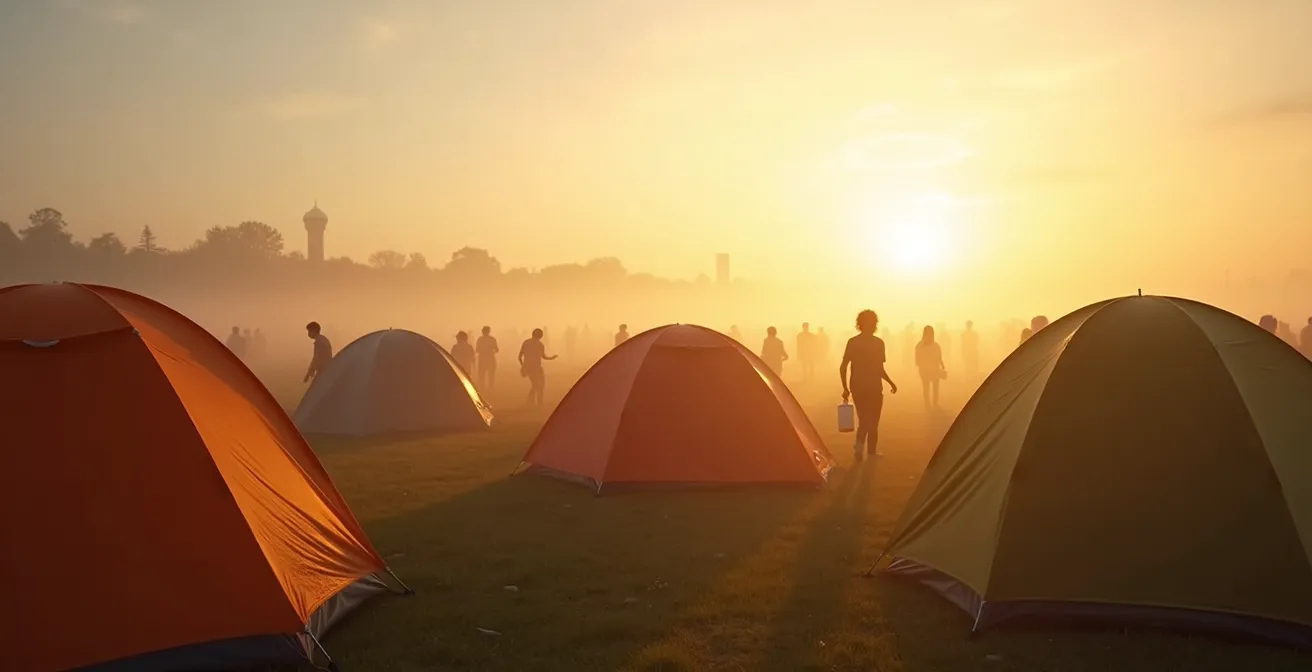
Staying clean at a festival isn’t about hygiene products; it’s a strategic battle against resource scarcity that you win before you even leave home.
- Your body is a “human battery” that requires careful management of electrolytes and fuel, not just water and junk food.
- Your biggest enemies are hidden costs and gear logistics; mastering your budget and the “last mile” gear haul is crucial.
Recommendation: Adopt a ‘combat-ready’ mindset: plan for security, communication, and sanitation failures, and train for the event like the endurance marathon it is.
Let’s be brutally honest. You’re not here because you want to know which biodegradable glitter is best. You’re here because you’ve had a flash-forward to Day 3: you’re caked in a film of dust and sweat, your hair is a greasy helmet, and you’re staring at a quarter-mile line for toilets that have seen unspeakable things. The standard advice—”pack baby wipes and dry shampoo”—is a tired platitude. It’s like telling a soldier to bring a band-aid to a firefight. Surviving, and actually enjoying, a multi-day festival isn’t about trying to replicate your at-home comfort. It’s about mastering a hostile environment with limited resources.
This isn’t a guide about looking pretty for the ‘gram. This is a veteran’s manual for adopting a combat-ready mindset. It’s about managing your gear, your body, and your sanity with ruthless efficiency. We’re going to move beyond basic hygiene and into a full-spectrum survival system. We’ll cover securing your base of operations, fueling your body like an athlete, navigating the financial minefield, and yes, dealing with the dreaded human waste situation. Forget the fantasy; this is your blueprint for feeling human when everything around you is chaos.
For those who want a visual taste of the camping experience, particularly at a large-scale event like Electric Forest, the video below offers a great boots-on-the-ground perspective. It complements the survival strategies in this guide by showing you the environment you’ll be mastering.
This guide is structured to build your survival system from the ground up. Each section tackles a critical mission component, from securing your campsite to training your body for the endurance challenge ahead. Follow this manual, and you won’t just survive your first festival—you’ll command it.
Summary: The Unofficial Festival Survival Manual
- How to Secure Valuables in a Tent When You Are at the Main Stage?
- Electrolytes vs. Water: What Actually Prevents Fainting in the Heat?
- Hidden Festival Costs: The Expenses That Break the Budget Beyond the Ticket
- Eating Healthy at Festivals: Avoiding the “Fried Food Coma” for Energy
- The “Totem” Method: How to Find Friends Without Cell Service?
- How to Pack Out Human Waste When There Are No Toilets?
- The “Last Mile” Problem: Combining Foldable Bikes with Trains?
- How to Train for High-Altitude Trekking Without Living Near Mountains?
How to Secure Valuables in a Tent When You Are at the Main Stage?
First rule of festival survival: your tent is your sanctuary, but it’s not a bank vault. A rookie mistake is to put a big, obvious lock on your tent zipper. All this does is scream, “My expensive stuff is in here!” to anyone walking by. The veteran’s approach is security through obscurity and misdirection. You want your tent to be the most boring, least interesting target in the entire campground. This means making valuables invisible or appear to be worthless trash.
The core of this strategy is the “decoy and disperse” method. You create an easy-to-find bag with low-value items—think old charging cables, a book, a cheap pair of sunglasses. Leave it somewhere obvious. Meanwhile, your actual valuables—phone, wallet, keys—are hidden in the last places anyone would look. Think inside a dirty laundry bag, tucked into an empty Pringles can, or wrapped in a towel at the bottom of your sleeping bag. Your most critical items (ID, one credit card, cash) should never leave your body. A good money belt worn under your clothes is non-negotiable.
Case Study: The Campsite Security Network
Experienced campers at events like Electric Forest have perfected a social approach to security. Instead of isolating their campsite, they build goodwill with their neighbors by sharing resources like duct tape, tools, or can openers. This creates an informal neighborhood watch. Some groups even implement a “camp duty” rotation, ensuring someone from the trusted circle stays behind during major headliner sets. This collaborative security network is often more effective than any lock because it provides active surveillance from people who know who belongs at your site.
Ultimately, your best defense is a strong community. Get to know the people camping around you. Share a beer, offer them a snack. A friendly neighbor who has your back is worth more than any piece of security gear you can buy. They are the ones who will notice if someone suspicious is poking around your tent while you’re gone.
Electrolytes vs. Water: What Actually Prevents Fainting in the Heat?
Here’s a piece of brutal honesty: water alone will not save you. Seeing rookies clutch a single water bottle all day is painful because they’re fighting the wrong battle. When you’re sweating for 10 hours straight under the sun, you’re not just losing water; you’re flushing out critical minerals called electrolytes—sodium, potassium, magnesium. Losing them is what leads to muscle cramps, headaches, nausea, and worst-case scenario, passing out in the middle of a crowd. Managing your human battery means actively replenishing these, not just hydrating.
Think of it this way: your body is trying to keep itself cool by sweating. But every drop of sweat takes salt with it. If you only drink pure water, you dilute the remaining salt in your system, which can be dangerous. Festival veterans know this and plan accordingly. The good news is, you don’t need expensive sports drinks. You can create your own system. This involves both what you drink and what you eat. Salty snacks aren’t just a craving; they’re a necessity. Pickles, pretzels, and salted nuts are your best friends.

Your goal is a constant, low-level intake of electrolytes throughout the day. Don’t wait until you feel thirsty or dizzy. By then, you’re already behind. To properly prepare, Electric Forest festival organizers recommend bringing 1 gallon per person per day of water as a baseline, but this must be supplemented. A simple DIY trick is to add a pinch of salt and a splash of fruit juice to your water bottle. It might not taste like a fancy sports drink, but it will do a far better job of keeping you on your feet.
Here is a simple, no-cook nutrition strategy to keep your electrolytes in check:
- DIY Drink: Mix a basic electrolyte solution: 1 liter of water + 1/4 teaspoon of salt + 1/4 teaspoon of a salt substitute (for potassium) + a splash of juice for flavor and sugar.
- Electrolyte-Rich Foods: Pack items like pickles/pickle juice, salted pretzels, bananas (for potassium), and coconut water.
- Monitor Yourself: Keep an eye on your urine color. Pale yellow is the goal. Dark yellow means you’re dehydrated.
- Know the Signs: Recognize electrolyte depletion symptoms beyond thirst, such as muscle cramps, a persistent headache, or nausea. If you experience confusion or stop sweating despite the heat, you need medical attention immediately.
Hidden Festival Costs: The Expenses That Break the Budget Beyond the Ticket
The ticket price is just the cover charge. The real financial damage happens on-site, where you’re a captive audience with a wallet. Every festival has a hidden “convenience tax” that can be 2-3 times retail prices. That $5 bag of ice from the gas station? It’s $20 inside. A cheap poncho? Try $30 in a sudden downpour. Forgetting a key item or underestimating your daily needs is how a manageable trip turns into a thousand-dollar weekend. A first-time attendee at Electric Forest, for example, reported spending about $1,000 beyond the ticket price, covering flights, shared rental car, and on-site costs.
Avoiding this financial trap requires a pre-festival budget audit. You need to be ruthlessly honest about your spending habits and plan for every contingency. The biggest budget killers are almost always food, ice, and “luxury” services like paid showers or phone charging stations. Bringing your own high-performance cooler, non-perishable food, and a portable battery pack are not just suggestions; they are fundamental money-saving strategies that can save you hundreds of dollars. The goal is to be self-sufficient, minimizing your reliance on overpriced on-site vendors.
Your Pre-Festival Budget Audit: 5 Points to Check
- Spending Points: List every potential cash drain: travel, on-site food, merch, “luxury” items like showers ($10 a pop), and a dedicated emergency fund.
- Gear Inventory: Audit what you own versus what you must buy (tent, cooler, chair). Prioritize borrowing from friends over buying new gear you’ll use once.
- Reality Check: Confront your ideal budget with festival reality. Is a $50 food budget for four days realistic when a single meal costs $15-20? Adjust your numbers based on facts, not hope.
- Experience Priority: Identify your “must-have” experiences (a specific artist’s merch, a famous food vendor) versus “nice-to-haves.” Allocate funds to what creates memories, not convenience items you could have packed.
- Action Plan: Create a final, line-item budget with a 20% contingency fund. Load this exact amount onto a separate debit card to create a hard spending limit.
The following table breaks down some of the most common planned expenses versus their inflated on-site reality. Use it to build your financial defense plan. As this detailed festival cost analysis shows, planning is everything.
| Expense Category | Pre-Festival Cost | On-Site Cost | Savings Strategy |
|---|---|---|---|
| Shower Access | $0 | $10 per use | Bring camp wipes, dry shampoo |
| Ice for Coolers | $5-10 | $20-30/day | High-performance cooler, freeze water bottles |
| Phone Charging | $30 (power bank) | $5-10 per charge | Portable battery pack |
| Rain Poncho | $10 | $25-40 | Pack in advance |
| Food/Water | $50-100 | $15-20 per meal | Bring non-perishables, camping stove |
Eating Healthy at Festivals: Avoiding the “Fried Food Coma” for Energy
Festival food is a trap. It’s overpriced, mostly deep-fried, and engineered to put you into a “food coma” right when you need energy the most. Living on corn dogs and pizza for four days is a surefire way to feel sluggish, bloated, and miserable. Fueling your body correctly is just as important as hydration for maintaining your energy levels. Your goal is to have a mix of easily digestible carbs for quick energy before dancing, and protein and healthy fats for sustained power throughout the day. This requires a no-cook nutrition strategy that you prepare at home.
A successful food plan balances convenience, nutrition, and cost. Many veterans adopt a hybrid approach: eat a solid, self-prepared breakfast at the campsite, buy one meal from a vendor during the day, and have another simple meal back at camp for dinner. This allows you to enjoy the festival food experience without destroying your budget or your body. Even when buying from vendors, make smart choices: look for grilled over fried options, choose bowls over wraps to get more nutrients and fewer empty carbs, and always get sauces on the side to control sugar and fat intake.
Bringing a small propane stove can be a game-changer, opening up options like scrambled eggs or reheating pre-made chili. But even without cooking, you can eat well with a little planning.
- Smart Breakfast: Pre-mix oats, chia seeds, and dried fruit in a jar. Just add cold water in the morning and let it sit for 15 minutes.
- Powerful Snacks: Pack protein bars, bananas, and single-serving packets of nut butter. A simple peanut butter sandwich on whole wheat bread is a fantastic energy source.
- No-Cook Lunch: Couscous salad is a miracle food; it rehydrates with cold water. Pre-mix the couscous with dehydrated vegetables and seasoning at home.
- Hydrating Meals: Powdered hummus is another excellent option. Just add water and serve with crackers or vegetable sticks for a protein-rich meal.
This isn’t about dieting; it’s about performance. You are an endurance athlete for the weekend, and you need to fuel yourself like one. The right food will keep you dancing longer and feeling better from the first act to the final encore.
The ‘Totem’ Method: How to Find Friends Without Cell Service?
At some point, the cell towers will overload and your phone will become a useless brick. This is not a possibility; it is a certainty. The panic of losing your friends in a sea of 100,000 people is a festival rite of passage, but it’s one you can avoid with an analog communication system. Relying on technology is a rookie move. The veteran’s method is a low-tech, high-visibility strategy built around totems and timed meetups.
The most iconic part of this system is the group totem. This is a unique, easily identifiable object raised high on a pole—an inflatable alien, a giant cutout of a celebrity’s head, a pool noodle wrapped in LED lights. It’s your group’s lighthouse in the chaotic sea of the crowd. When you’re trying to find your crew in front of the main stage, you’re not looking for faces; you’re scanning the horizon for your totem. This visual beacon is indispensable, especially after dark if it’s illuminated.

But a totem isn’t enough. You need a pre-agreed communication protocol. This is the “Hub, Spoke, and Time” system. It’s a simple but effective plan for when your group inevitably gets separated.
- Establish a “Hub”: Before you even enter the festival grounds, designate one primary, unmistakable meeting point. This shouldn’t be “by the sound booth,” but something truly unique, like “at the base of the giant metal dragon sculpture.” This is your emergency home base.
- Set “Spokes”: Designate secondary meeting spots at the back left or right of each major stage. This gives you options if the main Hub is too crowded.
- Implement a Check-in Time: Agree to meet at the Hub on the hour, every hour (or every two hours). If someone is lost, they know they can go to the Hub at the top of the hour and wait 10-15 minutes for the group to appear.
- Use a Campsite Message Board: A small whiteboard at your tent is perfect for leaving notes like “Gone to the techno stage, back by 10 PM.”
This system removes the panic and replaces it with a plan. It acknowledges that technology will fail and provides a robust, reliable backup that has worked for decades of festival-goers.
How to Pack Out Human Waste When There Are No Toilets?
Alright, let’s talk about it. The portable toilets. By Day 2, they become a biohazard zone. By Day 3, a war crime. And at some more primitive festivals or overflow camping areas, there might not be any at all. This is the single biggest fear for most first-timers, but it’s a logistical problem with a solution, just like everything else. The principle is “Leave No Trace,” and the practice is having the right gear and zero shame. Your two main options are a WAG bag system or a DIY bucket setup.
A WAG bag (Waste Alleviation and Gelling) is a purpose-built kit. It’s a puncture-resistant bag containing a special powder that gels liquid waste, neutralizes odors, and begins the decay process. You use it, seal it, and pack it out in a larger, opaque disposal bag. It’s the cleanest, most compact solution. The DIY alternative involves a 5-gallon bucket, a snap-on toilet seat lid, and a desiccant like kitty litter or sawdust. You line the bucket with a heavy-duty trash bag, do your business, and cover it with a scoop of litter to manage odor and moisture. When the bag is about half full, you tie it off securely (double-bag it!) and store it for disposal in designated bins.
The key to either system is creating a dedicated, private sanitation corner at your campsite. Use a tarp or sheet to create a privacy screen. Immediately next to it, set up a hand sanitation station with hand sanitizer and wipes. The rule is: use, seal, and sanitize immediately. According to National Park Service guidelines, if you must dig a “cathole” for urination, it must be 6-8 inches deep and located at least 200 feet minimum (about 70 big steps) from any water sources, trails, or campsites. Solid waste should always be packed out.
This isn’t glamorous, but mastering this process is the ultimate act of self-reliance. It frees you from dependence on horrifying communal toilets and gives you control over your own hygiene and comfort. It’s a mental hurdle, but once you cross it, you’ve truly achieved festival veteran status.
The ‘Last Mile’ Problem: Combining Foldable Bikes with Trains?
The title is jargon, but the problem is real and it hits you the second you arrive: “The Last Mile.” It’s the brutal, soul-crushing trek from your car in a distant parking lot to your designated patch of grass in the campground. You’ll see rookies struggling, making multiple trips, their arms loaded with gear, their backs breaking before the first band even plays. This initial gear-haul can drain your energy and set a negative tone for the whole weekend. The title might mention bikes and trains, but in the festival context, this problem is about bridging that massive gap on foot, often over uneven, muddy terrain.
Solving the Last Mile problem is about leverage, not brute strength. The single most valuable piece of non-camping gear you can bring to a festival is a sturdy, all-terrain trolley or wagon. Forget the little collapsible carts with skateboard wheels; they will die a horrible death in the first patch of mud. You need something with large, rugged wheels designed for abuse. This one piece of equipment transforms a multi-trip nightmare into a single, manageable journey.
Case Study: The Festival Trolley Transformation
Attendees who invest in a proper festival trolley, like the OLPRO Folding Festival Trolley, report a night-and-day difference in their arrival experience. One camper noted their group was able to transport a tent, multiple coolers, chairs, and backpacks—everything for a four-day stay—in a single, 20-minute walk. Without it, the same load would have taken three or four exhausting trips. The trolley then served as a makeshift storage table at the campsite and was even used for hauling water and ice from on-site vendors, saving even more physical effort throughout the weekend.
Think of it as an investment in your physical well-being. By saving your energy during the initial setup, you have more to spend where it counts: at the stages. Don’t be the person dragging a broken cooler through a field of mud. Plan for the Last Mile, and you’ll start your festival experience with a win.
Key Takeaways
- Security through obscurity beats locks. Hide your valuables in plain sight inside dirty laundry or empty food containers.
- Water isn’t enough in the heat. You need a dedicated electrolyte strategy to avoid collapsing.
- A festival is an endurance sport. Train for it by building up standing and dancing tolerance for weeks beforehand.
How to Train for High-Altitude Trekking Without Living Near Mountains?
This title sounds out of place, but the metaphor is perfect. A multi-day music festival *is* an endurance event. It’s a marathon, not a sprint. You don’t need to train for altitude, but you absolutely need to train for the physical demands you’re about to face. Thinking you can go from a desk job to dancing for 12 hours a day for four days straight is a recipe for “Day 2 Leg Failure,” blisters, and utter exhaustion. Your physical conditioning is a core part of your survival kit.
Festival endurance training focuses on three areas: cardiovascular capacity, muscular endurance, and acclimatization. You need a heart and lungs that can handle hours of activity, legs and a core that won’t quit, and feet that are prepared for the abuse. The data is clear: according to outdoor experts, festival attendees can easily spend 12+ hours on feet daily. Your training should reflect this reality.
A simple but effective training program started 4-6 weeks before the festival can make an enormous difference. It doesn’t require a gym membership, just consistency.
- Cardio (HIIT): High-Intensity Interval Training is perfect for mimicking the festival cycle of intense dancing followed by walking or resting. Think 1 minute of jumping jacks or running in place, followed by 2 minutes of walking. Repeat for 20-30 minutes, 3 times a week.
- Endurance (Loaded Carries & Isometrics): To prepare for hauling gear and standing for hours, practice farmer’s walks (walking with heavy weights in each hand) and static holds like wall sits and planks. This builds the specific endurance your legs and core will need.
- Acclimatization (Shoes & Sleep): This is the most overlooked step. Break in the shoes you plan to wear for weeks in advance. Wear them everywhere. You need to identify and solve potential blister spots before you’re miles from your tent. If possible, practice sleeping in your tent and sleeping bag in your backyard to get used to the setup.
Don’t let physical burnout cut your festival short. Treating the event with the respect of an athletic competition and preparing your body accordingly is the final piece of the veteran’s survival puzzle. You’ll recover faster, have more energy, and be able to enjoy the final act as much as the first.
Now stop worrying and start preparing. Use this guide to build your kit, train your body, and walk onto that festival ground like you own the place. This is how you don’t just survive—this is how you win.