Contrary to popular belief, franchise fatigue isn’t a sign of Hollywood’s lack of ideas, but the predictable result of an economic system that prioritizes risk-averse, billion-dollar assets over original storytelling.
- Blockbuster budgets have become so massive that only pre-existing Intellectual Property (IP) can justify the financial risk.
- Merchandising, premium ticket formats, and streaming windows create a feedback loop where commercial viability dictates narrative choices.
Recommendation: To break the cycle, audiences must actively seek out original films, using specific strategies to look beyond algorithm-driven platforms.
There’s a familiar sigh that unites moviegoers today. It’s the one you exhale after seeing a trailer for yet another sequel, prequel, or cinematic universe installment. The term “franchise fatigue” circulates widely, a shared cultural shorthand for our exhaustion with the seemingly endless parade of familiar heroes and recycled plots. We complain, we write critical tweets, we lament the death of originality in mainstream cinema. And then, many of us still buy the ticket, contributing to the very phenomenon we decry. This paradox lies at the heart of the modern film industry.
The common refrains are that “Hollywood is out of ideas” or that studios are simply “cashing in on nostalgia.” While there is truth to both, these explanations are incomplete. They fail to capture the powerful, underlying structural forces at play. The dominance of the franchise is not merely a creative failure or a symptom of greed; it is the logical, almost inevitable, outcome of a high-risk economic model. Blockbuster films have evolved from cultural products into something more akin to a financial asset class, too big and too interconnected to be allowed to fail.
This analysis moves beyond the surface-level complaints to dissect the economic engine driving this systemic inevitability. We will explore how staggering budgets create a form of economic gravity, pulling studios toward the safety of established Intellectual Property (IP). We will see how every aspect of the machine—from the visual effects pipeline and merchandise sales to premium theatrical formats and streaming release strategies—is engineered to minimize risk and maximize returns. Understanding this system reveals a startling truth: our complicity as consumers is not just a side effect, but a crucial component that keeps the gears turning.
To fully grasp the mechanics of this cinematic economy, this article breaks down the key components that create and sustain the franchise model. The following sections will guide you through the entire value chain, from a film’s initial budget to its long-tail life as a piece of merchandise, revealing why original, mid-budget movies struggle to survive in this ecosystem.
Summary: Franchise Fatigue: The Economic Engine of Sequels
- Budget vs. Box Office: How Much Does a Movie Need to Make to Break Even?
- CGI vs. Practical Effects: Why Do Older Blockbusters Look Better?
- Toy Sales Driven Scripts: How Merchandise Dictates Character Survival?
- IMAX vs. Dolby Cinema: Which Premium Format Justifies the $25 Ticket?
- The 45-Day Window: Why Waiting for Streaming Kills the Mid-Budget Movie?
- Why Do We Pay 300% More for a Screen-Printed Cotton T-Shirt?
- The Hidden Maintenance Costs of High-Tech Exhibitions
- Beyond the Algorithm: How to Discover Indie Films That Netflix Hides?
Budget vs. Box Office: How Much Does a Movie Need to Make to Break Even?
The first step in understanding franchise dominance is to grasp the brutal economics of blockbuster filmmaking. A common misconception is that a film is profitable once its box office gross exceeds its production budget. The reality is far more complex. Studios typically receive only about 50% of the domestic box office gross and an even smaller percentage from international markets. On top of that, a film’s marketing budget is often as large as its production budget. This leads to a widely accepted rule of thumb in the industry: a film must gross approximately 2.5 times its production budget just to break even.
When a film costs $200 million to produce, it needs to earn a staggering $500 million globally simply to avoid losing money. This immense financial pressure creates a powerful “economic gravity” that pulls studios away from original, unproven ideas and toward the perceived safety of established IP. The risk is simply too high. This is why, according to industry analysis by Matthew Ball, franchise films have captured a historic share of the box office. The logic is one of pure risk management. As analyst Matthew Ball puts it:
Why spend $50MM on a film that, at best, might return $25MM when you could spend $200MM and, if it works, build a franchise that might generate $100MM twice a year from spinoffs
– Matthew Ball, The Absurdities of ‘Franchise Fatigue’ and Sequelitis
This calculation transforms filmmaking from a creative endeavor into a portfolio management strategy. An original, mid-budget drama is a high-risk, low-reward gamble. A sequel in a beloved cinematic universe is a blue-chip investment, a cornerstone of a financial strategy designed for predictable, scalable returns. It is this fundamental economic reality that lays the groundwork for everything that follows.
CGI vs. Practical Effects: Why Do Older Blockbusters Look Better?
A frequent complaint among moviegoers is that the computer-generated imagery (CGI) in many modern blockbusters feels weightless, rushed, or visually unconvincing, especially when compared to the practical effects of older films. This isn’t just nostalgia. The issue is often not the technology itself, but the punishing production model it serves. The franchise machine demands a relentless pipeline of content, with multiple tentpole films and streaming series in production simultaneously, all needing thousands of VFX shots on compressed timelines.
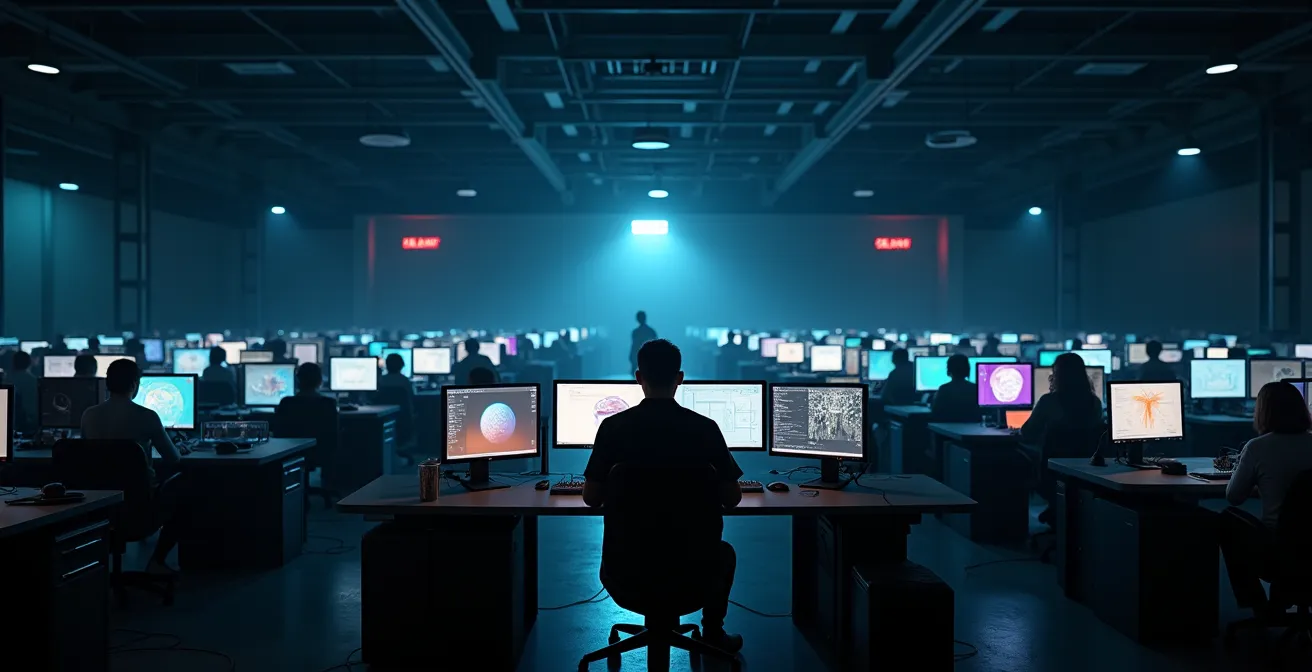
This has created what many in the industry call a VFX burnout crisis. As detailed in reports on the industry, studios’ aggressive release schedules and competitive bidding processes force VFX houses into unsustainable working conditions. Artists often work extreme hours to meet impossible deadlines, leading to rushed work and a reliance on templated solutions. Instead of crafting unique visual assets for a single film, teams are often churning out content for an entire slate of interconnected projects. The result is a visual homogenization and a drop in perceived quality, where spectacular set pieces can feel generic because the underlying creative process has been industrialized.
Practical effects, by contrast, are bound by the laws of physics. They require time for physical construction, on-set photography, and meticulous planning, which inherently slows down the production process. While more limiting, this forced deliberation often results in a more tangible and visually coherent final product. The “better look” of older films is frequently the byproduct of a production model that allowed for more focused, hands-on artistry, a luxury that the modern franchise assembly line can rarely afford.
Toy Sales Driven Scripts: How Merchandise Dictates Character Survival?
In the modern franchise ecosystem, a film is often not the final product but rather a two-hour advertisement for a vast array of other goods. The financial power of merchandising is immense, with the most successful media franchises generating tens of billions of dollars from merchandise alone. As documented in industry analysis, properties like Pokémon, Star Wars, and the Marvel Cinematic Universe derive a substantial portion of their total value from toys, apparel, and collectibles, often dwarfing their box office revenue.
This commercial reality has created a powerful merchandise feedback loop that directly influences narrative decisions. The survival, return, or even creation of a character can be determined by their “toyetic” potential—how well they can be translated into a marketable product. A character who sells a lot of action figures is far more likely to be resurrected from a seemingly definitive death or given a spinoff series. Conversely, characters who don’t perform well on toy store shelves may find their screen time reduced in subsequent installments.
This synergy-based model, where films serve as launching pads for consumer products, can subordinate narrative logic to commercial imperatives. Story arcs are engineered to introduce new costumes, vehicles, or cute sidekicks that are perfect for merchandise lines. The film becomes an IP asset, and its primary role is to service the larger commercial ecosystem. When audiences wonder why a certain character inexplicably survived or why a new, slightly jarring creature was introduced, the answer can often be found not in the writers’ room, but in a marketing meeting about the next quarter’s toy catalog.
IMAX vs. Dolby Cinema: Which Premium Format Justifies the $25 Ticket?
As home entertainment systems become more sophisticated, theaters can no longer compete solely on the basis of showing a film. Their strategic response has been to pivot to the “experience economy,” transforming a trip to the movies into a premium event that cannot be replicated at home. This is the domain of Premium Large Formats (PLFs) like IMAX and Dolby Cinema, which command ticket prices 40-60% higher than a standard screening. This shift has a profound impact on franchise economics, as these high-margin tickets can significantly boost a film’s profitability.
The central value proposition of PLFs is sensory immersion. They offer bigger screens, more advanced sound systems, and brighter, higher-contrast images. The choice between them often comes down to personal preference, as each offers a distinct aural and visual philosophy. The table below outlines the key differences and their impact on a franchise film’s bottom line.
| Format Feature | IMAX | Dolby Cinema | Impact on Franchise Revenue |
|---|---|---|---|
| Screen Size | Up to 70ft tall | Standard large format | Drives ‘event’ perception |
| Sound System | 12-channel | Dolby Atmos (128 channels) | Justifies premium pricing |
| Visual Enhancement | 70mm film or dual 4K laser | Dual laser HDR | Compensates for weak narratives |
| Average Ticket Premium | 40-60% above standard | 35-50% above standard | High-margin revenue stream |
For franchise films, PLFs are a perfect match. Their epic scale and CGI-heavy set pieces are designed to take full advantage of these formats. As one analysis notes, this changes the fundamental promise made to the audience. The pitch is no longer about the quality of the story but the exclusivity of the spectacle. As one industry observer states, “The value proposition shifts from ‘come see a great story’ to ‘come have an experience you can’t get at home.'” This strategy effectively insulates blockbuster films from criticisms of weak narrative by focusing the audience’s attention on the undeniable sensory overload that only a high-end theater can provide.
The 45-Day Window: Why Waiting for Streaming Kills the Mid-Budget Movie?
For decades, the theatrical window—the exclusive period during which a film could only be seen in cinemas—was a cornerstone of the industry, typically lasting 90 days. The pandemic shattered this model, forcing studios to experiment with simultaneous streaming releases or dramatically shortened windows. The new industry standard has settled around 45 days, a change that has had a devastating, if unintended, consequence for a specific type of film: the original, mid-budget movie.
Large franchise films are “event” movies. Their marketing blitz and cultural dominance create an urgent need to be seen immediately, on the biggest screen possible, to avoid spoilers and participate in the cultural conversation. The 45-day window does little to harm them. However, for smaller, adult-oriented dramas, comedies, or thrillers that rely on word-of-mouth to build an audience over time, this compressed window is a death sentence. Audiences are now conditioned to know that if they just wait six weeks, the film will be available to stream at home. The incentive to pay for a theatrical ticket for anything less than a massive spectacle has collapsed.
This new audience behavior further reinforces the dominance of franchises. As reported by film industry observers, the overwhelming majority of financially successful movies since 2020 have been sequels, spinoffs, or part of an existing IP. Theatrical exhibition is increasingly becoming a space reserved only for the largest, most bombastic blockbusters. The mid-budget film, once a staple of Hollywood and a breeding ground for new talent, is being squeezed out of existence, unable to compete in a landscape where the only options are a massive theatrical event or a quiet debut on a streaming platform.
Why Do We Pay 300% More for a Screen-Printed Cotton T-Shirt?
The final piece of the franchise puzzle is our own complicity as consumers, most visibly demonstrated through merchandise. When a fan pays $40 for a t-shirt that costs a few dollars to produce, they aren’t just buying a piece of cotton. They are purchasing a token of identity. As industry reporting on the psychology of merchandise explains, the premium price represents the accumulated cultural value of the IP, built over decades of storytelling and billions in investment.
This act of purchasing is a form of identity signaling. It allows fans to publicly declare their allegiance to a “tribe” and participate in a shared cultural ecosystem. Even when fans are critical of a franchise’s latest installment, wearing its merchandise demonstrates a deep, long-term engagement that transcends the quality of a single film. The purchase is an affirmation of belonging to the community surrounding the IP. This behavior is driven by several key psychological mechanisms:
- Merchandise serves as a “Talisman of Identity” for fans to signal their belonging to a community.
- The premium price reflects the IP’s cultural resonance and the value of shared nostalgia, not the material cost.
- Purchasing is an act of participation in the fan ecosystem, strengthening one’s connection to the narrative world.
- Owning collections of merchandise functions like creating a personal museum, chronicling one’s history with the franchise.
This dynamic creates a fascinating paradox: the same fan who complains about a creatively bankrupt sequel will willingly pay a 300% markup on a t-shirt, directly funding the very studio system that produced it. This is not hypocrisy; it is a demonstration of how deeply an IP can be integrated into a person’s identity. The merchandise is no longer just a product; it’s a tangible piece of a story they feel a part of, making the high price feel justified.
The Hidden Maintenance Costs of High-Tech Exhibitions
If a franchise is an asset, then each new film is a form of high-stakes maintenance designed to keep that asset valuable and relevant. This “maintenance” comes with enormous and ever-escalating costs. In the 21st century, major media conglomerates have favored a model where franchises require constantly increasing budgets to create a sense of spectacle that outdoes the last installment. The expectation of bigger explosions, more complex CGI, and grander set pieces creates a financial arms race, both with competing franchises and with a franchise’s own past.
This budget bloat has a chilling effect on creativity. The immense financial risk associated with a $250 million production budget discourages any form of genuine innovation. Studios become pathologically risk-averse, relying on proven formulas, familiar character arcs, and predictable plot beats. The goal is no longer to tell a compelling story but to safely deliver a product that meets a pre-defined set of market expectations. Originality is seen as a dangerous variable that could jeopardize a quarter-billion-dollar investment.
This vicious cycle is perfectly captured in a simple but powerful observation from the adjacent gaming industry, which faces identical pressures. As one analysis on franchise fatigue notes, there is a direct correlation between financial risk and creative stagnation.
Budgets increase risk, and increased risk discourages innovation
– Game Industry Analysis, Franchise Fatigue: How Many Sequels is Too Many?
The “high-tech exhibition” of a modern blockbuster is therefore a double-edged sword. Its spectacular nature is necessary to draw audiences into theaters, but the cost of that spectacle is precisely what strangles the creativity that could make it truly memorable. The system is designed to produce films that are too big to fail, and as a result, they are often too safe to truly succeed as art.
Key takeaways
- Franchise dominance is an economic inevitability driven by the need to mitigate the immense financial risk of blockbuster budgets.
- The entire production and exhibition ecosystem, from VFX and merchandise to premium tickets, is designed to support and reinforce the value of established IP.
- Audience behavior, particularly the willingness to pay for premium experiences and identity-signaling merchandise, actively fuels the system they often critique.
Beyond the Algorithm: How to Discover Indie Films That Netflix Hides?
After dissecting the economic machinery of the franchise model, the situation can feel hopeless for those craving originality. Streaming platforms, once hailed as a democratizing force, increasingly prioritize their own high-budget productions and algorithmically push content that resembles what you’ve already watched. This creates a “content bubble” that makes discovering unique, independent films more difficult than ever. However, breaking out of this bubble is not impossible; it simply requires a more conscious and proactive approach to film discovery.
The key is to move beyond passive, algorithm-driven viewing and become an active curator of your own media diet. It means using dedicated tools and communities that value human curation over machine learning. While major awards like the Oscars often highlight original scripts, the real gems are frequently found by digging deeper into the festival circuit and international film scenes. Adopting a structured discovery strategy can turn the search for originality from a chore into a rewarding journey.
Your Action Plan: A Discovery Funnel for Original Films
- Identify Starting Points: Begin with an indie film you love. Note the director, writer, and production company.
- Explore Filmographies: Use platforms like IMDb or Letterboxd to explore the complete filmography of those key creatives.
- Locate Availability: Use a service like JustWatch to find out where these films are streaming, renting, or available for purchase.
- Find Similar Voices: Browse communities on Letterboxd or Reddit (e.g., r/truefilm) to see what fans of those specific films and creators also recommend.
- Follow Curators and Festivals: Actively track the selections and winners from renowned film festivals like Sundance, Cannes, TIFF, or smaller, genre-specific ones. Follow critics and programmers whose tastes align with yours.
This methodical process empowers you to build a personalized roadmap to films that exist far from the shadow of blockbuster marketing campaigns. It requires more effort than simply launching Netflix, but the reward is a richer, more diverse, and ultimately more satisfying cinematic experience. It is the most effective way for an individual viewer to push back against the tide of systemic inevitability.
By becoming a more conscious and deliberate consumer of film, you not only enrich your own viewing experience but also send a small but vital signal to the industry that an audience for original, daring, and personal storytelling still exists and is worth serving.