
The most effective cardio protocol isn’t HIIT or LISS; it’s the one that matches your body’s daily readiness for stress.
- High-Intensity Interval Training (HIIT) is a high-reward tool best used when you are fully recovered and energized.
- Low-Intensity Steady-State (LISS) and NEAT are superior for promoting recovery, managing stress, and building a sustainable fat-burning base on low-energy days.
Recommendation: Use daily biofeedback like Heart Rate Variability (HRV) to decide your workout intensity, shifting from a rigid schedule to a dynamic, data-driven training plan.
You have a 30-minute window. It’s the only time you’ll get today to focus on your fitness. The question is paralyzing: do you go all-out with High-Intensity Interval Training (HIIT) to maximize the “afterburn,” or do you opt for Low-Intensity Steady-State (LISS) cardio, which supposedly burns more fat? The internet offers a firehose of conflicting advice. Some swear by HIIT’s time efficiency, while others praise LISS for its recovery benefits and direct use of fat for fuel.
This endless debate misses the point entirely. The conversation isn’t about which protocol is universally superior, but which is tactically correct for you, today. For the busy professional or parent, optimizing training isn’t about blindly following one camp; it’s about learning to manage your body’s energy systems with precision. The real key to unlocking cardiovascular efficiency and sustainable fat loss isn’t in the workout itself, but in the decision you make before you even start.
But what if the answer wasn’t to pick a side, but to develop metabolic flexibility? This means training your body to be equally adept at burning carbohydrates for high-intensity fuel and tapping into fat stores for low-intensity energy. This guide abandons the dogmatic HIIT vs. LISS war. Instead, it provides a strategic framework for using biofeedback and understanding your body’s signals to choose the right protocol, at the right time, for maximum results in your limited schedule.
This article will provide a clear, data-driven framework to help you move beyond the guesswork. We’ll explore how to interpret signals from your body and wearable tech, how to implement ultra-efficient workouts in any environment, and how to use exercise as a tool to build not just physical, but mental resilience. The following sections break down exactly how to apply this strategic approach.
Summary: The Ultimate Guide to Efficient Cardio Training
- Does Running on an Empty Stomach Actually Burn More Fat?
- Tracking HRV: What Your Watch Tells You About Overtraining?
- Burpees and Jump Rope: A 15-Minute Hotel Room Cardio Session?
- The No-Sweat Cardio Routine: Is It Possible to Train Without Showering?
- Low-Impact Cardio: Raising Your Heart Rate Without Jumping?
- How to Use Wearable Tech Data Without Becoming Obsessed with Numbers?
- Why Using Poles Increases Calorie Burn by 20% Without More Effort?
- Training for Mental Toughness: How Athletic Discipline Conquers Anxiety?
Does Running on an Empty Stomach Actually Burn More Fat?
The concept of “fasted cardio” is a frequent topic in fat-loss discussions. The theory is straightforward: with depleted glycogen (stored carbohydrate) levels after an overnight fast, your body is forced to oxidize, or “burn,” more fat for fuel during exercise. For a LISS session, like a steady 30-minute walk or light jog, this holds true. The body can efficiently tap into fat stores to power low-intensity activity, potentially enhancing your overall ability to utilize fat as a fuel source—a key component of metabolic flexibility.
However, the equation changes dramatically when applied to HIIT. The very nature of high-intensity training demands quick, explosive energy that can only be provided by readily available glycogen. Attempting a true HIIT session in a fasted state is often counterproductive. You won’t be able to reach the peak power output required to stimulate the desired metabolic adaptations, such as the significant post-exercise oxygen consumption (EPOC) or “afterburn” effect. Your performance will be compromised, diminishing the primary benefit of HIIT.
Therefore, the decision to train fasted should be protocol-dependent. If your biofeedback indicates a LISS or recovery day, a fasted session can be a strategic tool to improve fat oxidation. If you are primed for a high-intensity day, providing your body with a small, easily digestible carbohydrate source 30-60 minutes before your workout will ensure you have the fuel to perform at your peak and reap the full rewards of the session. The goal isn’t just to burn fat during the workout, but to optimize total daily energy expenditure and performance.
Ultimately, choosing to run on an empty stomach isn’t a simple yes or no; it’s a strategic choice based on the intended intensity and goal of that specific day’s training.
Tracking HRV: What Your Watch Tells You About Overtraining?
For the data-driven individual, Heart Rate Variability (HRV) is the single most important metric for optimizing training and preventing burnout. Unlike resting heart rate, which simply measures beats per minute, HRV measures the tiny, millisecond variations in time *between* each heartbeat. A high HRV indicates that your autonomic nervous system is balanced and resilient—a sign of good recovery and readiness to handle stress. A low HRV, conversely, signals that your body is under stress, whether from poor sleep, illness, mental strain, or accumulated training fatigue.
Think of HRV as your body’s daily readiness score. It removes the guesswork from the HIIT vs. LISS decision. Waking up to a high HRV score is a green light from your nervous system; you are recovered, adapted, and ready for a metabolically demanding workout like HIIT. This is the day to push your limits. However, a low or declining HRV score is a clear red flag. It’s your body telling you it needs more time to recover. Pushing through with another high-intensity session on a low-HRV day is a direct path to overtraining, injury, and diminished returns.

On these low-HRV days, LISS, active recovery, or complete rest becomes the most productive choice. This approach, known as biofeedback-driven programming, ensures that you apply stress only when your body is prepared to adapt to it. It transforms your training from a rigid, arbitrary schedule into a dynamic conversation with your physiology. Your wearable tech stops being a simple activity tracker and becomes a sophisticated coaching tool, guiding you to train smarter, not just harder.
By making HRV your primary decision-making metric, you ensure every 30-minute session, whether high or low intensity, is the most effective one you could be doing on that particular day.
Burpees and Jump Rope: A 15-Minute Hotel Room Cardio Session?
The hotel room or a small apartment space presents a classic challenge for the busy traveler. Yet, with minimal equipment like your own bodyweight and a jump rope, you can execute either a highly effective HIIT or LISS session. The determining factor isn’t the equipment, but the programming and intensity. This is where you apply your energy system management strategy in a real-world scenario.
According to research highlighted by conditioning expert Thomas DeLauer, the same tools can be programmed for vastly different metabolic effects. The key is adhering to true intensity zones. For a time-efficient HIIT session, you could perform a protocol of 20 seconds of maximum-effort burpees followed by 40 seconds of complete rest, repeated for 15 minutes. This work-to-rest ratio is designed to push you to near-maximal heart rate, triggering a significant metabolic response. This type of training is highly effective, as studies on excess post-exercise oxygen consumption show that it elevates your metabolism for up to 24 hours after the workout is over.
Case Study: Protocol Flexibility Based on Energy Availability
Thomas DeLauer’s research shows that the same equipment (bodyweight, jump rope) can be effectively programmed for either HIIT (30s work/30s rest at 90% effort) or LISS (continuous movement at 60% effort for 15+ minutes). The key differentiator is maintaining true intensity zones – HIIT requires genuine maximal effort sprints under 20 seconds, while LISS should allow conversation throughout.
Conversely, on a day when your HRV is low or you’re feeling fatigued, the same jump rope becomes a tool for a restorative LISS session. The goal would be 15 minutes of continuous, steady-state skipping at an intensity of around 60% of your max heart rate—a pace where you could comfortably hold a conversation. This approach still burns calories and improves cardiovascular health without adding significant stress to a tired system. It promotes blood flow, aids recovery, and reinforces your aerobic base.
This demonstrates that efficiency isn’t about having a gym full of equipment; it’s about knowing how to program the right protocol for your body’s needs with the tools you have available.
The No-Sweat Cardio Routine: Is It Possible to Train Without Showering?
For many professionals, a major barrier to a midday workout is the time required for showering and changing afterward. This is where the concept of a “no-sweat” routine, centered on Non-Exercise Activity Thermogenesis (NEAT), becomes a game-changer. NEAT is the energy you expend for everything you do that is not sleeping, eating, or formal exercise. It includes activities like walking to your car, taking the stairs, or even fidgeting. Intentionally increasing your NEAT is the ultimate form of LISS—a low-grade, sustainable “cardio” session spread throughout your day.
This isn’t about finding 30 minutes for a workout; it’s about reclaiming dozens of small, 2-to-5-minute windows. As metabolic expert Thomas DeLauer notes, this approach can be surprisingly effective. On The Model Health Show Podcast, he stated: “Zone 1-2 activity accumulated throughout the workday in 5-10 minute ‘snacks’ can equal or exceed the calorie burn of a single 20-minute HIIT session”. This strategy focuses on cumulative volume over acute intensity.

Implementing this involves simple environmental and behavioral changes. Taking all your phone calls while pacing around the office can add thousands of steps. Setting a timer to stand up and stretch every hour prevents metabolic slowdown. Opting for the stairs instead of the elevator adds small bursts of incline work. These “exercise snacks” keep your metabolism active, improve blood sugar control, and contribute significantly to your total daily energy expenditure without ever requiring a change of clothes or a shower.
On your busiest or lowest-energy days, a NEAT-focused strategy is not a compromise; it’s the most intelligent and efficient training protocol you can choose.
Low-Impact Cardio: Raising Your Heart Rate Without Jumping?
A common misconception is that effective HIIT must involve high-impact movements like sprinting or burpees. For individuals with joint concerns or those simply looking to reduce physical strain, this can be a major deterrent. However, the true driver of HIIT’s benefits is cardiac output, not joint impact. It is entirely possible to achieve a heart rate of 80-90% of your maximum through low-impact means, eliciting the same powerful metabolic response.
Machines like the stationary bike, rower, or elliptical are perfect tools for low-impact HIIT. For example, research on athletes using assault bikes and rowers has demonstrated that low-impact protocols are highly effective. A protocol of 20-second maximal effort sprints on a rower, followed by 40-60 seconds of easy recovery, can produce a similar EPOC effect to high-impact running sprints, but with significantly less perceived joint discomfort. This makes high-intensity training accessible and sustainable for a much broader population.
Case Study: Low-Impact HIIT Protocol Effectiveness
Research on assault bike and rowing protocols demonstrates that low-impact HIIT can achieve 80-90% HRmax without joint stress. As detailed in a study on HIIT versus LISS, athletes using 20-second maximal efforts on rowers showed similar EPOC effects to high-impact sprint training, while reporting 60% less perceived joint discomfort over 8-week training periods.
On the other side of the spectrum, low-impact LISS is a cornerstone for building a robust aerobic base and improving the body’s ability to use fat as a primary fuel. Steady-state training in “Zone 2” (an intensity where you can hold a conversation) for 30 minutes or more is a powerful stimulus for mitochondrial growth. In fact, compelling research published in the Journal of Applied Physiology found that 12 weeks of Zone 2 training can improve the body’s fat utilization capacity by as much as 40%. This adaptation is fundamental to achieving long-term metabolic health and body composition goals.
Whether you’re aiming for peak intensity or building your aerobic engine, low-impact options provide a safe and highly effective path to achieving your cardiovascular goals.
How to Use Wearable Tech Data Without Becoming Obsessed with Numbers?
Wearable technology offers a wealth of data, but this can quickly lead to “analysis paralysis” or an unhealthy obsession with daily fluctuations. The key to using this data effectively is to shift from a reactive, day-to-day focus to a strategic, trend-based approach. Instead of panicking over a single poor sleep score or a drop in HRV, you should focus on weekly and monthly averages to make informed adjustments to your training and lifestyle.
A powerful method to avoid this obsession is the One-Metric-Focus Strategy. Rather than trying to optimize every metric at once, you concentrate on improving a single, relevant data point for a dedicated period. This creates clarity and actionable goals. For example, for one month, your sole focus might be on your morning HRV, using it to decide between a HIIT or LISS session. The following month, you might shift your focus to increasing your average weekly active calorie total. This methodical approach prevents overwhelm and fosters mastery over one variable at a time.
As a sports science research team from the International Journal of Sports Physiology noted, “Using weekly summaries rather than daily metrics moves you from obsession to strategic planning.” Pairing this quantitative data with a subjective rating, such as your perceived energy level on a scale of 1-10, provides crucial context. A low HRV score might be explained by a stressful day at work, not necessarily overtraining. This combination of objective data and subjective feeling allows for a more holistic and less obsessive relationship with your wearable tech.
Action Plan: The One-Metric-Focus Strategy
- Weeks 1-4: Track only morning HRV. Use this single data point to decide between HIIT (high HRV) and LISS/rest (low HRV).
- Weeks 5-8: Continue tracking HRV, but add a secondary focus: your average heart rate during LISS sessions, aiming for consistency in Zone 2.
- Weeks 9-12: Maintain previous habits and introduce a focus on weekly active calorie totals, using the data to plan for energy intake and recovery.
- Pair each metric with a daily subjective rating of your energy and mood (scale of 1-10). This provides context for the numbers.
- Commit to reviewing your data only once a week to identify trends, rather than reacting to daily fluctuations. Set designated “data-free” days to train intuitively.
By implementing this structured approach, your watch transforms from a source of anxiety into a valuable partner for long-term strategic planning and sustainable progress.
Why Using Poles Increases Calorie Burn by 20% Without More Effort?
For those seeking to maximize the efficiency of their LISS sessions, Nordic walking—walking with specially designed poles—is an exceptionally effective upgrade. The technique transforms a lower-body exercise into a full-body workout, significantly increasing the metabolic cost without a corresponding increase in perceived exertion. It’s the definition of training smarter, not harder.
The secret lies in biomechanics. Proper Nordic walking technique involves actively engaging the upper body. With each step, you plant the opposite pole behind you and push off, engaging the muscles of your arms, shoulders, chest, and back. This coordinated movement recruits a much larger percentage of your total muscle mass compared to regular walking. More muscles working means a higher demand for oxygen and energy, which directly translates to a greater calorie burn. In fact, a thorough biomechanical analysis reveals that Nordic walking achieves a 20% to 45% increase in calorie expenditure compared to walking at the same speed without poles.
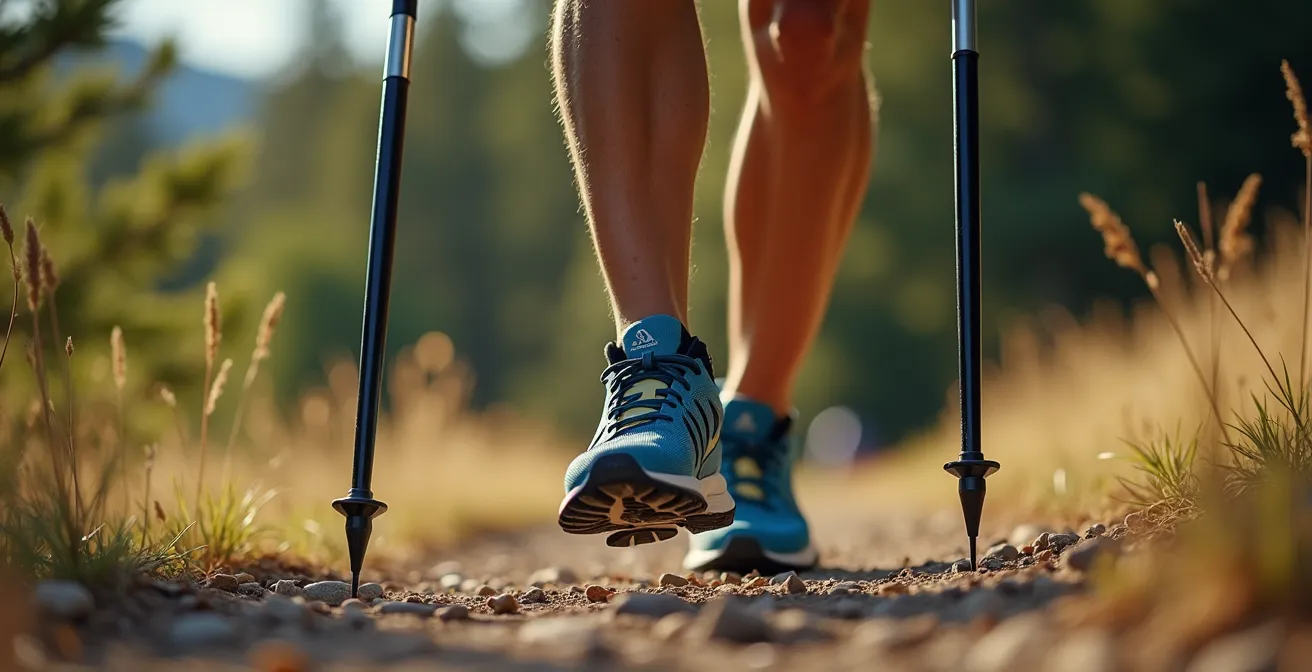
This increased caloric cost comes with an added benefit: it distributes the effort across your entire body. This can make the activity feel less strenuous on your legs, allowing you to maintain a brisk pace for longer periods or tackle inclines with greater ease. The poles also provide additional stability and reduce the impact on your knees and hips, making it an excellent option for individuals with joint sensitivities.
By simply adding poles to your walk, you elevate a simple LISS activity into a highly efficient, full-body conditioning session, perfectly aligning with the goal of achieving maximum results in minimum time.
Key Takeaways
- The optimal cardio choice (HIIT vs. LISS) is not fixed; it should be determined daily by your body’s readiness, measured by biofeedback like HRV.
- On low-energy or high-stress days, accumulating movement through NEAT and “exercise snacking” is a more productive strategy than forcing a high-intensity workout.
- Cardio is a tool for mental conditioning; using HIIT for controlled stress exposure can build resilience, while LISS can actively reduce anxiety.
Training for Mental Toughness: How Athletic Discipline Conquers Anxiety?
The benefits of cardiovascular training extend far beyond fat loss and heart health. For the busy professional dealing with constant pressure, exercise is a powerful tool for managing stress and building mental toughness. The physical stress induced by a workout, when controlled and structured, can inoculate your nervous system against the psychological stressors of daily life.
HIIT, in particular, can function as a form of controlled stress inoculation. During an intense interval, your body experiences symptoms that mimic an anxiety response: a racing heart, shortness of breath, and a surge of adrenaline. By voluntarily and repeatedly exposing yourself to these sensations in a safe and controlled environment, you teach your nervous system to differentiate between genuine threat and physical exertion. Clinical studies have shown that this process can be highly effective. For example, a structured protocol of just two 15-minute HIIT sessions per week has been shown to reduce anxiety symptoms by helping to desensitize the body’s panic response.
Conversely, LISS and Zone 2 cardio serve a different but equally important role in mental health. These lower-intensity activities activate the parasympathetic nervous system, our “rest and digest” state. A 30-minute steady-state walk or swim can actively lower cortisol levels, reduce feelings of being overwhelmed, and promote mental clarity. The choice of protocol can therefore be tailored to your immediate mental state, not just your physical goals.
The following table provides a practical guide for pairing a training protocol with your mental state to achieve the desired psychological benefit.
| Mental State | Recommended Protocol | Duration | Expected Benefit |
|---|---|---|---|
| Anxious/Overwhelmed | LISS (walking, swimming) | 30-45 min | Parasympathetic activation, cortisol reduction |
| Sluggish/Unmotivated | Short HIIT | 10-15 min | Endorphin boost, dopamine release |
| Stressed/Tense | Zone 2 cardio | 20-30 min | Mental clarity, tension release |
| Restless/Agitated | Moderate intervals | 20-25 min | Energy regulation, mood stabilization |
By viewing your training through this lens, every session becomes an opportunity not only to improve your physical fitness but also to fortify your mind against the challenges of a high-pressure life.