
Installing solar on an aging roof is less about a single “go/no-go” decision and more about strategic sequencing to maximize long-term financial and ecological value.
- Prematurely replacing a functional roof solely for solar can generate a massive hidden carbon cost, undermining the environmental benefits.
- Phasing upgrades—structural reinforcement, insulation, heat pumps, and finally solar—aligns with your roof’s natural lifecycle and your budget, creating a more robust and efficient system.
Recommendation: Your first step is not calling a solar installer, but commissioning a structural assessment and analyzing your home’s hourly energy consumption to create a data-driven plan.
As a homeowner, the push to “go green” with solar energy is compelling. Yet, for those of us with roofs that have seen more than a few seasons, a critical question injects a dose of financial anxiety: is it truly worth installing solar panels on an older structure? The common wisdom often presents a stark, expensive binary: replace the entire roof first, or forget about solar. This advice, while safe, overlooks a more nuanced and financially sound reality. It treats the house as a static object rather than a dynamic system where energy efficiency, structural integrity, and financial payback are deeply interconnected.
This all-or-nothing approach often leads to analysis paralysis or a massive, premature investment that isn’t always necessary. The real challenge isn’t just the age of your shingles, but understanding the total structural load budget of your home, the embodied carbon of your decisions, and the proper sequence of energy upgrades. What if the most effective strategy wasn’t a single, monolithic project, but a carefully phased retrofit? What if improving insulation or installing a heat pump *before* the solar array could lead to a smaller, cheaper, and more efficient system in the long run?
This analysis moves beyond the simplistic “replace your roof” mantra. We will act as your technical and financial consultant, dissecting the true payback period when structural costs are factored in. We will explore how to manage the added weight of battery systems, the real-world challenges of going off-grid, and the often-invisible digital footprint of your new energy system. By the end, you will have a strategic framework to decide not just *if* you should install solar, but *how* and *when* to do so for maximum financial return and environmental benefit.
To navigate this complex decision, this guide is structured to address each critical component of a successful solar integration on an existing property. We will break down the financial calculations, technical choices, and long-term strategic considerations step-by-step.
Summary: Home Solar Integration on an Older Roof
- The Payback Period: How Long Until Your Solar Panels Actually Save Money?
- Tesla Powerwall vs. Generac: Do You Need a Battery If You Have Net Metering?
- Grid-Tied vs. Off-Grid: Why Going Completely Off-Grid Is Harder Than You Think?
- Cleaning Solar Panels: Does Dust Really Reduce Efficiency by 20%?
- Smart Meters: How Real-Time Data Changes Your Consumption Habits?
- Heat Pumps: Are They Viable in Very Cold Climates for Cost Savings?
- The Privacy Error That Leaves 60% of Smart Homes Vulnerable to Hacks
- Digital Ecology: How to Reduce Your Invisible Carbon Footprint Online?
The Payback Period: How Long Until Your Solar Panels Actually Save Money?
The concept of the solar payback period is the most cited financial metric, yet it’s often dangerously oversimplified. While marketplace data indicates the average homeowner breaks even in about 10.5 years, this figure assumes a “solar-ready” roof. For a homeowner with an aging roof, this number is the beginning, not the end, of the calculation. The true payback period must account for the potential, and often substantial, cost of roof replacement or reinforcement. Ignoring this is the single biggest financial mistake a prospective solar owner can make.
A typical asphalt shingle roof has a lifespan of 20-25 years. Solar panels, conversely, are often warrantied for 25 to 30 years. This mismatch is where the financial risk lies. Installing a 30-year asset on a 15-year-old roof means you will almost certainly have to pay to remove the panels, replace the roof, and then reinstall the panels mid-lifecycle—a process that can cost thousands and significantly extend your payback period. In Maryland, for instance, a residential solar system might have an average payback of just 12 years and an average ROI of 8.18% under ideal conditions. Factoring in a mid-cycle roof replacement can slash that ROI dramatically.
A candid financial analysis requires a scenario-based approach directly tied to your roof’s age and condition. The decision is not simply “replace or not,” but “when and at what cost.”
This following breakdown provides a more realistic financial framework for homeowners with older roofs, factoring in the inevitable costs associated with roof age.
| Roof Age | Recommended Action | Additional Cost Impact |
|---|---|---|
| 0-5 years | Install solar directly | No additional costs |
| 5-10 years | Roof inspection required | Potential future removal/reinstall: $5,000 |
| 10-15 years | Strong consideration for roof replacement | Panel removal/reinstall: $255-275 per panel |
| 15+ years | Replace roof before solar | Combined project may qualify for bundled savings |
Ultimately, the payback period is a dynamic calculation. It must be viewed through the lens of your roof’s entire lifecycle, not just the solar installation itself. A slightly longer payback period that includes a new roof from day one is often superior to a shorter, “best-case” scenario that ignores a multi-thousand-dollar surprise a decade down the line.
Tesla Powerwall vs. Generac: Do You Need a Battery If You Have Net Metering?
The decision to add a battery system like a Tesla Powerwall or Generac PWRcell introduces another layer of complexity, particularly concerning your roof’s structural integrity. A battery isn’t just an electrical component; it’s a significant physical weight. For older homes, the question shifts from “which battery is better?” to “what is my roof’s structural load budget?” Each Powerwall unit adds hundreds of pounds of static load, which must be supported by your home’s framing. Before comparing models, a structural engineer must verify that your joists and rafters can handle this added, permanent stress.
Even with a robust net metering policy that credits you for excess energy sent to the grid, a battery offers two things net metering cannot: resilience during outages and the ability to arbitrage time-of-use (TOU) electricity rates. If your utility has high peak-hour charges, a battery allows you to store cheap solar energy during the day and use it during expensive evening hours, accelerating your ROI. However, this financial benefit must be weighed against the battery’s cost and, critically, its physical impact.

As the image highlights, the stress on structural components is real. The choice between a modular system like Generac’s, which allows you to start small and add capacity later, and a fixed-capacity unit like Tesla’s, can be a strategic one. Starting with a smaller battery bank reduces both the initial financial outlay and the immediate structural load. From a technical standpoint, while both are leading solutions, they have key differences in power output, efficiency, and scalability that cater to different household needs.
This comparison shows the technical trade-offs between two of the most popular home energy storage solutions on the market.
| Feature | Tesla Powerwall 3 | Generac PWRcell |
|---|---|---|
| Capacity | 13.5 kWh per unit | 9-36 kWh (modular) |
| Continuous Power | 11.5 kW | 7.6 kW |
| Peak Power | 15 kW | 9.0 kW |
| Round-Trip Efficiency | 97.5% | 96.5% |
| Depth of Discharge | 100% | 84% |
| Warranty | 10 years | 10 years |
For an older home, the “best” battery may be the one that provides sufficient backup for critical loads without requiring a prohibitively expensive structural overhaul. The modularity of the Generac PWRcell can be a significant advantage, allowing for a phased approach that aligns with your budget and your roof’s capacity.
Grid-Tied vs. Off-Grid: Why Going Completely Off-Grid Is Harder Than You Think?
The romantic notion of “going off-grid” and achieving complete energy independence is a powerful motivator for many considering solar. However, for a homeowner with an older, likely less-insulated property, this dream is often a practical and financial nightmare. The reality is that severing ties with the utility requires a system that is not only robust but massively oversized to handle the least sunny, coldest days of the year. This has profound implications for both cost and structural load.
An older home is typically less energy-efficient. It has air leaks, older windows, and less effective insulation. This means its baseline energy consumption, especially for heating and cooling, is significantly higher. To go off-grid, you must size your solar array and battery bank for your absolute worst-case scenario—a string of cloudy winter days. Industry analysis shows that older, less-insulated homes typically require a 40-50% larger system to achieve the same level of energy security as a modern, efficient home. This directly translates to more panels on your roof, more weight, more structural stress, and a much higher upfront cost.
A more pragmatic and financially viable path is a progressive independence strategy. This involves installing a grid-tied system with battery backup and gradually reducing your reliance on the grid over time. This approach allows you to maintain the grid as an affordable “backup battery” for extreme weather events while operating independently 80-90% of the time. It avoids the massive capital expenditure and structural risk of a fully off-grid system, providing a more balanced and achievable form of energy resilience.
Your Action Plan: A Progressive Off-Grid Strategy
- Install a grid-tied solar system with the capability for future battery backup.
- Begin by adding a small battery storage system sized for critical loads only (e.g., refrigerator, internet, essential lighting).
- Implement smart load management, using your system’s monitoring to shift heavy energy use to peak sun hours.
- Gradually increase your battery capacity over several years, based on analysis of your actual usage patterns and decreasing costs.
- Maintain your grid connection for emergency backup, enjoying near-total independence without the extreme cost and risk of a 100% off-grid setup.
For the vast majority of homeowners, especially those with older properties, the grid is not an enemy to be defeated but a tool to be leveraged. True energy strategy isn’t about absolute independence; it’s about optimal resilience, and that almost always means staying connected.
Cleaning Solar Panels: Does Dust Really Reduce Efficiency by 20%?
The question of solar panel maintenance, specifically cleaning, becomes more critical when dealing with an older, potentially more fragile roof. While claims of efficiency loss often get exaggerated in marketing materials, the impact of soiling—the accumulation of dust, pollen, bird droppings, and grime—is a real and measurable factor that can erode your financial returns. The oft-quoted figure of 20-25% loss is typically an extreme case found in very dusty, arid regions with infrequent rain. However, ignoring cleaning entirely is a mistake.
According to the National Renewable Energy Laboratory (NREL), soiling accounts for a more modest but still significant loss, potentially as much as 7% of annual energy production in parts of the United States. For a standard residential system, this could equate to hundreds of dollars in lost savings over a year. The problem is amplified in regions with long dry spells. Experts at MIT have suggested that even a tiny 1% reduction in power from a large-scale 150 MW solar project could cause $200,000 in lost revenue annually, illustrating how small percentages add up.
For a homeowner with an older roof, the key challenge is safety. Walking on aging shingles to clean panels is a recipe for disaster, risking damage to the roof and personal injury. The solution lies in professional cleaning methods that avoid direct roof contact.
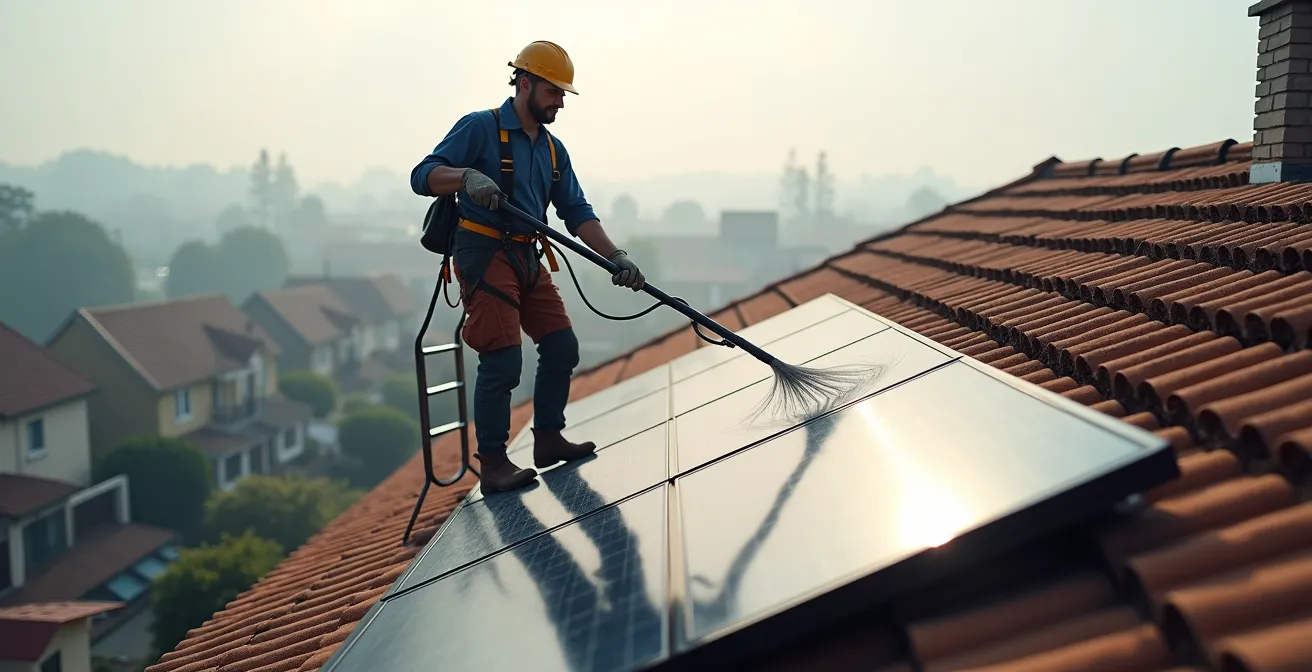
As shown, professionals use telescoping, water-fed pole systems to clean panels safely from a ladder or the edge of the roof. This eliminates foot traffic on the roof surface, protecting its integrity. For a DIY approach, a similar system can be purchased, but it’s essential to follow strict safety protocols. The frequency of cleaning depends on your local environment. A visual inspection after a long dry period or in a high-pollen season is the best guide. If a noticeable film of grime is visible, a cleaning is likely to be cost-effective.
Think of panel cleaning not as a constant chore, but as a strategic tune-up. A simple cleaning once or twice a year, performed safely, can be one of the easiest ways to protect your investment and ensure you’re generating every possible kilowatt-hour of free energy.
Smart Meters: How Real-Time Data Changes Your Consumption Habits?
The smart meter installed by your utility is one of the most powerful—and most underutilized—tools in your solar planning arsenal. It is far more than a simple billing device. For the homeowner planning a phased energy retrofit, the granular, real-time data it provides is the foundation for every decision. Without this data, you are essentially guessing at the right size for your solar array, your battery bank, and even your heat pump. This is a recipe for overspending and inefficiency.
A traditional monthly electric bill is a blunt instrument; it tells you *what* you used in total, but not *when* or *how*. A smart meter, by contrast, typically records your consumption in 15-minute or hourly intervals. By downloading a year’s worth of this data from your utility’s online portal, you can build a precise energy consumption profile for your home. This profile reveals critical patterns: your morning and evening peaks, your baseline “always-on” load, and the dramatic seasonal swings in heating and cooling demand.
This data-driven approach transforms your planning from guesswork to engineering. Instead of using a generic online calculator, you can model exactly how a 5 kW versus an 8 kW solar system would perform against your *actual* historical usage. You can see precisely how much energy a battery would need to store to cover your evening peak from 7 PM to 10 PM. This allows you to right-size every component of your system. You might discover that your winter heating demand is so high that a larger solar array is needed, or conversely, that your consumption is modest enough to allow for a smaller, less expensive system.
Before you get a single quote from a solar installer, your first action should be to become an expert on your own energy habits. Spending a weekend analyzing your smart meter data can save you thousands of dollars by preventing you from buying a system that is either too big for your needs or too small to make a meaningful difference.
Heat Pumps: Are They Viable in Very Cold Climates for Cost Savings?
Integrating a heat pump into your home’s energy system is a strategic move that can significantly alter your solar calculations, especially in colder climates. Modern cold-climate heat pumps are remarkably efficient, but they are electricity-intensive appliances. Adding one can easily double your home’s electrical load, which means you’ll need a larger solar array to offset that consumption. This again brings us back to the central issue for an older home: structural capacity and project sequencing.
The common mistake is to install solar first and then add a heat pump later, only to find the solar array is now undersized. A strategic consultant would advise the opposite. By making your home more efficient *first*—upgrading insulation and then installing a heat pump—you can accurately measure your new, higher electrical demand *before* sizing your solar system. This ensures the solar array is right-sized from day one. A combined project of a new roof and solar can cost upwards of $40,000, and adding a heat pump further increases this investment, making correct sequencing paramount.
This phased approach allows you to spread the financial burden over several years while making logical, sequential improvements to your home’s overall energy performance. Each step builds on the last, leading to a fully optimized system.
The timeline below illustrates a logical, phased investment strategy that maximizes benefits while managing cash flow and ensuring each component is correctly sized.
| Phase | Timeline | Investment | Key Benefit |
|---|---|---|---|
| Roof Replacement | Year 1 | $8,000-15,000 | Solar-ready structure |
| Insulation Upgrade | Year 1-2 | $3,000-5,000 | Reduced heating/cooling load |
| Heat Pump Install | Year 2 | $5,000-8,000 | Efficient heating/cooling |
| Solar Panel System | Year 3 | $15,000-25,000 | Energy independence |
By viewing the heat pump not as an isolated appliance but as a key component in a larger energy ecosystem, you can create a far more resilient and cost-effective home. The goal is a synergistic system where each part supports the others, and that starts with proper planning and sequencing.
The Privacy Error That Leaves 60% of Smart Homes Vulnerable to Hacks
When integrating a solar system, the focus is almost entirely on the physical and financial aspects. However, every modern solar inverter is a connected, “smart” device—an endpoint on your home network that creates a new and often overlooked digital vulnerability. The data stream from your solar system is not just about kilowatt-hours; it contains sensitive information about your lifestyle that can be exploited if not properly secured.
Your solar production data creates a clear picture of your home’s occupancy patterns. A sharp drop in energy use during the day combined with high solar production indicates you’re at work. A week of minimal, flatline consumption is a clear signal that you’re on vacation. In the hands of a malicious actor, this information is a goldmine. This is not theoretical; smart home devices are notoriously insecure, and your solar inverter should be treated with the same level of cybersecurity scrutiny as your security cameras or smart locks.
As one cybersecurity expert noted in a 2024 analysis of smart home security:
Solar production data reveals occupancy patterns—when you’re home, on vacation. This data stream requires the same security protocols as any smart home device to prevent exploitation.
– Cybersecurity Expert, Smart Home Security Analysis 2024
Securing this digital footprint is not complicated, but it does require proactive steps. First and foremost, you must change the default password on your inverter’s monitoring portal and enable two-factor authentication (2FA). This single step is the most effective defense against unauthorized access. Additionally, consider creating a separate, isolated network (VLAN) for your IoT devices, including your solar equipment, to prevent a breach in one device from compromising your entire network. Regularly updating your inverter’s firmware is also crucial, as these updates often contain critical security patches.
Your energy independence should not come at the cost of your digital privacy. Treating your solar system as a critical piece of your network infrastructure from day one is essential to enjoying its benefits without opening your home to new risks.
Key takeaways
- Strategic sequencing of home upgrades (roof, insulation, solar) is more financially and ecologically sound than a single, massive project.
- Your roof’s structural capacity and your home’s granular energy data are the two most critical factors in planning a solar installation.
- The “greenest” choice involves minimizing embodied carbon, which often means waiting to install solar until your roof’s natural replacement cycle.
Digital Ecology: How to Reduce Your Invisible Carbon Footprint Online?
The ultimate goal of installing solar is to reduce your carbon footprint. Yet, a narrow focus on energy generation can ironically lead to decisions that have a massive, negative environmental impact. The concept of digital ecology extends to the physical world through the principle of embodied carbon—the total greenhouse gas emissions generated to produce a material. When you prematurely tear off a functional roof to install solar panels, you are throwing away an asset with significant embodied carbon and generating a huge new carbon footprint in the process.
Lifecycle analysis shows that prematurely replacing a functional roof generates 15-20 tons of CO2 from manufacturing the new materials, transporting them, and disposing of the old ones. This upfront carbon “debt” can take years of clean energy production to “pay back,” undermining the entire environmental premise of the project. A truly holistic ecological approach considers the entire lifecycle of all materials involved.
Environmental analysis confirms this. One study on the total carbon footprint of solar installation timing revealed that waiting to install panels until a roof’s natural end-of-life can reduce the total project carbon footprint by 30-40% compared to a premature replacement. This strategy might only delay the solar savings by a few years but results in a vastly superior overall environmental outcome. This aligns perfectly with the phased retrofit strategy: use the remaining years of your current roof’s life to improve insulation and analyze energy data, so when the time for a new roof comes, you are ready to execute a perfectly sized and maximally efficient solar installation.
The most sophisticated energy strategy, therefore, is one of patience. It involves aligning your solar ambitions with the natural lifecycle of your home. Before you commit to a project that could have an enormous hidden carbon cost, your first step should be a thorough structural and energy audit to build a data-driven, long-term plan that is as kind to your wallet as it is to the planet.