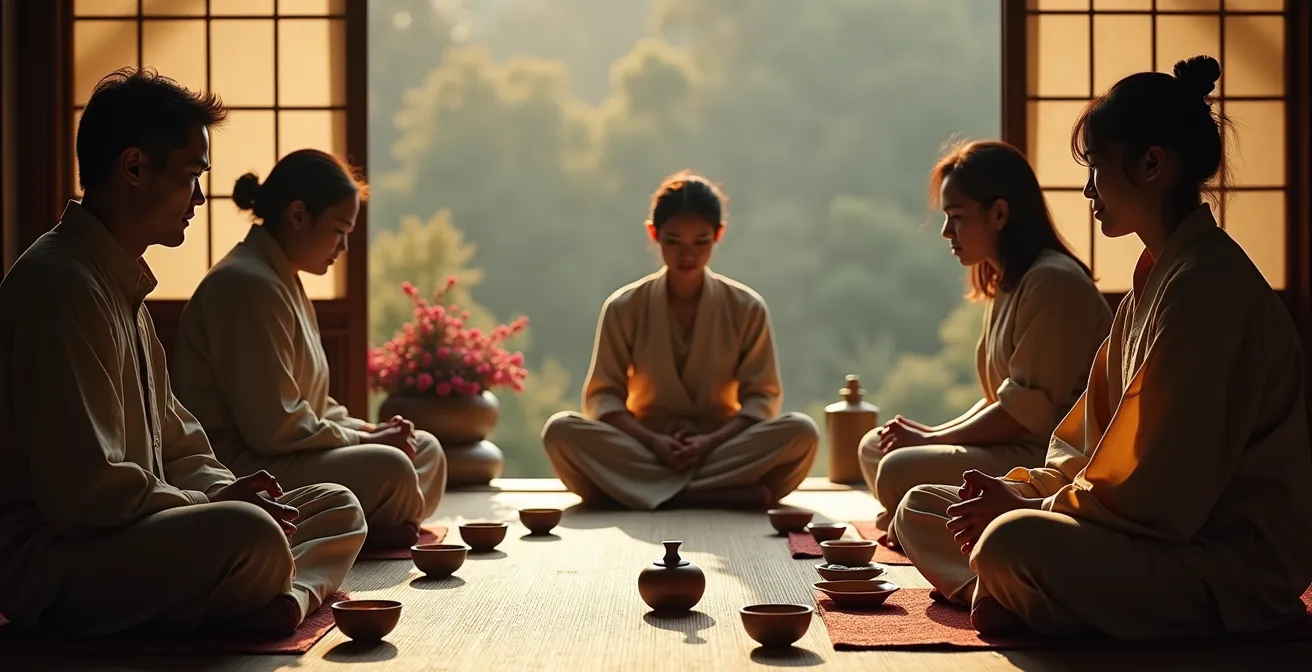
Contrary to popular belief, respectful travel isn’t about memorizing a list of rules, but about a fundamental shift from a passive “tourist gaze” to an active participant’s mindset.
- Authenticity is born from understanding the “why” behind a custom, not just obeying the “what.”
- Genuine connection is a form of reciprocity that often transcends monetary exchange.
- Your role is not to consume a culture, but to humbly engage with it as a shared human experience.
Recommendation: Before your next trip, ask yourself not “What do I want to see?” but “How can I participate respectfully and what can I learn?” This simple question changes everything.
The desire to travel authentically runs deep. We yearn to move beyond the polished facade of tourist traps and connect with the real, living pulse of a place. Yet, this desire is often shadowed by a profound fear: the fear of being an intruder. We hold our cameras, hesitant, wondering if we are capturing a moment or stealing it. We accept a cup of tea from a local family, worrying if our presence is a welcome curiosity or an unspoken burden. This tension between a desire for connection and the fear of being a voyeur is the central challenge of modern, conscientious travel.
Many guides offer well-meaning checklists: cover your shoulders, learn to say “thank you,” ask before taking photos. While these actions are important, they are merely the surface. They treat culture as a set of rules to be followed rather than a complex web of meanings to be understood. This approach can inadvertently reinforce the very distance we seek to overcome, turning us into polite observers rather than genuine participants. It addresses the symptoms of disrespectful travel but fails to diagnose the root cause: the mindset of a consumer, a spectator behind a velvet rope.
But what if the key wasn’t in a longer checklist of dos and don’ts? What if the secret to authentic experience lies in a profound internal shift? This guide is built on that premise. We will explore how to move beyond the “tourist gaze” and adopt the perspective of a cultural anthropologist: one of deep respect, nuanced understanding, and, most importantly, cultural humility. It’s not about becoming an expert overnight, but about learning to ask better questions, listen more deeply, and recognize that the most valuable exchanges are often intangible.
This article will guide you through the nuanced situations where good intentions can go wrong. We will deconstruct common travel behaviors and rebuild them on a foundation of respect and understanding. From the ethics of photography to the subtleties of gratitude, you will learn the principles that transform a trip from a series of sights into a story of connection.
Summary: A Traveler’s Guide to Authentic Cultural Engagement
- Why Taking Photos of Rituals Can Be Offensive even if Not Forbidden?
- How to Accept Hospitality Without Imposing a Financial Burden on Hosts?
- Covering Shoulders and Knees: Why It Matters Even for Men?
- The 5 Phrases That Unlock Genuine Smiles in Any Culture
- When Tipping Is Insulting: Understanding Local Gratitude Customs
- The Bucket List Trap: Visiting for the Photo vs Visiting for the History
- Feeding Animals: The “Kind” Gesture That Sentences Them to Death
- Does UNESCO Status Actually Improve the Visitor Experience at Major Sites?
Why Taking Photos of Rituals Can Be Offensive even if Not Forbidden?
The camera is the modern traveler’s most common tool, but it can also be the most significant barrier to authentic connection. The act of taking a photograph instantly creates a dynamic of observer and observed, reinforcing the “tourist gaze.” This is especially sensitive during rituals. While a public festival may feel like a spectacle, for the community, it is a moment of spiritual significance, not a performance. The key is to distinguish between what is staged (a cultural show for visitors) and what is sacred (an authentic practice for the community). Pointing a lens at a sacred moment, even without a prohibitive sign, can feel like an act of consumption, reducing a profound experience to a visual commodity.
Some cultures hold beliefs that a photograph captures a part of the soul or spiritual energy, making your snapshot a deeply personal intrusion. Even where such beliefs don’t exist, the relentless clicking of shutters can disrupt the solemnity and focus required for a ritual. It shifts the energy from communal participation to self-conscious performance. The most respectful approach is to put the camera away first. Be present. Witness the moment with your own eyes, not through a viewfinder. If you feel a photograph is appropriate, always ask permission, but be prepared for a “no” and accept it with grace. True authenticity is found in participation, not documentation, and cultural tourism experts note that 9 out of 10 cultural experiences feel authentic when hosts can share the origins and responsibilities behind their traditions, something a camera lens cannot capture.
Before raising your camera, consider these guidelines:
- Ask Permission, Always: This applies especially to photographing people, whether in religious or private settings. A nod and a smile are not consent.
- Observe and Differentiate: Is this a performance staged for tourists, or an authentic cultural practice happening for its own sake? Your behavior should change accordingly.
- Prioritize Witnessing: Your primary goal should be to understand and experience, not to document. The memory you hold will be more valuable than the photo you take.
- Dress and Act Accordingly: Adhere to the dress code of sacred sites and maintain silence. Your presence should be one of reverence.
Ultimately, the best photograph is the one you don’t take. It’s the moment you choose to be fully present, creating a memory that is etched in your mind rather than on a memory card.
How to Accept Hospitality Without Imposing a Financial Burden on Hosts?
One of the most rewarding aspects of travel is experiencing local hospitality. An invitation into a home for a meal or tea is a golden opportunity for genuine connection. However, it can also be fraught with anxiety. How do you accept such generosity without making your hosts feel obligated or creating a financial strain? In many cultures, hospitality is a matter of honor, and refusing an offer can be more offensive than accepting it. The key is to shift your understanding of exchange from a purely monetary one to a model based on the reciprocity of dignity.
In this model, your gratitude is shown not with cash, which can feel transactional and even insulting, but with genuine interest and human connection. Your undivided attention is a valuable gift. Ask about their family, their stories, their daily life. This expresses that you value them as people, not just as service providers. This concept is being formalized in some areas through sustainable tourism. For example, in Nepal, a WWF-supported project helped a village establish a homestay business where income directly benefits the families, ensuring the exchange empowers the community while fostering deep connections between hosts and guests. The goal is to make the interaction feel like a mutual sharing of worlds, not a transaction.
Here are non-monetary ways to express profound gratitude:
- Share Your World: Offer your undivided attention, listen to their stories, and share your own. A small, thoughtful gift from your home country can also be a wonderful gesture of exchange.
- Offer Your Skills: If appropriate, help with daily chores, practice a language with their children, or share a skill you have. This contributes to the household in a meaningful way.
- Praise Them Publicly: After you leave, write a glowing online review that mentions your hosts by name. A boosted reputation can be more valuable than a one-time tip.
- Follow Up: Sending a postcard or a photo of your time together after you’ve returned home shows that the experience was memorable and that you value the connection you made.
By focusing on human connection, you honor their generosity in a way that money cannot. You leave them with the feeling of having made a new friend, which is a far richer reward than a few extra dollars.
Covering Shoulders and Knees: Why It Matters Even for Men?
The travel advice to “dress modestly” is common, but it’s often perceived as a rule primarily for women or a mere suggestion for hot climates. This misses the deeper cultural and spiritual significance. Covering shoulders and knees, for all genders, is not just about adhering to a dress code; it is a non-verbal signal of respect. In many cultures, particularly in and around religious sites, this standard of dress signifies a transition from the profane, everyday world to a sacred space. By covering up, you are acknowledging that you are a visitor in a place with values and norms that may differ from your own, and you are choosing to honor them.
For men, who may be accustomed to more relaxed dress codes in Western cultures, this can seem unnecessary. However, showing up to a temple, mosque, or monastery in shorts and a tank top can be interpreted as dismissive or ignorant. It communicates that you view their most sacred site as just another tourist attraction, equivalent to a beach or a bar. It’s an act of cultural humility to adapt your attire. This simple gesture demonstrates your awareness and respect, opening doors to more positive interactions with locals who will see you as a considerate guest rather than a thoughtless tourist. The act of dressing appropriately is the first step in shifting your mindset from observer to respectful participant.

This respect extends beyond just clothing. As the Quest.to-Travel Cultural Tourism Guide highlights, small physical gestures carry immense weight. They offer this simple but profound advice:
In Asian temples, slip off your shoes. It’s a sign of honor.
– Quest.to-Travel Cultural Tourism Guide, Cultural Tourism: Exploring the World Through Local Traditions
This single act, like covering your knees, is a powerful and silent acknowledgment of the sanctity of the space you are entering. It costs nothing but a moment of awareness and yields a great deal of goodwill.
Ultimately, dressing appropriately is not a restriction on your freedom but an expansion of your ability to connect. It is the passport to being welcomed not just into a building, but into a space of shared respect.
The 5 Phrases That Unlock Genuine Smiles in Any Culture
While learning “hello,” “please,” and “thank you” is a standard first step, moving beyond these basics is what transforms a transactional interaction into a human connection. The goal isn’t fluency; it’s the demonstration of effort. When you stumble through a new phrase, you are communicating something far more important than the words themselves: you are showing humility, curiosity, and respect. You are signaling that you see their culture as worthy of your time and effort. This simple act can instantly disarm and delight, breaking down the invisible wall between “tourist” and “local.”
The most effective phrases are often those that open a door for a shared moment of humanity. They are questions that show appreciation, or self-deprecating statements that invite a laugh. Instead of just stating your order, you’re inviting a small conversation. Travel experts often suggest that dedicating just 15 minutes a day to learning key phrases with a free app can lead to more meaningful daily conversations. The return on this small investment is immense, paying dividends in smiles, warmer welcomes, and a deeper sense of belonging.
To go beyond the basics, try mastering these types of phrases that build connection:
- “This is delicious! What is it called?” This shows genuine appreciation for their cuisine and invites them to share knowledge, turning a simple meal into a cultural lesson.
- “I am learning, can you help me say it correctly?” This phrase demonstrates profound humility. You are positioning them as the expert and yourself as the eager student.
- “Your village/town is beautiful.” A sincere, specific compliment about their home expresses admiration and shows you see the beauty beyond the main tourist sights.
- “My pronunciation is terrible, I’m sorry!” A little self-deprecating humor is a universal connector. It shows you don’t take yourself too seriously and makes you more approachable.
- The Compliment Sandwich: This is a powerful technique. Start with appreciation (“Your craftsmanship is amazing”), ask a curious question (“How long does it take to make one?”), and end with gratitude (“Thank you for sharing that with me”).
These phrases are more than just words; they are keys that unlock the potential for a genuine smile, a shared laugh, and a moment of connection that will likely become the most cherished memory of your trip.
When Tipping Is Insulting: Understanding Local Gratitude Customs
In many Western cultures, tipping is a standard, almost obligatory, way to show appreciation for good service. We often carry this habit abroad, believing it’s a universal sign of gratitude. However, this assumption can lead to awkwardness and even offense. In some cultures, a tip can imply that an employee’s salary is insufficient, questioning the employer’s integrity. In others, excellent service is considered a point of professional pride, and a monetary reward can cheapen the interaction, reducing a genuine effort to please into a mere transaction. Understanding when and how to show gratitude is a crucial aspect of cultural sensitivity.
The concept of “Baksheesh” in the Middle East, the all-inclusive service culture of Northern Europe, and the non-tipping customs of Japan all stem from different social contracts and views on labor. Forcing a Western tipping model onto these frameworks is a form of cultural imposition. The alternative is to learn the local “language” of gratitude. This might be a heartfelt verbal compliment delivered to the individual and their manager, a positive online review, a small, non-monetary gift, or simply a respectful bow. The goal is to support the entire local ecosystem in a way that aligns with their values. According to travel experts, supporting local businesses directly preserves cultural heritage and ensures tourism benefits the community, shifting the focus from individual tips to a more sustainable form of support for the entire professional environment.
The following table, based on insights from travel analysts, offers a starting point for understanding these diverse customs. It’s essential to research the specific country you’re visiting, but this provides a general framework.
| Region | Tipping Custom | Alternative Gratitude Method |
|---|---|---|
| Japan | Not customary – implies insufficient salary | Bow of appreciation, written thank you note |
| Northern Europe | Service included in price | Verbal thanks, online review mentioning staff |
| Southeast Asia | Varies by country | Small gift from home country |
| Middle East | Often expected | Generous verbal praise to manager |
These varying norms are highlighted in analyses of responsible tourism, which emphasize that true support comes from understanding and respecting local economic structures. As one analysis of responsible tourism practices points out, the best way to be a responsible tourist is to adapt to local norms rather than imposing your own.
By taking the time to understand and adapt to local customs of gratitude, you show a deeper level of respect that will be far more appreciated than an unthinking tip.
The Bucket List Trap: Visiting for the Photo vs Visiting for the History
In the age of social media, travel is often reduced to a “bucket list”—a checklist of iconic locations to be captured and shared. This mindset creates the “Bucket List Trap,” where the primary goal becomes getting the photo rather than understanding the place. We see it every day: hordes of visitors jostling for the perfect selfie spot, their backs turned to the very monument they traveled thousands ofmiles to see. This approach not only diminishes the personal experience, turning a potential journey into a mere transaction, but it also contributes to overtourism, which puts immense strain on fragile sites. Overtourism is a significant challenge, with iconic locations like Machu Picchu receiving 1.5 million people yearly, far exceeding its sustainable capacity and forcing authorities to implement strict daily entry caps.
Escaping this trap requires a conscious shift from a “checklist” to a “chapter” mindset. Instead of thinking “I need to check this off my list,” ask “What story does this place tell, and what is my role in it?” A chapter is immersive; it has context, depth, and personal meaning. It requires you to be present and engage. This means spending an hour before your visit reading personal accounts or historical narratives connected to the site. It means choosing an oral history tour over a simple walk-through. This shift in perspective transforms you from a passive consumer of scenery into an active participant in history.
The goal is to leave a place with a story to tell, not just a photo to post. It’s the difference between saying “I was here” and “I learned this.”
Action Plan: Audit Your Travel Mindset
- Pre-Visit Research: Before visiting a major site, list three things you want to learn about its history or the people who lived there. This sets an intention beyond just seeing it.
- Define Your “Why”: Articulate in one sentence why you want to visit a particular place. If the reason is “for the photo,” challenge yourself to find a deeper motivation.
- On-Site Observation: Once there, spend the first 15 minutes without your camera. Observe the details, the atmosphere, and how others interact with the space. Note the difference between reverence and consumption.
- Question Your Engagement: Review your planned activities. Are they passive (viewing) or active (learning, participating)? Look for opportunities to engage with interactive exhibits, local guides, or workshops.
- Post-Visit Reflection: After leaving, write down one surprising thing you learned. This helps solidify the experience as a “chapter” of learning rather than a checked-off item.
When you start writing chapters instead of checking boxes, your travels gain a richness and meaning that no “like” or “share” could ever provide.
Feeding Animals: The “Kind” Gesture That Sentences Them to Death
The impulse to connect with wildlife is a natural and often beautiful part of the travel experience. Offering a piece of your lunch to a curious monkey or a stray dog can feel like an act of kindness. Unfortunately, this well-intentioned gesture can be a death sentence. Wild animals have specialized diets, and human food can cause serious health problems. More dangerously, feeding wildlife creates dependency. It teaches them to associate humans with food, leading them to become aggressive or lose their natural foraging skills. An animal that loses its fear of humans is often considered a “nuisance” and may be culled by authorities to protect the public.
Furthermore, the high tourist demand for close-up animal encounters has fueled an industry of exploitation. As highlighted by responsible travel advocates, the popularity of experiences like swimming with pigs or riding elephants creates a consumer-driven demand that can lead to unethical practices. An analysis of the impact of consumer demand shows that what seems like a harmless tourist activity can be the visible tip of an industry that mistreats animals behind the scenes. Your ticket purchase can inadvertently support businesses that capture animals from the wild, subject them to cruel training methods, or keep them in inadequate conditions, all for the sake of a photo opportunity.
True kindness towards animals is expressed through respect for their wildness, not through forced interaction. The most ethical way to appreciate wildlife is from a distance, in their natural habitat, without interfering. Supporting legitimate conservation efforts and choosing genuinely ethical sanctuaries that prioritize animal welfare over visitor entertainment are the most responsible ways to engage.
- Maintain a Respectful Distance: Use binoculars or a zoom lens. Never crowd or chase an animal for a better view.
- Never Feed Wildlife: Their survival depends on their ability to find their own food. Do not interfere with this natural process.
- Research Extensively: Before visiting any animal sanctuary or park, thoroughly investigate their practices. Look for certifications from reputable animal welfare organizations.
- Follow “Leave No Trace”: This principle is paramount. Leave natural environments exactly as you found them to protect habitats.
The greatest gift you can give a wild animal is the freedom to remain wild. Observe, appreciate, and then walk away, leaving them undisturbed.
Key takeaways
- Authentic travel demands a mindset of cultural humility, shifting from a “what can I get” to a “what can I learn” perspective.
- Respect is communicated through actions that go beyond a checklist, such as understanding the reasons behind dress codes and local customs of gratitude.
- The most powerful connections are built on non-monetary exchanges: genuine interest, shared stories, and demonstrated effort to learn and adapt.
Does UNESCO Status Actually Improve the Visitor Experience at Major Sites?
A UNESCO World Heritage designation is often seen as a seal of quality, a guarantee of a site’s outstanding universal value. For many travelers, it’s a key factor in planning an itinerary. However, this prestigious label can be a double-edged sword. While it brings attention and resources for preservation, it also dramatically increases tourist numbers, often leading to the very overtourism that can degrade both the site and the visitor experience. The case of Venice is a stark example, where an analysis shows that around 5.7 million tourists visited in 2023, overwhelming a resident population of only about 250,000 and turning the city’s living culture into a museum piece.
The UNESCO stamp doesn’t automatically create a better experience; in fact, it can lead to long lines, crowded viewpoints, and a sense that you are on a tourist conveyor belt. The responsibility for a quality experience, therefore, falls back on both the site managers and the visitors themselves. Progressive management strategies are emerging as a response. These include implementing strict visitor caps, promoting a “second city” approach to divert tourists to lesser-known but equally valuable sites, and integrating community ownership models to ensure economic benefits stay local. These strategies aim to balance preservation with accessibility.
As a traveler, you have the power to improve your own experience and lessen your impact. This means actively seeking out these “second cities” or visiting major sites during the off-season. It means engaging with community-based tourism initiatives that offer a more intimate and authentic perspective. The UNESCO label is a starting point for your research, not the final word. It tells you a place is significant, but it’s up to you to find a significant way to visit it.
| Strategy | Implementation | Impact |
|---|---|---|
| Visitor Caps | Peru limits Machu Picchu to 2,500 daily | Site preservation improved |
| Second City Approach | Promote lesser-known UNESCO sites | Better visitor experience, less crowding |
| Community Integration | Local ownership models | Economic benefits stay local |
| Green Tourism Practices | Low-impact stays, walking/biking | Reduced environmental damage |
Your next journey is an opportunity. Instead of just seeing the world, choose to understand it. Start planning your travels not as a checklist of sights, but as a series of chapters in your own story of connection, whether the site has a famous label or not.