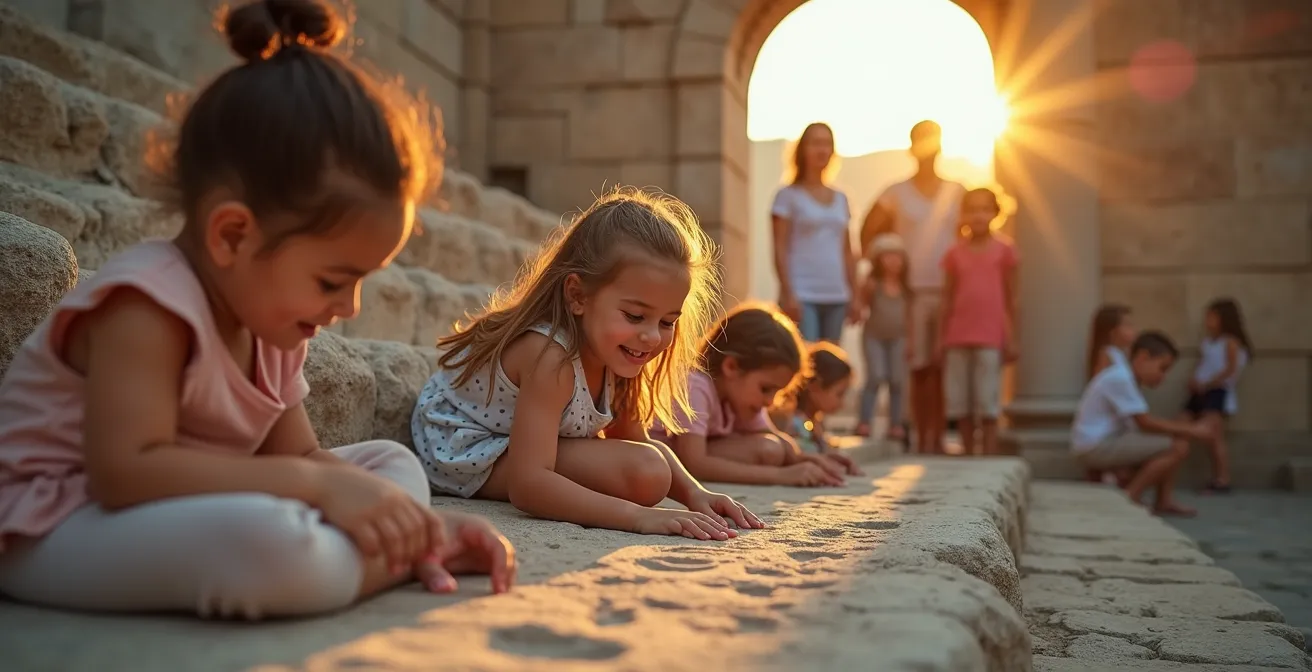
In summary:
- The dread of visiting historical sites with kids stems from making them passive spectators; the solution is to make them active ‘history detectives’.
- Swap passive tools like audio guides for active games like ‘I Spy’ to engage a child’s natural curiosity and observation skills.
- Prepare children before the trip with books and maps to build ‘imaginative scaffolding,’ giving them a mental framework to connect with the physical site.
- Focus on sensory engagement—sketching, texture hunting, and role-play—over simply looking at things.
The thought of dragging a seven-year-old through the Roman Forum or the Acropolis can fill any parent with a unique sense of dread. You picture the glazed-over eyes, the constant “I’m bored,” and the inevitable meltdown next to a 2,000-year-old column. The common advice is to “make it fun” or “tell them stories,” but these well-meaning tips often fall flat because they miss a fundamental truth about how children experience the world. We try to pour facts into their heads when they are desperate to use their hands, eyes, and imaginations.
The challenge isn’t that history is boring; it’s that we present it in a boring way. We hand them an audio guide, a tool designed for adult learning, and expect them to be fascinated. But what if the secret wasn’t about giving them more information, but about giving them a better mission? What if, instead of being a passive tourist, your child could become an active ‘history detective,’ equipped with the tools to solve the mysteries of the past themselves? This shift in perspective is the key to transforming a dreaded family outing into a genuine adventure.
This guide moves beyond generic advice to give you a concrete playbook. We’ll explore why simple games trump high-tech guides, how to talk about the “gory details” without causing nightmares, and how to use sketchbooks as investigative tools. By the end, you’ll have a new framework for turning any historical site into a playground for your child’s curiosity.
To help you navigate these strategies, this article breaks down the essential techniques for transforming your little tourist into an eager explorer. The following sections offer a clear roadmap, from pre-trip preparation to on-site tactics that really work.
Table of Contents: A Parent’s Playbook for Exploring Ancient Sites with Kids
- Why “I Spy” Games Work Better Than Audio Guides for Kids?
- How to Tell the “Gory Details” Without Giving Nightmares?
- Movies or Books: Which Medium Primes Curiosity Best Before a Trip?
- The “Museum Fatigue” Wall: Recognizing When to Stop for Gelato
- Sketchbooks vs. Plastic Swords: Encouraging Active Observation
- Active vs. Passive: Do Students Learn More in VR History Lessons?
- How to Beat the Bus Tours at Popular Heritage Sites?
- Does UNESCO Status Actually Improve the Visitor Experience at Major Sites?
Why “I Spy” Games Work Better Than Audio Guides for Kids?
The standard-issue museum audio guide is a parent’s hopeful crutch, but for a child under ten, it’s often a one-way ticket to zoning out. The reason is simple: it demands passive listening, a skill most adults struggle with, let alone an energetic child. An audio guide turns a vibrant, three-dimensional space into a flat lecture, disconnecting the child from their immediate, sensory environment. They are told what to see instead of being empowered to discover it for themselves. This is where the profound power of a simple “I Spy” game comes into play.
An “I Spy” game, or any scavenger hunt, flips the script entirely. It gives the child a mission and a purpose. Their role instantly shifts from passive spectator to active ‘history detective.’ They are no longer being force-fed information; they are scanning, searching, and making connections. “I spy something round that a giant would have worn as a ring” (the Colosseum) or “I spy a face with a broken nose” (a weathered statue) focuses their attention on a specific, manageable task. This active seeking is neurologically more engaging than passive reception. It creates a small, satisfying “aha!” moment with every discovery, building a positive feedback loop of engagement.
This isn’t just theory. For example, a case study at the Roman Baths in the UK found that children participating in ‘finding’ activities showed far more sustained attention than those using audio guides. Parents reported that the game-like approach was the key to maintaining their child’s focus. The goal isn’t to trick them into learning; it’s to align with their natural cognitive state, which is one of curiosity-driven exploration, not quiet contemplation. The audio guide tells a story; the scavenger hunt invites them to find the clues to piece the story together themselves.
How to Tell the “Gory Details” Without Giving Nightmares?
Kids are magnetically drawn to the “gross” and “gory” parts of history—gladiators, battles, and mummification are far more interesting than tax codes. But there’s a fine line between fascinatingly macabre and genuinely terrifying. The key to navigating this is to reframe the narrative. Instead of focusing on the violence itself, you can present these events as historical problems that required solutions. This shifts the focus from passive horror to active problem-solving and empathy.
A great technique is to use abstract metaphors. A siege doesn’t have to be a gruesome, bloody affair. It can be explained “like a giant wave knocking down a sandcastle.” This communicates the scale and impact without the traumatic imagery. Similarly, you can shift the focus to the helpers and problem-solvers of the era. When discussing a battle, talk about the Roman doctors and their surprisingly advanced surgical tools. When talking about the plague, focus on the people trying to figure out how it spread. This teaches resilience and ingenuity, not just suffering.
This approach allows you to deliver the fascinating details your child craves in a way that empowers rather than frightens them. It’s about distinguishing between ‘gory’ (which is frightening) and ‘gross’ (which is fascinating). A skeleton is gross and interesting; a story about how the person died in agony is gory and scary. Pre-warning is also a powerful tool. A simple, “Okay, this next story is a little bit spooky, are you ready?” gives your child control and reduces the shock factor.
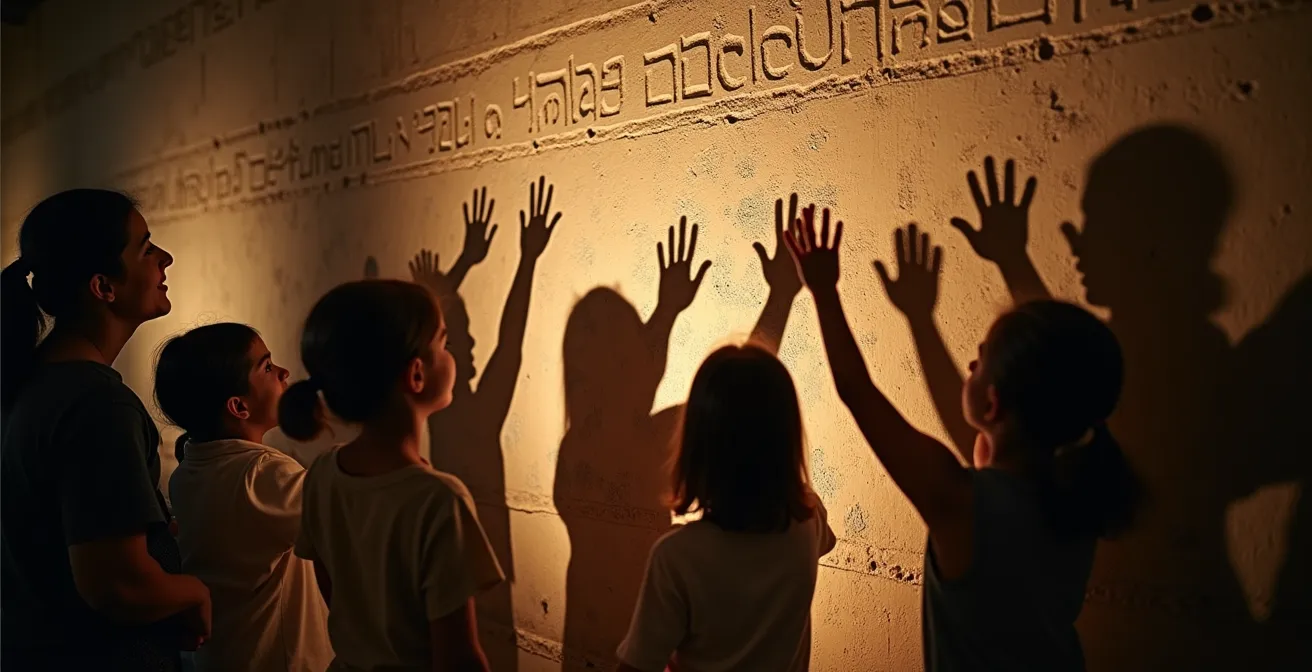
As this image suggests, storytelling is a physical act. Using your hands, your voice, and your environment to create safe, symbolic narratives can turn a potentially scary topic into a moment of captivated learning. The goal is to spark curiosity about the “how” and “why” of history, not just the shocking “what.”
Movies or Books: Which Medium Primes Curiosity Best Before a Trip?
Building excitement before you even leave home is one of the most effective ways to guarantee an engaged child at a historical site. The two most common tools for this are books and movies, but they serve very different cognitive purposes. Understanding how to use them in sequence can dramatically enhance your child’s experience. The consensus among educational psychologists is that you should always start with books and follow up with movies.
Books are powerful because they build what is known as ‘Imaginative Scaffolding.’ When a child reads a story about ancient Rome, their brain is forced to do the heavy lifting. They must construct the scenes, the characters, and the atmosphere in their own mind. This creative process forges a deep, personal connection to the material. A well-chosen historical fiction book or a compelling non-fiction DK Eyewitness guide gives them a mental framework to hang their experiences on once they arrive at the site.
Movies, on the other hand, provide what experts call ‘Visual Anchors,’ helping kids recognize real-world objects. After a child has built their own mental version of the Colosseum from a book, watching a movie like *Gladiator* (with judicious use of the fast-forward button!) provides powerful visual cues. When they finally stand in the real Colosseum, they can exclaim, “That’s where the emperor would have sat!” or “Look, that’s like the helmet we saw in the movie!” The movie doesn’t create the world for them; it populates the world they’ve already built in their imagination.
Using these tools in the wrong order can be counterproductive. Starting with a movie can set unrealistic expectations of constant action and can stifle a child’s own imaginative work. The following table from a resource on historical travel with kids breaks down the distinct advantages of each medium.
| Medium | Cognitive Impact | Best Use | Limitations |
|---|---|---|---|
| Books | Build imaginative scaffolding, self-paced emotional connection | Use first to let children construct their own mental images | Requires sustained attention span |
| Movies | Provide visual anchors for recognition at sites | Use after books to reinforce and compare mental images | Can create unrealistic excitement expectations |
| Maps/Floor Plans | Develop spatial reasoning and orientation | Essential for preventing overwhelm at large sites | Abstract for younger children |
The “Museum Fatigue” Wall: Recognizing When to Stop for Gelato
Every parent has seen it: the energetic, curious child who, after 45 minutes in a museum or at a ruin, suddenly transforms into a whiny, sluggish zombie. This is a real and documented phenomenon known as “museum fatigue.” It’s not just boredom; it’s a form of cognitive and physical exhaustion. Understanding its signs and respecting its power is the difference between a fond memory and a travel-day disaster. The most important rule is to quit while you’re ahead.
Museum fatigue happens because our capacity for directed attention is finite. As research on museum fatigue demonstrates, visitors naturally stop at fewer exhibits and spend less time observing as a visit progresses. For a child, whose attention reserves are smaller to begin with, this depletion happens much faster. The signs are subtle at first: they stop asking questions, their pace slows, or they start leaning against things. These are the yellow flags. The red flags—the whining, the flopping on the ground—mean you’ve already gone too far.
The solution is not to “push through.” The solution is a strategic retreat for gelato, a run around in a nearby piazza, or simply heading back to the hotel. It’s crucial to frame this not as a failure, but as part of the plan. Before you even enter the site, say, “We’re going to be history detectives for one hour, and then we’re going to celebrate our discoveries with the best gelato in Rome!” This gives them a clear, finite timeline and a reward to look forward to. It also preserves their positive association with the site, making them more willing to return another day.
One of the biggest mistakes families make is trying to “see it all.” A successful visit with a young child might mean exploring only one small part of a massive site like Pompeii. Choosing to see three things thoroughly and joyfully is infinitely better than rushing through twenty things miserably. Respect the fatigue wall, and make the gelato break a celebrated part of the historical discovery process.
Sketchbooks vs. Plastic Swords: Encouraging Active Observation
Once you’re at the site, your mission is to keep your ‘history detective’ engaged. This means providing them with the right tools for the job. While a plastic sword might seem like a frivolous toy, it can be a powerful tool for kinesthetic learning, helping a child understand scale and movement. A sketchbook, on the other hand, is a tool for deep, analytical observation. The secret is not to choose one over the other, but to understand that different tools facilitate different types of engagement.
A plastic sword or helmet is not just a prop; it’s a key to imaginative role-play. It allows a child to physically inhabit the space. Suddenly, they aren’t just looking at a column; they are a Roman legionary hiding behind it. This kinesthetic connection makes the abstract history tangible. The rule, however, should be: “You can only use the sword if you can tell me its story.” This links the prop directly to the narrative, preventing it from becoming a simple distraction.
A sketchbook works a different muscle. It forces a child to slow down and truly see. Instead of a passive glance, they are actively analyzing shapes, textures, and shadows. You can make this even more effective by giving them specific “sketching missions”: “Draw the oldest-looking stone you can find,” or “Sketch the shadow that this broken column is making.” This turns observation into a focused, creative task. A photo scavenger hunt (“Find something moss-covered”) serves a similar purpose, training their eye to look for details. A successful family visit to the Colosseum might involve combining these tools: sketchbooks for observing architectural details, swords for role-playing in the open spaces, and cameras for a detail-oriented scavenger hunt. This multi-tool approach caters to different learning styles and keeps the engagement fresh.
Your Pre-Trip Engagement Audit: Planning Your Detective Kit
- Points of contact: List all the ways your child will interact with the site (looking, listening, drawing, role-playing, walking).
- Collecte: Inventory the engagement tools you’ll bring (e.g., sketchbook, specific scavenger hunt list, a prop like a compass or map, a book for context).
- Cohérence: Check if your planned activities align with your child’s interests. If they love drawing, prioritize sketching missions. If they are physical, plan for role-play areas.
- Mémorabilité/émotion: Plan one “peak” moment. Will it be finding a specific carving from their book, or reaching the top of a viewpoint? Focus on creating one unforgettable memory.
- Plan d’intégration: Decide which tool to use where. “We’ll use the sketchbook in the quiet courtyard and the compass in the big open forum.”
Active vs. Passive: Do Students Learn More in VR History Lessons?
In our tech-saturated world, it’s tempting to see Virtual Reality (VR) as the ultimate solution for making history engaging. And while VR can offer breathtaking experiences, its most effective role isn’t as a substitute for a real visit, but as a powerful preparation tool. The key is understanding that, like movies, VR is best used as a “pre-enactment” tool, not a replacement for reality.
The true power of VR in a historical context is its ability to provide a complete 3D mental model before a trip. As one Educational Technology Research study highlights, VR’s greatest value is in allowing a child to mentally overlay the complete, vibrant structure onto the existing ruins they will see in person. Imagine your child “walking” through a fully rendered Roman Forum in VR a week before your trip to Rome. They can grasp the scale, understand the layout, and see the temples in their full glory. When they later stand among the actual, broken columns, their brain doesn’t see just a pile of rocks. It sees the ghost of the structure they’ve already explored. This connection is incredibly powerful.
However, an over-reliance on technology at the site itself can be counterproductive. It can pull a child out of the real, sensory environment—the feel of the sun on the stones, the sound of the wind, the sheer scale of the architecture—and back into a screen. The physical experience of being in a place, with all its textures and imperfections, is an irreplaceable part of learning. VR can build the scaffold, but the child needs to do the real construction on-site with their own senses.

Ultimately, nothing replaces the feeling of being small in a vast, ancient place. Technology can prime the pump of curiosity, but the most profound learning happens when a child is physically present, running their hand over a 2,000-year-old stone and connecting the virtual model in their head with the tangible reality under their feet.
How to Beat the Bus Tours at Popular Heritage Sites?
Even with the most engaged child, a visit can be ruined by one thing: overwhelming crowds. The river of bus tour groups that floods major sites between 10 AM and 2 PM can make exploration impossible and stressful. Beating the crowds isn’t about magic; it’s about smart, counter-intuitive strategy. The goal is to find pockets of quiet and give your family the space to explore.
The single most effective tactic is to walk the standard tour route in reverse. Most sites have a logical, prescribed path that 99% of visitors follow. By starting at the end and working your way to the beginning, you will be moving against the main current of traffic, often finding yourself in major areas just as the big groups are leaving. This simple trick can feel like you have the place to yourself.
Another powerful strategy is what can be called the “Scout and Pounce” technique. Don’t just follow the signs. Find a high vantage point, observe where the large tour groups are clustered, and then deliberately head to a different area. When you see a group leaving a key spot (like the Parthenon itself), that’s your moment to “pounce” and enjoy a few minutes of relative peace before the next wave arrives. It’s also vital to embrace the “B-list” areas. While everyone mobs the main temple, the adjacent residential quarters, smaller side temples, or ancient workshops are often nearly empty and just as fascinating for a child’s imagination.
Timing is everything, both on a macro and micro level. Being at the gate when it opens or arriving in the last two hours before it closes are classic ways to avoid the peak rush. But also think in terms of micro-timing. An attraction that was packed at 11 AM might have a quiet secondary viewpoint just a few steps away. Always plan 2-3 strategic exit points near cafes or parks, so when you feel the crowds swelling or fatigue setting in, you have an easy and positive escape route ready.
Key Takeaways
- Shift your child’s role from passive visitor to active ‘history detective’ to ignite their natural curiosity.
- Prioritize sensory and interactive tools (sketchbooks, scavenger hunts) over passive information delivery (audio guides).
- Manage energy and expectations by planning short, focused visits and celebrating breaks as part of the adventure.
Does UNESCO Status Actually Improve the Visitor Experience at Major Sites?
Seeing “UNESCO World Heritage Site” on a brochure feels like a guarantee of quality, and in many ways, it is. The designation ensures that sites like the Colosseum or Machu Picchu are protected and conserved for future generations. However, for a parent visiting with a young child, this status can create a frustrating paradox. The very thing that protects the site can sometimes detract from the tactile, exploratory experience that kids crave.
This is the “UNESCO Paradox”: the designation dramatically increases a site’s fame, which leads to more tourism, bigger crowds, higher ticket prices, and, most importantly, more restrictions. Suddenly, everything is behind a rope. “Don’t touch” signs are everywhere. The freedom to run a hand over an ancient wall or duck into a small, mysterious crevice is gone, replaced by prescribed walkways and barriers. While necessary for conservation, these restrictions can neuter the sense of adventure and discovery that is so vital for a child’s engagement.
Families often report having better, more intimate experiences at lesser-known, non-UNESCO historical sites. A small, local Roman ruin might allow for more freedom to explore and touch than the heavily managed Pompeii. This doesn’t mean you should avoid UNESCO sites. It simply means you need to manage expectations. Explain to your child beforehand why these rules exist, using an analogy they can understand. You can explain that the site is a “world treasure” and the ropes are there to protect it, like a case in a jewelry store protects a diamond.
Visiting during the off-season or at the very beginning or end of the day can help mitigate the crowds. Moreover, at large UNESCO sites, the best strategy is often to explore the peripheral areas. While everyone is packed into the main attraction, the outer sections often have fewer people and fewer restrictions, offering a much better playground for a young history detective.
Turning a historical site into an adventure for your child is not about becoming a history professor overnight. It’s about becoming a clever mission designer. By shifting the focus from passive learning to active discovery, you empower them to forge their own connections with the past. Remember to prepare them with stories, equip them with tools for observation, respect their energy levels, and outsmart the crowds. These strategies don’t just prevent boredom; they plant the seeds of a lifelong love for history and exploration. The next time you stand before ancient ruins, you won’t just see a pile of stones—you’ll see a playground of mysteries waiting for your little detective to solve.
Frequently Asked Questions about Preparing Kids for Historical Sites: Making Ancient Ruins Engaging for Under-10s
How can I explain UNESCO status to my child?
Frame it as ‘The World’s Treasure Chest Committee’ – a club that chooses the most special places to protect forever for everyone in the world. Using a positive and exclusive framing like a “special club” makes the rules and importance feel like part of an exciting secret, not just a list of things they can’t do. This helps them understand why the site is so important and needs to be treated with care.
Why are entrance fees higher at UNESCO sites?
You can explain that because it’s a “world treasure,” the site needs special “doctors” (conservators) and “guards” (staff) to protect it from getting worn out by all the visitors and the weather. According to a guide on educational travel, the ticket money helps pay for this important protection work, ensuring the treasure will be there for their own kids to see one day.
Are UNESCO sites worth visiting with young children?
Yes, absolutely, but with the right strategy. The key is to manage expectations about crowds and the number of “don’t touch” rules. Visiting during off-peak times (early morning or late afternoon) makes a huge difference. Also, instead of trying to see the main attraction with everyone else, focus on exploring the peripheral areas of the site, which are often just as interesting but far less crowded.