
A quality wardrobe isn’t an expense; it’s an asset class with a quantifiable 5-year return on investment that financially outperforms fast fashion.
- The real cost of an item is its Total Cost of Ownership (Initial Price + Maintenance – Resale Value), not just the price tag.
- By redirecting funds from just one avoided impulse purchase per month, you can create a dedicated investment fund that grows significantly over time.
Recommendation: Shift from a simple “cost per wear” mindset to a comprehensive “return on investment” strategy for every clothing purchase to build both style and wealth.
There’s a common frustration among those trying to build a more thoughtful wardrobe: the sticker shock. You hear the advice to “invest in quality,” but when a single coat costs $200, and a fast-fashion alternative is just $50, the math seems simple. For many with a median income, sustainable, high-quality fashion feels like a luxury they’ve been priced out of. The conversation often revolves around abstract concepts like “timelessness” or a simplistic “cost per wear” calculation that feels incomplete.
But what if we approached this not as a style dilemma, but as a financial problem? What if we analyzed a wardrobe with the same rigor we apply to a stock portfolio? The truth is, the real financial power of a capsule wardrobe isn’t just in buying less; it’s in treating each purchase as a wardrobe asset with a predictable depreciation curve, maintenance costs, and terminal value. The key isn’t just what you spend, but the return you get on that spending over a multi-year horizon.
This guide reframes the entire debate. We will move beyond vague platitudes and build a concrete financial model for your closet. By calculating an item’s Total Cost of Ownership (TCO) and understanding the power of opportunity cost, you can build a high-quality, sustainable wardrobe that not only serves you better but also actively improves your financial health. This isn’t about restriction; it’s about strategic allocation of capital to build lasting value.
To master this financial approach to fashion, we will explore the core principles that transform your closet from an expense into an asset. This guide breaks down the essential calculations, timing strategies, and maintenance routines needed to maximize your wardrobe’s long-term ROI.
Summary: Investment Pieces: Calculating the Real ROI of a Capsule Wardrobe Over 5 Years
- Why a $200 Coat Is Cheaper Than a $50 Coat After Two Winters?
- How to Identify the “Core 5” Items Your Wardrobe Is Missing?
- Natural Fibers vs. Synthetics: Which Material Holds Resale Value Better?
- The 30-Day Rule That Saves You $1000 a Year on Unworn Clothes
- When to Buy Winter Boots for Maximum Discount and Selection?
- Jewelry and Hardware: The Hidden Assets in Your Wardrobe
- The ‘Expense Ratio’ of Your Wardrobe: How Hidden Costs Erode ROI
- Why Does Expensive Cashmere Pill and How to Prevent It Effectively?
Why a $200 Coat Is Cheaper Than a $50 Coat After Two Winters?
The answer lies in moving beyond the initial price tag to a more sophisticated financial metric: Total Cost of Ownership (TCO). The simple formula is: TCO = Initial Price + Lifetime Maintenance Costs – Final Resale Value. While the $50 fast-fashion coat wins on initial price, it loses catastrophically on the other two variables. Its poor construction often leads to repair costs (or replacement), and its resale value is effectively zero.
Conversely, a well-made $200 coat is designed as a durable asset. Its value retention is significant. For instance, data from Vestiaire Collective shows that while luxury brands increased prices by 25-50% over five years, the resale values for iconic pieces from brands like Prada and Dior also rose by 11-12%. This demonstrates that quality items act more like a store of value. The fast-fashion coat is a disposable good; the investment coat is a depreciating asset with tangible terminal value. This shift in thinking is catching on, with The RealReal’s 2024 report noting that 78% of its members prioritize value when shopping resale.
Let’s run the numbers. After two years, the $50 coat might be unwearable, making its TCO $50. The $200 coat, with minimal care, could be resold for $100. Its TCO after two years of use is only $100, making it the financially superior choice in the long run, even before factoring in the superior experience of wearing it. The cheaper item is, paradoxically, the more expensive one to own.
How to Identify the “Core 5” Items Your Wardrobe Is Missing?
Identifying your “Core 5” isn’t about following a generic list; it’s a personal audit based on a simple two-axis matrix: versatility and frequency. An item’s value as a core asset is determined by how many different outfits it can anchor (versatility) and how often your lifestyle requires it (frequency). Your goal is to invest the most capital in the quadrant where high-versatility meets high-frequency.
Imagine laying out your clothes in a grid, as shown below. In one corner, you have single-use items (e.g., a formal gown). In another, you have items you wear often but with only one outfit (e.g., specific gym shorts). Your core items—a perfectly tailored blazer, dark-wash denim, a crisp white shirt, durable leather boots, a high-quality neutral sweater—occupy the sweet spot. These are the workhorses of your wardrobe and where your investment yields the highest return.

By analyzing your actual life and activities, not an idealized version, you can spot the gaps. Do you constantly find yourself needing a smart-but-casual jacket? That’s a sign a blazer is a missing core item. Are all your pants either too formal or too casual? High-quality denim or chinos could be the missing link. The “Core 5” are the pieces that solve the most “I have nothing to wear” problems with the least effort.
Action Plan: Auditing a Potential Wardrobe Investment
- Points of contact: Scrutinize all stress points where quality is revealed—check for dense stitching (8-10 stitches per inch), smooth-gliding zippers (like YKK or RiRi), and solid, weighty buttons.
- Collecte: Inventory its material qualities. Compare the fabric’s feel, weight (e.g., 400-600 GSM for a wool coat), and drape to other high-quality items you own or can reference in-store.
- Cohérence: Confront the item with your existing wardrobe. Can you mentally create at least five distinct outfits by pairing it with pieces you already own?
- Mémorabilité/émotion: Step back and assess the “why.” Does this piece align with your authentic personal style, or are you being influenced by a fleeting trend? A true investment piece feels like an extension of you.
- Plan d’intégration: Calculate the projected Cost Per Wear by dividing the price by a realistic number of wears over 5 years. If you can’t realistically see yourself wearing it at least 30 times, it’s likely not a core asset.
Natural Fibers vs. Synthetics: Which Material Holds Resale Value Better?
The conventional wisdom is that natural fibers like wool, cashmere, and silk hold their value better than synthetics like polyester or nylon. While often true for unbranded items, the modern resale market reveals a more nuanced reality, especially as it becomes a major force in fashion. A 2025 report from Boston Consulting Group and Vestiaire Collective reveals that resale now comprises 28% of the average wardrobe, making value retention a critical purchase factor.
The key differentiator is often not the material itself, but the brand equity attached to it. A 2024 analysis from The RealReal provides a compelling counter-narrative. It showed that demand for clothing from top-tier brands like Khaite, The Row, and Toteme surged, with resale values increasing by 76%, 26%, and 53% respectively. Many of these sought-after pieces incorporate high-end synthetics or blends. This suggests that a polyester-blend blazer from a coveted designer can retain significantly more value than a 100% cashmere sweater from an unknown brand.
Therefore, the investment calculation changes based on brand recognition. For globally recognized luxury houses, the brand premium often outweighs the material premium. The logo or signature design is the primary driver of value. For smaller, quality-focused brands, the intrinsic value of the material becomes paramount. A buyer on the secondary market might not know the brand, but they will pay a premium for high-grade Mongolian cashmere or Italian wool. Your strategy should adapt: with top brands, you’re investing in their name; with others, you’re investing in the raw material itself.
The 30-Day Rule That Saves You $1000 a Year on Unworn Clothes
The 30-day rule is often presented as a simple “cooling off” period to curb impulse buys. However, in a financial framework, it’s an active research and capital allocation phase. Instead of just waiting, you use those 30 days to perform due diligence on the potential purchase. More importantly, you make the opportunity cost of that purchase tangible by creating a “Wardrobe Investment Fund.”
Here’s how it works: The moment you feel the urge to buy an item, you don’t. Instead, you immediately transfer its full cost into a separate high-yield savings account. This single action does two things: it creates a real financial barrier to the impulse and starts the clock on your 30-day research protocol, which should include checking for alternatives, reading durability reviews, and calculating its true TCO. If, after 30 days, the desire is gone, the money remains in your investment fund. If you decide to purchase it, you’ve done so with full financial conviction.
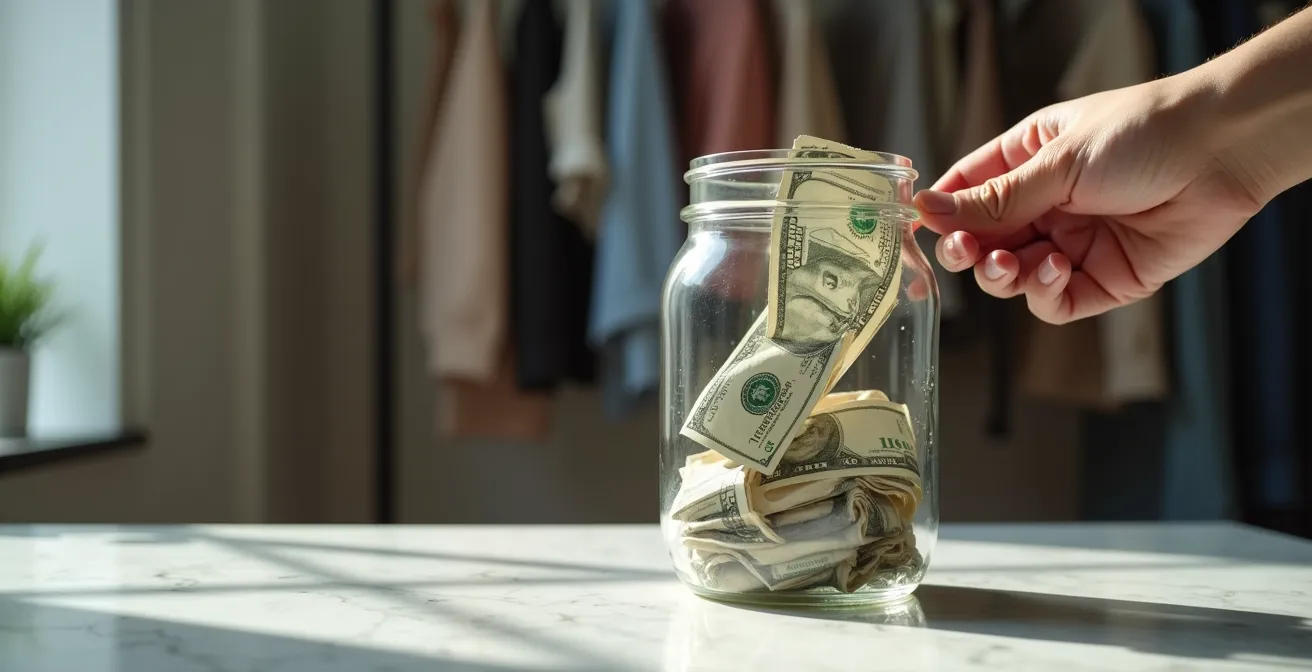
The financial impact of this discipline is staggering. Let’s say you avoid one $85 impulse buy each month. That’s over $1,000 a year. Instead of sitting as unworn clothes depreciating to zero in your closet, that money is now a productive asset. A dedicated financial analysis shows that $1,000 saved annually and invested at a modest 7% annual return could grow to over $5,750 in just five years. This isn’t “saving” in the abstract; it’s actively converting the depreciating liability of fast fashion into a compounding financial asset.
When to Buy Winter Boots for Maximum Discount and Selection?
A core tenet of investment is buying assets at the right price. In fashion, this means moving beyond random “sale” notifications and adopting a strategic buying calendar. Waiting for end-of-season clearance in March or April might yield the steepest discounts, but it often comes with significant risk: limited sizes, undesirable styles, and damaged floor models. For a true investment piece like winter boots, where fit and quality are paramount, this is a poor strategy.
The optimal time to buy is not at the deepest discount, but at the point of maximum value, which balances discount with selection. Analysis of retail patterns shows two key windows. The first is pre-season (August-September), offering minor discounts (10-15%) but the absolute best selection. The true “sweet spot,” however, often occurs during mid-season private sales for loyalty members, typically in October. These events can offer 25-30% off while inventory levels for classic styles and common sizes are still strong.
The following table provides a clear financial breakdown of the trade-offs at each stage of the retail cycle, allowing you to tailor your purchasing strategy to your specific goals, whether they be trend-consciousness, balanced value, or pure budget focus.
| Purchase Timing | Average Discount | Selection Quality | Risk Level | Best For |
|---|---|---|---|---|
| August-September (Pre-season) | 10-15% | Excellent | Low | Trend-conscious buyers |
| October (Mid-season sales) | 20-30% | Very Good | Low | Balanced value seekers |
| January (Post-holiday) | 40-50% | Good | Medium | Classic style buyers |
| March-April (End of season) | 60-70% | Limited | High | Budget-focused shoppers |
Jewelry and Hardware: The Hidden Assets in Your Wardrobe
While we focus heavily on fabric and construction, the metal components of your wardrobe—from jewelry to zippers—are hidden assets with their own ROI calculations. Just as with clothing, the value proposition is a battle between intrinsic material value and brand equity. A generic 18k gold chain has a clear, commodity-based value. However, a Cartier “Love” bracelet, which is gold-plated, can have a resale value far exceeding its weight in gold due to immense brand desire.
This principle extends directly to the hardware on your clothing and accessories. When you’re auditing a potential investment piece, the quality of the zippers, buttons, and clasps is a powerful indicator of the item’s overall TCO. For example, the presence of a zipper from a renowned manufacturer like RiRi or YKK signals that the designer did not cut corners. These components are more expensive upfront but are engineered for thousands of cycles, dramatically reducing the likelihood of costly repairs and thus lowering the “maintenance cost” portion of the TCO formula.
Think of hardware as a microcosm of the entire investment thesis. A flimsy, unbranded zipper on a leather jacket is a red flag, suggesting other hidden quality compromises. A solid, smooth-running piece of hardware is a sign of integrity that will pay dividends in durability and, ultimately, in higher resale value. When choosing between two similar items, the one with superior hardware often has the better long-term ROI.
The ‘Expense Ratio’ of Your Wardrobe: How Hidden Costs Erode ROI
In stock market investing, the “expense ratio” is a small annual fee that can silently devour a huge portion of your long-term gains. Your wardrobe has its own version of this: hidden maintenance costs. An item that seems like a bargain on the rack can become a financial drain if its “expense ratio” is too high, completely eroding its ROI.
This is a critical component of the Total Cost of Ownership calculation. Before purchasing any item, you must consider its ongoing care requirements. A “Dry Clean Only” label on a blouse you plan to wear weekly is a significant financial commitment. A delicate silk dress that requires professional steaming or a pair of leather shoes that need annual resoling carry higher maintenance costs than their machine-washable or more durable counterparts. For example, a $150 blazer that needs to be dry-cleaned 10 times a year at $15 per cleaning adds $150 to its annual cost of ownership, effectively doubling its price in the first year alone.
The goal is to find items with a low expense ratio relative to their quality and versatility. Look for high-quality materials that are also resilient. A well-constructed merino wool sweater that can be hand-washed has a much better financial profile than a cheaper, similarly styled cashmere-blend sweater that demands expensive professional care. Factoring in these ongoing costs before you buy is essential for making a sound financial decision and ensuring your wardrobe assets work for you, not against you.
Key takeaways
- Calculate an item’s Total Cost of Ownership (TCO = Price + Maintenance – Resale), not just its initial price, to understand its true long-term cost.
- Brand equity is a powerful driver of value; a recognized designer’s synthetic piece can retain more value than an unbranded natural fiber garment.
- Savings from avoided impulse buys are not just “money saved” but capital that can be invested to generate compound returns via an “Opportunity Cost Fund.”
Why Does Expensive Cashmere Pill and How to Prevent It Effectively?
It’s one of the most disappointing experiences in building an investment wardrobe: spending a significant amount on a cashmere sweater, only to see it pill after a few wears. The reason this happens, even with expensive pieces, lies in the fiber itself. Pilling is caused by the shorter, coarser fibers on the cashmere goat’s coat rubbing together and tangling. The highest-quality, and most expensive, cashmere uses only the longest, finest fibers from the goat’s underbelly, which are far less prone to pilling. A lower-grade (yet still expensive) cashmere might blend in shorter fibers, leading to the dreaded pilling.
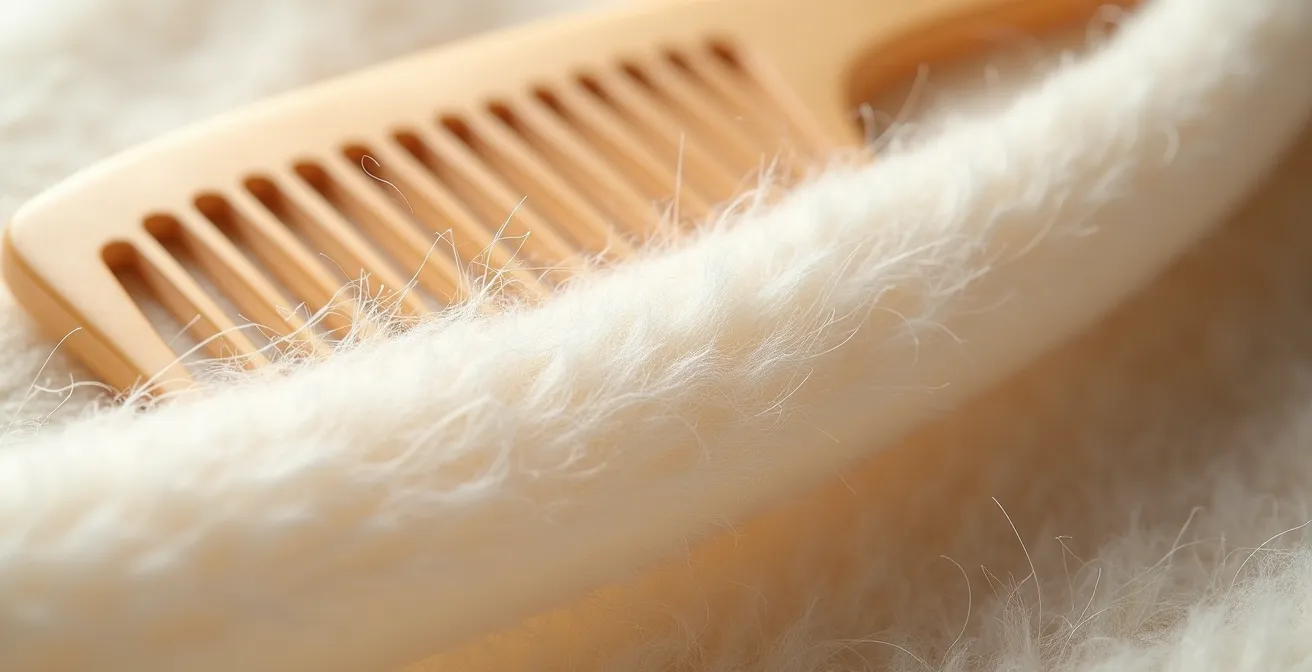
However, even the best cashmere requires a specific care routine to protect its value and maximize its lifespan. This isn’t just about cleaning; it’s an asset protection strategy. Proper maintenance can dramatically lower the Cost Per Wear. For instance, professional stylist calculations demonstrate that a £450 cashmere sweater worn 180 times over 5 years has a CPW of just £2.50 if properly cared for—a testament to its value as a long-term asset. The image below shows the fine texture you are aiming to preserve.
Protecting this investment involves a strict regimen that allows the delicate fibers to rest and recover. Aggressive washing, improper drying, or hanging the garment can permanently damage its structure and value. Follow this routine to ensure your cashmere asset appreciates in softness and value over time:
- Allow a mandatory 24-48 hour rest period between wears for fibers to recover.
- Hand wash in lukewarm water using a pH-neutral baby shampoo, which is gentler than detergent.
- Gently squeeze out water. Never wring or twist the garment, as this breaks the delicate fibers.
- Roll the sweater in a clean towel and press firmly to remove excess moisture.
- Dry the garment flat on a mesh screen, away from direct sunlight or heat.
- Store it folded with cedar blocks to repel moths; never use hangers, which cause irreversible stretching.
- Use a dedicated cashmere comb (not a shaver) monthly during the wearing season, combing gently in one direction to remove any pills.
Start today by applying the Total Cost of Ownership formula to your next potential purchase. By shifting your mindset from “how much does this cost?” to “what is its 5-year ROI?”, you can begin to see your wardrobe transform from a simple expense line into a powerful and stylish financial asset.