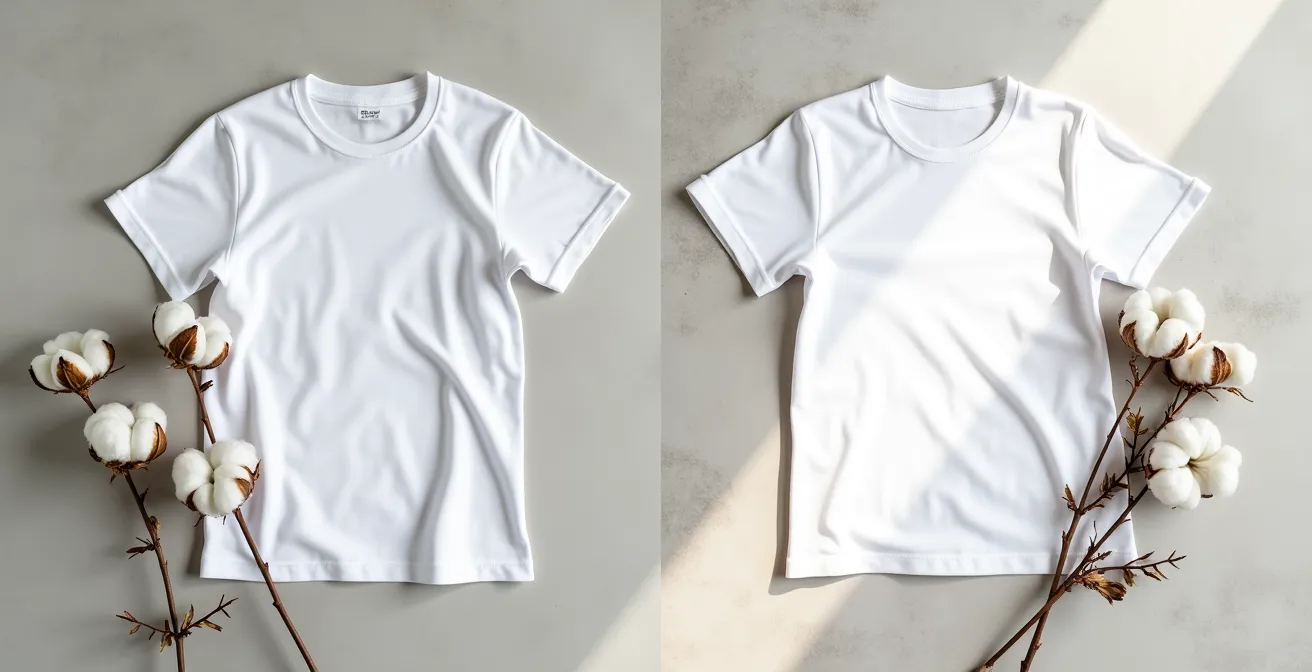
The higher price of an organic cotton t-shirt is misleading; a cost-per-wear analysis often reveals it as the more economical and healthier long-term choice.
- Reduced health burden from eliminating pesticide residues, a critical factor for sensitive skin.
- Superior fiber integrity, when cared for correctly, leads to a significantly longer garment lifespan, lowering the effective cost over time.
Recommendation: Evaluate your next apparel purchase based on its total lifecycle cost—including health and durability—not just its initial price tag.
The moment of decision in front of a clothing rack is a familiar one. Two t-shirts, seemingly identical. One is conventional cotton, priced for an impulse buy. The other, organic cotton, carries a noticeable premium. For a budget-conscious person or a parent weighing every household expense, the question is immediate and practical: is that higher price just for a feel-good label, or does it represent a tangible return on investment? The common advice points to vague environmental benefits and a “softer feel,” but rarely offers a concrete financial or health-based justification.
This ambiguity often leads to a default choice for the cheaper option, filed under “good enough.” We’ve been conditioned to focus on the upfront cost, overlooking the hidden expenses of lower-quality goods: the premature fading and shrinking, the potential for skin irritation from chemical residues, and the more frequent need for replacement. These factors accumulate, turning a seemingly small purchase into a recurring expense. The real cost of a garment isn’t its price tag; it’s the price tag divided by the number of times you can comfortably and confidently wear it.
But what if we reframe the question? Instead of asking “Is it worth the cost?”, let’s ask “What is the true cost-per-wear?” This article moves beyond the platitudes to provide a textile economist’s perspective. We will deconstruct the value proposition of organic cotton, analyzing it not as a luxury, but as a quantifiable investment in two key areas: personal health and asset longevity. We will examine the data on skin health, the science behind fabric durability, and the critical care mistakes that can erase your investment, providing a clear framework to determine if that premium is, in fact, the smarter financial decision.
For those who prefer a visual summary, the following video offers a broader message about our planet, reinforcing the importance of making conscious choices in our daily lives.
This guide will explore the key factors that determine the true value of organic cotton. By breaking down its impact on health, longevity, and environmental footprint, you will have the data needed to make an informed economic choice for your everyday basics.
Summary: A Cost-Benefit Analysis of Organic Cotton for Your T-Shirts
- Why Dermatologists Recommend Organic Cotton for Eczema Prone Skin?
- How to Wash Organic Cotton so It Lasts Twice as Long as Conventional Cotton?
- Conventional vs. Organic Farming: Who Really Uses Less Water?
- The Drying Mistake That Shrinks Organic Cotton Garments by One Size
- Combed vs. Ring-Spun Organic Cotton: Which Texture Feels Softer?
- Paper Towels vs. Swedish Dishcloths: Which Is More Hygienic and Eco-Friendly?
- Nylon or Polyester: Which Recycled Fabric Breathes Better in Humid Weather?
- Recycled Polyester vs. Virgin Fibers: Which Performs Better for High-Intensity Activewear?
Why Dermatologists Recommend Organic Cotton for Eczema Prone Skin?
For individuals with sensitive skin, eczema, or allergies, the choice of fabric is not a matter of comfort but of health. The primary recommendation from dermatologists is often organic cotton, and the reasoning is rooted in what is absent from the final product: harsh chemical residues. Conventional cotton is one of the most chemically intensive crops in the world. Astonishingly, data shows that 25% of global insecticide use is dedicated to conventional cotton, despite it occupying only 2.4% of cultivated land. These pesticides, herbicides, and defoliants don’t always wash out completely, leaving trace amounts that can act as irritants and trigger flare-ups on the skin’s delicate barrier.
Organic cotton, by contrast, is grown without these synthetic chemicals. This fundamentally reduces the “health burden” on the wearer. The fibers are not only cleaner but also maintain their natural structure, resulting in a fabric that is inherently softer and more breathable. This breathability is a critical factor, as it allows for better air circulation, which helps keep the skin cool and reduces the buildup of sweat and bacteria—common triggers for eczema. The National Eczema Society reinforces this, stating in their guide:
Cotton—preferably 100% and ideally organic—is often called the ‘safest’ fabric for sensitive skin. It’s naturally soft and breathable, allowing air to circulate so your skin stays cool.
– National Eczema Society, Best Fabrics for Sensitive Skin Guide
From an economic standpoint, choosing organic cotton is a form of preventative care. By minimizing exposure to known irritants, a budget-conscious family can potentially reduce costs associated with medicated creams, doctor’s visits, and the discomfort of skin conditions. The higher initial cost of the garment is offset by the reduced financial and physical cost of managing skin sensitivity.
How to Wash Organic Cotton so It Lasts Twice as Long as Conventional Cotton?
The superior durability of organic cotton is not automatic; it is unlocked through proper care. The longer, stronger fibers of well-grown organic cotton have the potential for a much longer lifespan than their conventional counterparts, but they are still susceptible to damage from harsh washing routines. High heat and aggressive detergents can break down these natural fibers, negating the very reason for your investment. Maximizing the garment’s life is key to lowering its cost-per-wear, turning a premium product into a frugal one.
The primary enemies of fiber integrity are thermal shock and chemical abrasion. Washing in hot water causes the fibers to constrict and tighten, leading to shrinkage and a loss of softness. Fabric softeners and detergents with optical brighteners coat the fibers, which can weaken them over time and reduce their natural absorbency. An effective care routine focuses on gentle, cool processes that clean the garment while preserving its structure.
This approach isn’t about more work; it’s about smarter work. By adopting a few simple habits, you can dramatically extend the life of your organic cotton basics, ensuring they stay soft, hold their shape, and deliver value for years, not just seasons. This is how you protect your initial investment and realize the true economic benefit of choosing a higher-quality material. The following checklist provides a clear, step-by-step plan for this process.
Your Action Plan: Preserving Your Organic Cotton Investment
- Wash Cool: Always use cold water (30°C/86°F or below). This prevents fiber constriction, maintains the natural structure, and is the single most effective step to prevent shrinkage.
- Choose Gentle Detergent: Opt for a mild, pH-neutral, and fragrance-free detergent. Avoid any products containing chlorine bleach, optical brighteners, or fabric softeners which degrade fibers.
- Protect the Surface: Turn all garments inside out before placing them in the washing machine. This simple action protects the outer surface from friction and pilling caused by contact with other clothes or the machine drum.
- Rinse Thoroughly: Consider using an extra rinse cycle. This ensures all detergent residue is removed, as leftover soap can weaken the cotton fibers and cause them to feel stiff.
- Air Dry Correctly: Avoid the high heat of a tumble dryer at all costs, as this is the primary cause of permanent shrinkage and fiber damage. The best method is to lay the garment flat on a drying rack away from direct sun.
Conventional vs. Organic Farming: Who Really Uses Less Water?
The “less water” claim is one of the most common arguments for organic cotton, but the reality is more nuanced and far more impressive than a simple slogan. The key isn’t just the total volume of water used, but its source. A deep dive into water-use accounting reveals the superior efficiency of organic systems. According to a comprehensive study, organic farming can result in 71% less water used compared to conventional cotton. This staggering figure is achieved by fundamentally different agricultural practices.
Organic farming prioritizes healthy soil, rich in organic matter. This soil acts like a sponge, retaining rainwater far more effectively. Consequently, organic systems rely heavily on “green water” (rainwater stored in the soil), whereas conventional farms depend more on “blue water” (irrigation from rivers, lakes, and aquifers), which has a much higher environmental and economic cost. Furthermore, conventional cotton farming requires significant amounts of water simply to dilute the potent pesticides and fertilizers being used, a step entirely absent in organic agriculture.
The following data, based on lifecycle assessments, provides a clear comparison of water sourcing for a single t-shirt. This breakdown shows that the true advantage of organic cotton lies in its dramatically reduced reliance on precious irrigated water sources, as illustrated by a detailed analysis of water consumption.
| Water Type | Organic Cotton | Conventional Cotton |
|---|---|---|
| Blue Water (Irrigation) | 30% of total usage | 70% of total usage |
| Green Water (Rainwater) | 70% of total usage | 30% of total usage |
| Water for Chemical Dilution | 0 liters | 20% of total water use |
| Total per T-shirt | 1,800 liters | 2,700 liters |
Case Study: Egypt’s SEKEM Initiative
The potential for large-scale success is not just theoretical. In Egypt, the SEKEM organization provided a powerful proof of concept. By converting 400,000 hectares to integrated organic methods, they achieved a remarkable 90% reduction in synthetic pesticide use while simultaneously increasing crop yields by 30%. This project demonstrated that organic farming can be both highly productive and vastly more efficient with resources, challenging the notion that conventional methods are necessary for large-scale agriculture.
The Drying Mistake That Shrinks Organic Cotton Garments by One Size
Perhaps the greatest fear for anyone investing in a quality cotton garment is shrinkage. You follow the wash instructions perfectly, only to pull your favorite t-shirt out of the dryer a size smaller. This frustrating experience is almost always caused by one single mistake: exposure to high heat. While some minor shrinkage can occur in the first wash cycle if the fabric wasn’t pre-shrunk, the dramatic, garment-ruining shrinkage is a direct result of the intense heat from a conventional tumble dryer. The heat causes the natural cotton fibers to constrict rapidly and permanently.
Organic cotton, with its untreated fibers, can be particularly susceptible to this thermal shock. The key to preserving the size, shape, and softness of your investment is to manage the drying process with as much care as the washing process. The ideal method completely avoids the tumble dryer, but for those with limited space or time, there are tiered options that can significantly mitigate the risk of damage.
Understanding these drying methods is essential for maximizing asset longevity. A garment that maintains its fit and feel for years offers a far better cost-per-wear than one that becomes unwearable after a few laundry cycles. The choice you make after the wash cycle is just as critical as the choice you made at the store. Here is a practical guide to drying your organic cotton for optimal results:
- Best Method: Lay Flat to Dry. This is the gold standard for garment care. Laying the item flat on a mesh drying rack away from direct sunlight allows it to dry evenly without any stress on the seams or fibers. It perfectly maintains the garment’s original shape and is the gentlest method possible.
- Better Method: Line Dry. Hanging your garments on a line, either indoors or in the shade outdoors, is an excellent alternative. It uses zero energy and is very gentle on the fabric. The key is to avoid direct, harsh sunlight, which can cause colors to fade over time.
- Good Method: Tumble Dry on Air-Only. If you must use a dryer, use the “Air-Only” or “Extra Low” heat setting. Adding wool dryer balls can help to soften the fabric and speed up the drying time slightly by improving air circulation. This should be a last resort, not a regular habit.
Combed vs. Ring-Spun Organic Cotton: Which Texture Feels Softer?
Not all organic cotton is created equal. Once you’ve decided to invest in organic, a new layer of complexity appears: processing methods. Terms like “combed” and “ring-spun” on a product label are not marketing jargon; they are indicators of a specific manufacturing process that has a direct and significant impact on the final garment’s texture, durability, and cost. Understanding these differences is key to making a truly informed purchase and ensuring you get the quality you’re paying for.
Standard organic cotton is soft, but these advanced processes take it to another level. Combed cotton is a process where the raw cotton fibers are literally combed with fine brushes to remove short, breakable fibers and any impurities. This leaves only the longest, strongest, and straightest fibers to be spun into yarn, resulting in a fabric that is exceptionally soft and less prone to pilling. Ring-spun cotton involves a process of continuously twisting and thinning the cotton strands, which creates a much finer, stronger, and more durable yarn. The result is a noticeably softer hand-feel and a more resilient fabric.

When these two processes are combined, you get the highest echelon of cotton fabric: incredibly soft, smooth, and built for longevity. From a textile economist’s perspective, this is where the cost-benefit analysis becomes most interesting. While these premium processes add to the initial cost, they also significantly enhance the “asset longevity” of the garment. The following table breaks down the relationship between processing, softness, and the typical price premium you can expect.
| Processing Method | Fiber Length | Softness Rating | Price Premium |
|---|---|---|---|
| Regular Organic | Standard | Good | Base price |
| Combed Organic | Long-staple only | Very Good | +15-20% |
| Ring-Spun Organic | Standard | Very Good | +20-25% |
| Combed + Ring-Spun | Long-staple only | Excellent | +30-40% |
Paper Towels vs. Swedish Dishcloths: Which Is More Hygienic and Eco-Friendly?
The same economic and sustainable mindset used to evaluate clothing can be applied to other household textiles. A prime example is the kitchen cleanup choice between disposable paper towels and reusable Swedish dishcloths. On the surface, a roll of paper towels is cheap and convenient. However, a cost-benefit analysis over a year reveals a different story. A typical household can spend hundreds of dollars annually on single-use paper towels, which contribute to landfill waste and methane production.
Swedish dishcloths, made from a blend of cellulose and cotton, present a compelling alternative. A single cloth can replace numerous rolls of paper towels, lasting for 6-12 months and being fully compostable at the end of its life. The upfront cost is higher than one roll of paper towels, but the long-term savings are substantial. Beyond the financial and environmental benefits, there is a significant hygienic advantage.
Hygiene Study: The Power of Drying Quickly
A key concern with reusable cloths is bacterial growth. However, laboratory tests show a distinct advantage for Swedish dishcloths. Unlike traditional sponges that can stay damp for hours, the cellulose-cotton blend of a Swedish dishcloth allows it to dry to a rigid state, often within 15 minutes. This rapid drying process drastically inhibits the proliferation of bacteria, which thrive in moist environments. For sanitation, the cloths can be easily cleaned by boiling or running them through a dishwasher.
The annual cost and impact comparison makes the economic case clear. The long-term value, combined with the hygienic and eco-friendly properties, positions the Swedish dishcloth as a superior investment for a budget-conscious and health-aware household.
| Factor | Paper Towels | Swedish Dishcloths |
|---|---|---|
| Annual Cost (typical household) | $180-250 | $20-30 |
| Lifespan | Single use | 6-12 months per cloth |
| Biodegradability | Yes, but creates methane in landfills | 100% compostable at home |
| Sanitization Method | N/A (disposed) | Boiling water or dishwasher |
Nylon or Polyester: Which Recycled Fabric Breathes Better in Humid Weather?
While organic cotton is an exceptional choice for daily wear, its performance limits become apparent during high-intensity exercise, especially in humid conditions. Cotton is highly absorbent, but it dries slowly. Once saturated with sweat, it becomes heavy, clings to the skin, and can cause chilling. For activewear, the primary goal is moisture management—wicking sweat away from the skin to evaporate quickly. This is where synthetic fabrics like nylon and polyester excel.
When evaluating recycled versions of these synthetics, breathability and wicking performance remain the top criteria. Both fabrics are hydrophobic (water-repelling), which is why they don’t absorb sweat like cotton. Instead, they move moisture along their fibers to the fabric’s surface. However, performance testing in high-humidity environments shows a clear winner. Data indicates that polyester wicks moisture 50% faster than nylon, making it the superior choice for staying dry and comfortable during a strenuous workout in damp weather.
This performance edge is even recognized by dermatological experts when considering athletic pursuits. While they recommend cotton for everyday sensitive skin, they acknowledge the practical need for synthetics in certain contexts. As the American Academy of Dermatology notes in its guide for athletes:
For intense workouts in high humidity, synthetics have a performance edge over organic cotton. Polyester’s superior wicking ability is more effective at keeping skin dry.
– American Academy of Dermatology, Fabric Guide for Athletes with Sensitive Skin
From an investment standpoint, choosing the right tool for the job is crucial. While a 100% organic cotton t-shirt is a poor choice for a marathon, a recycled polyester shirt is equally ill-suited for casual, everyday wear due to its lower breathability in non-sweaty conditions. A smart wardrobe portfolio contains the right material for the right context.
Key Takeaways
- Cost-Per-Wear is King: The true cost of a garment is its price divided by its lifespan; durable organic cotton often wins this calculation.
- Health is a Financial Factor: Avoiding chemical residues in conventional cotton can reduce costs associated with skin irritation and allergies.
- Proper Care Unlocks Value: The superior longevity of organic cotton is only realized through gentle washing and, most importantly, avoiding high-heat drying.
Recycled Polyester vs. Virgin Fibers: Which Performs Better for High-Intensity Activewear?
As consumers increasingly seek sustainable options, recycled polyester (often labeled rPET, made from plastic bottles) has become a popular choice for activewear. The immediate question for a discerning buyer is whether this eco-friendly choice comes at the cost of performance. Does “recycled” mean “weaker”? Laboratory studies provide a nuanced answer. The process of recycling plastic does shorten the polymer chains by about 10-15% compared to virgin polyester. However, durability testing reveals this difference is negligible for the average consumer, only becoming a potential factor after more than 50 wash cycles. For most, the performance and durability are functionally identical.
However, the economic analysis of recycled synthetics cannot ignore a significant hidden cost: microplastic pollution. Both recycled and virgin polyester shed microscopic plastic fibers during every wash. This is not a small problem; environmental research reveals that a single wash load can release over 700,000 microplastic fibers into the water system. These particles are too small to be filtered by wastewater treatment plants and ultimately pollute oceans and enter the food chain.
This creates a complex trade-off. Recycled polyester reduces plastic waste and has a lower carbon footprint than virgin polyester, representing a positive step. Yet, it does not solve the persistent problem of microplastic shedding. A truly sustainable approach, therefore, involves not just choosing recycled materials, but also adopting practices to mitigate their impact, such as using specialized laundry bags designed to capture these fibers. The best choice is often a blend, such as organic cotton with a small percentage of synthetic for stretch and durability, which offers a balance of comfort, performance, and reduced environmental impact for moderate activities.
Start evaluating your wardrobe not as a collection of purchases, but as a portfolio of assets. Apply this cost-per-wear analysis to your next purchase to make a decision that is both economically and environmentally sound.