
The key to avoiding age-related mobility decline is not gentle activity, but proactively training for strength, power, and stability to build a robust physiological reserve.
- Heavy lifting and impact exercises are not only safe but essential for maintaining bone density and muscle mass.
- True mobility relies on controlled stability and neuro-muscular coordination, not just passive flexibility.
Recommendation: Shift your focus from simply “staying active” to a structured program that challenges your strength, balance, and cognitive engagement to actively combat the specific declines that lead to the ‘senior shuffle’.
Watching a parent or loved one develop the slow, uncertain “senior shuffle” is a sobering experience. It’s a visible sign of shrinking confidence and a loss of independence. The common advice is predictable: stay active, go for walks, do some gentle stretching. While well-intentioned, this advice misses a critical truth. The shuffle isn’t just a result of getting older; it’s a symptom of losing specific physical capacities that walking and gentle stretching alone cannot preserve: absolute strength, explosive power, and the complex neuro-muscular coordination that allows for confident, automatic movement.
The fear of falling leads many to adopt an overly cautious approach to movement, ironically creating a self-fulfilling prophecy. By avoiding challenging movements, we teach our bodies and brains to forget how to perform them. We stop lifting heavy things, we stop moving quickly, and our physical “vocabulary” shrinks. But what if the secret to lifelong mobility wasn’t to move less or more gently, but to move with more purpose and intensity? What if the real preventative medicine lies in activities we’ve been told to avoid?
This is the perspective of a geriatric physical therapist. True longevity is not about bubble-wrapping our lives; it’s about building a physiological buffer so robust that it can withstand the challenges of aging. It’s about training the very systems that prevent the shuffle in the first place. This guide will dismantle common myths and provide a clear, evidence-based framework for building that buffer. We will explore why heavy lifting is necessary, how simple balance tests predict future health, why impact is your friend, and how complex movements like dancing protect not just the body, but the brain.
text
This article provides a detailed roadmap, moving from foundational strength to advanced coordination, to help you build a comprehensive mobility strategy for the decades to come. Explore the key components of a truly effective anti-aging exercise program in the summary below.
Summary: A Proactive Guide to Lifelong Mobility
- Why Heavy Lifting Is Safe and Necessary After Age 50?
- The “One Leg Stand” Test: predicting Fall Risk in 10 Seconds?
- Impact Exercises: How Jumping Prevents Osteoporosis?
- Why Being Too Flexible Can Be Dangerous as You Age?
- Dancing and Coordination: Why Complex Movement Protects the Brain?
- Road Cycling or Trail Running: Which Is Better for Knees Over 40?
- Low-Impact Cardio: Raising Your Heart Rate Without Jumping?
- Swimming for Rehabilitation: Healing Joint Injuries Without Impact?
Why Heavy Lifting Is Safe and Necessary After Age 50?
The notion of “heavy lifting” for older adults often conjures images of injury and risk. This is a fundamental misunderstanding of how the body ages. After age 30, adults can lose 3-5% of their muscle mass per decade, a condition called sarcopenia. This loss of strength is a primary driver of frailty, reduced metabolic health, and the inability to perform daily tasks, from carrying groceries to getting up from a chair. Gentle exercise is not enough to combat this; to build or maintain muscle, the body needs a stimulus it is not accustomed to—it needs progressive overload.
Heavy resistance training is the most effective way to provide this stimulus. When performed correctly, it is remarkably safe. The key is focusing on relative intensity, not absolute weight. “Heavy” simply means a weight that is challenging for *you* for a low number of repetitions. This stress signals the body to synthesize new muscle protein and strengthen the underlying neuro-muscular connections. It’s not about becoming a powerlifter; it’s about reclaiming the strength to move through life with confidence and capacity.
Furthermore, compound movements like squats and deadlifts train the body as an integrated system, mimicking the real-world demands of lifting a grandchild or a heavy suitcase. This functional strength is the bedrock of mobility. It provides the raw power that other skills, like balance and coordination, are built upon. Far from being dangerous, a properly structured heavy lifting program is one of the most powerful anti-aging interventions available.
The “One Leg Stand” Test: predicting Fall Risk in 10 Seconds?
How can ten seconds on one leg tell you so much about your future health? The single-leg stance test is a deceptively simple yet powerful assessment of your balance, proprioception (your sense of body position), and muscular stability. It’s a microcosm of the dynamic stability required to walk, climb stairs, or recover from a trip. An inability to perform this test reveals underlying deficits in the systems that prevent falls, making it a stark predictor of future mobility issues and even mortality.
Indeed, the data is compelling. A landmark 2022 study found that middle-aged and older individuals unable to complete a 10-second one-leg stand had a significantly higher risk of all-cause mortality over the following decade. This isn’t because the test itself is magical; it’s because it’s a proxy for the health of your entire neuro-muscular system. It requires your brain, inner ear, eyes, and muscles in your feet, ankles, legs, and core to work in perfect harmony. A failure in this test indicates a breakdown in that communication.
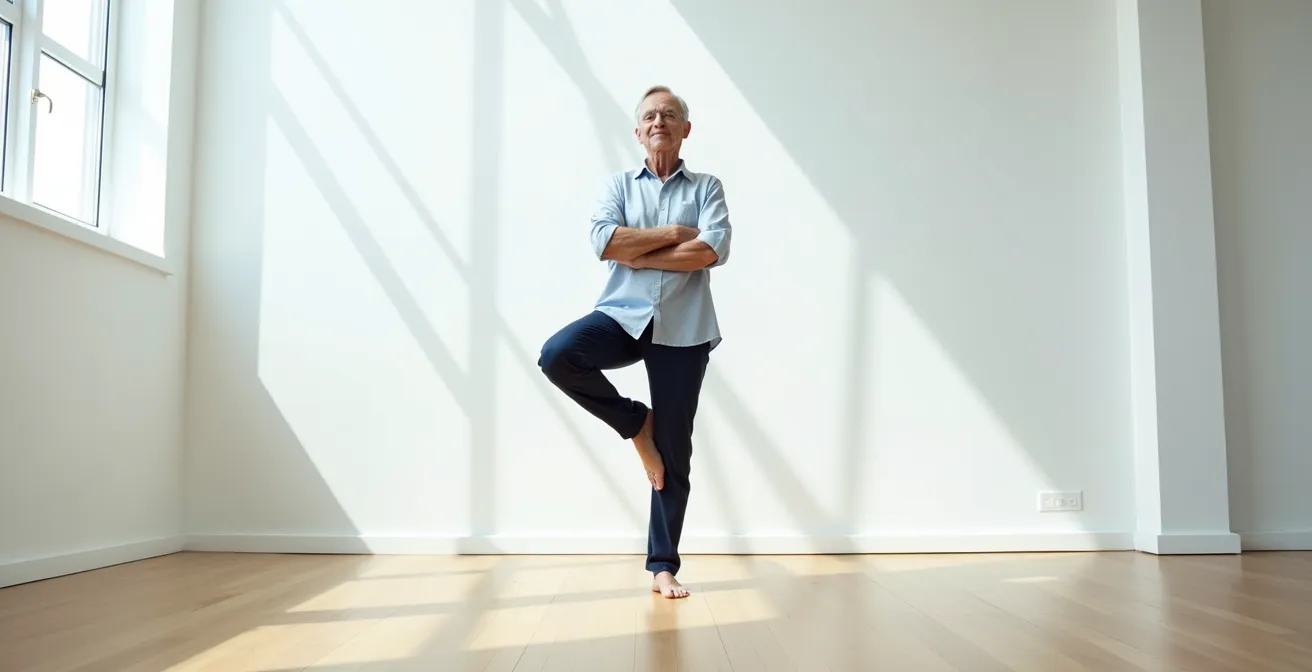
The good news is that balance is a trainable skill. Regularly practicing single-leg stances, and making them more challenging by closing your eyes or standing on an unstable surface, can dramatically improve this vital capacity. It’s a direct way to train your body’s “reflexive stability” and reduce your risk of falling long before it becomes a serious concern.
Case Study: Predicting Falls with Balance Metrics
A 2024 longitudinal study highlighted the predictive power of balance. Researchers followed 153 older adults and found that specific measures during a single-leg stance, such as side-to-side sway, could effectively predict who would experience a fall within six months. While the average time the test was held was 14.8 seconds, the study suggests that being able to hold the stance for at least 23 seconds is a better indicator of robust balance, demonstrating that subtle deficits can be detected with a slightly longer test.
Impact Exercises: How Jumping Prevents Osteoporosis?
For years, “low-impact” has been the mantra for anyone over 40 concerned about their joints. While well-meaning, this advice ignores a fundamental law of physiology: Wolff’s Law, which states that bones adapt to the loads under which they are placed. To maintain or increase bone mineral density and fight off osteoporosis, bones need to experience impact. The brief, high-force loading from jumping sends a powerful signal to osteoblasts—the cells responsible for building new bone—to get to work. Without this signal, the body assumes the bones don’t need to be strong, and density gradually declines.
Activities like walking or swimming are excellent for cardiovascular health but provide insufficient stimulus for bone building. Jumping, even in small doses, is a potent medicine for the skeleton. Fitness experts and longevity specialists now advocate for incorporating this type of movement, recommending that even just 10-20 jumps per day can provide the necessary stimulus for bone growth. This doesn’t mean you need to start a high-intensity plyometric routine tomorrow. The key is a gradual and progressive approach.
The goal is to re-introduce your body to impact safely. It’s about teaching your muscles to absorb force effectively to protect your joints, a skill that atrophies from disuse. By starting with forceful stomping and progressing to small hops and eventually box jumps, you are not only strengthening your bones but also building the explosive power needed to react quickly, catch yourself from a fall, or climb stairs with ease. This power is one of the first physical capacities to decline with age and is critical for maintaining functional independence.
Action Plan: Progressive Impact Exercise Spectrum
- Start with forceful stomping and marching in place to act as “plyometric primers” and reacquaint your body with ground force.
- Progress to performing heel raises, then practice landing softly and in a controlled manner from the small height of your toes.
- Advance to low-level box jumps, starting with a height of just 4-6 inches. Focus entirely on a soft, controlled landing.
- Master the landing mechanics: land with your knees slightly bent to allow your muscles, not your joints, to absorb the impact.
- Once confident, build up to jump squats, focusing on exploding upwards and then landing as softly and quietly as possible.
Why Being Too Flexible Can Be Dangerous as You Age?
The pursuit of flexibility is often seen as a cornerstone of healthy aging. We stretch to “stay loose” and “prevent injury.” However, there’s a crucial distinction between healthy mobility and potentially dangerous hyper-flexibility. Mobility is strength and control through a full range of motion. Flexibility is simply the passive range of a joint. Having excessive flexibility without the corresponding muscular strength to control it can lead to joint instability, increasing the risk of sprains, dislocations, and falls.
As we age, our ligaments naturally become a bit laxer. An overemphasis on passive stretching, especially at the end-ranges of motion, can exacerbate this without building the muscular “brakes” needed to protect the joint. Imagine a car with a steering wheel that can turn 360 degrees but has no mechanism to stop it at the right point—that’s a hyper-flexible joint without stability. What’s more protective against a fall is not the ability to do the splits, but the ability of your muscles to instantaneously fire and stabilize your hip and knee when you trip on a curb.
This is why training for stability and motor control is far more important than chasing extreme flexibility. This involves strengthening the small stabilizer muscles around your joints and practicing controlled movements. Eccentric exercises (slowly lowering a weight), isometric holds (holding a challenging position), and balance work are all superior methods for building this protective strength. They teach your body to decelerate and control momentum, which is the key to injury prevention.
Case Study: Stability Trumps Flexibility in Fall Prevention
p>
A 2020 systematic review in the journal Diagnostics analyzed factors related to fall risk. The findings were clear: measures of medio-lateral (side-to-side) balance control, which heavily relies on muscular stability, were much stronger predictors of falls than other measures. This suggests that the body’s ability to control its center of mass and stabilize joints is more protective than simply having a large, uncontrolled range of motion. The focus should be on building a strong, stable “chassis” rather than just a flexible one.
Dancing and Coordination: Why Complex Movement Protects the Brain?
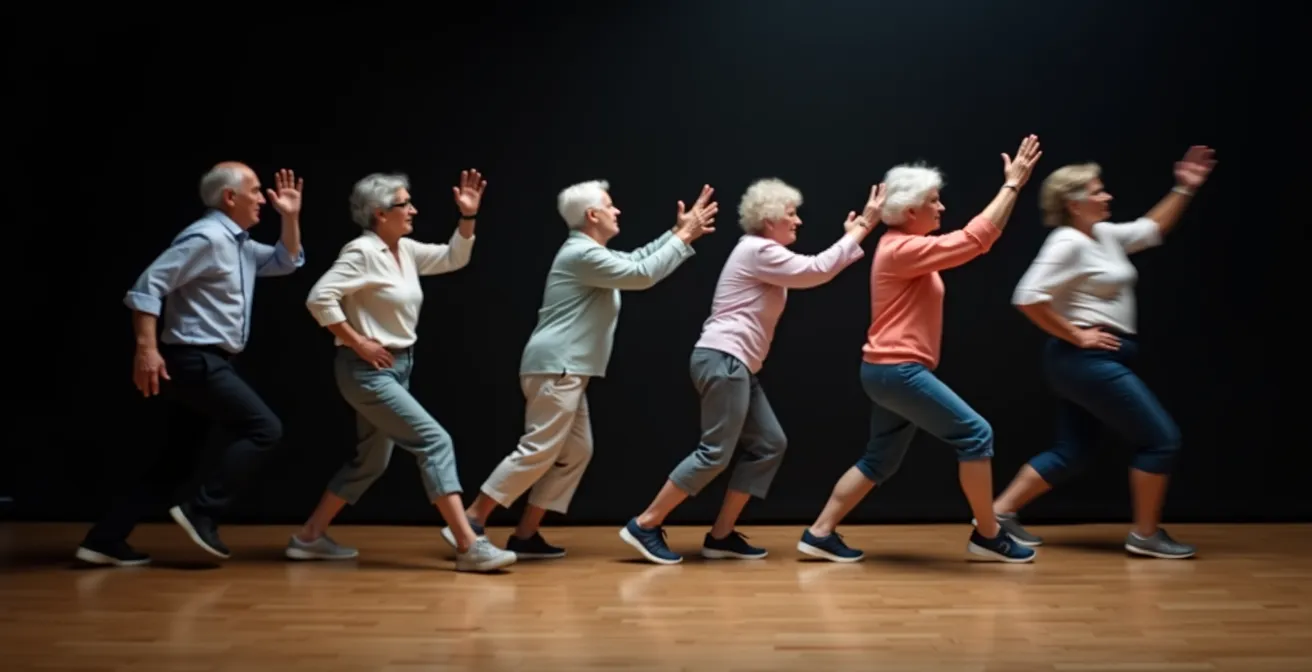
If heavy lifting builds the engine and balance training fine-tunes the suspension, then activities like dancing upgrade the onboard computer. The “shuffling gait” is not just a muscular problem; it’s a neurological one. It reflects a breakdown in the brain’s ability to coordinate complex, multi-limb movements automatically. The antidote is to actively practice and learn new, complex movement patterns. Dancing is perhaps the perfect activity for this, as it combines physical, cognitive, and social engagement.
When you learn a dance routine, you’re not just moving your body. You are engaging in a high-level dual-tasking challenge. Your brain must process music, remember sequences of steps, coordinate the movements of your arms and legs, navigate space, and often interact with a partner. This intense cognitive engagement stimulates neuroplasticity—the brain’s ability to form and reorganize synaptic connections. It’s like a workout for the motor cortex, the cerebellum, and the prefrontal cortex all at once, building cognitive reserve and preserving the very pathways that atrophy with disuse.
Unlike repetitive, single-plane movements like walking or cycling, dancing forces the body to move in all three planes of motion: forward-and-back, side-to-side, and rotational. This expands your “movement vocabulary” and improves your ability to react to unexpected situations in the real world. The constant weight-shifting and turning are excellent forms of dynamic balance training, directly combating the rigidity that leads to shuffling. More than just an exercise, dancing is a joyful way to actively preserve the intricate neuro-muscular connection that underpins a lifetime of confident movement.
Road Cycling or Trail Running: Which Is Better for Knees Over 40?
This is a classic dilemma for aging athletes wanting to maintain cardiovascular fitness. Both activities offer tremendous benefits, but they stress the body in different ways, particularly the knees. The choice between them often comes down to your current joint health, your goals, and understanding the concept of “controlled instability.” Road cycling is a closed-chain, low-impact exercise. Your foot is fixed on the pedal, creating a predictable, smooth range of motion that puts minimal compressive stress on the knee joint. This makes it an excellent choice for building quadriceps strength and cardiovascular endurance, especially for individuals with pre-existing knee arthritis or those recovering from injury.
Trail running, on the other hand, is a high-impact, open-chain activity that introduces a significant degree of unpredictability. The constantly changing terrain—rocks, roots, inclines, declines—forces the small stabilizer muscles around your ankles, knees, and hips to work overtime. This is a powerful form of proprioceptive training, teaching your body to react and stabilize on uneven surfaces. While the impact is higher, the softer surfaces of a trail (compared to pavement) can be more forgiving, and the varied foot-strikes can distribute forces more diversely than the repetitive motion of road running.
So, which is better? It’s not a simple “one or the other” answer. Cycling is superior for building controlled strength in a joint-friendly manner. Trail running is superior for developing real-world stability, bone density, and the reflexive “bounce” that protects you from falls. An ideal program might include both: cycling to build a strong cardiovascular and muscular base, and short sessions of trail running or hiking to challenge your stability and maintain bone health. The following table breaks down the key differences.
As shown in a recent comparative analysis in Sports Medicine – Open, the choice depends on your specific goals for impact and stability.
| Factor | Road Cycling | Trail Running |
|---|---|---|
| Impact on Knees | Low impact, minimal stress | Higher impact, but builds bone density |
| Proprioceptive Training | Limited balance challenge | Constant ankle stability work on uneven surfaces |
| Quadriceps Strengthening | Controlled resistance through gears | Dynamic strengthening through hills |
| Core Engagement | Moderate, mainly static | High, dynamic stabilization required |
| Cardiovascular Intensity | Easily controllable | Variable based on terrain |
Low-Impact Cardio: Raising Your Heart Rate Without Jumping?
For individuals who are deconditioned, recovering from injury, or have severe joint issues, high-impact exercise may not be an appropriate starting point. However, “low-impact” does not have to mean “low-intensity.” It’s entirely possible to achieve a high heart rate and a powerful training effect without ever leaving the ground. The secret is to increase load and engage as much muscle mass as possible. The more muscles you have working, the harder your heart and lungs have to work to supply them with oxygen.
p>
One of the simplest and most effective methods is incline walking. Walking up a steep hill or on a treadmill set to a high incline forces your glutes, hamstrings, and quadriceps to work significantly harder than walking on a flat surface, driving your heart rate up without any pounding. Another increasingly popular method is “rucking,” which is simply walking with a weighted backpack or vest. This increases your body’s load-bearing demand, turning a simple walk into a potent strength-building and cardiovascular session. Starting with just 5-10% of your body weight can make a dramatic difference.
Furthermore, incorporating loaded carries is a phenomenal way to get your heart rate up while building functional, full-body strength. Exercises like the Farmer’s Walk (carrying a heavy weight in each hand) or Suitcase Carry (a weight in just one hand) challenge your grip, core, back, and legs simultaneously. They build work capacity and directly train the kind of real-world strength that defines longevity. These methods prove that you don’t need to jump to be powerful; you just need to find smart ways to increase the demand on your body.
Key Takeaways
- True mobility is built on a foundation of strength, power, and stability, not just gentle activity.
- Resistance training and controlled-impact exercises are crucial for combating muscle loss (sarcopenia) and bone-density decline (osteoporosis).
- Balance and coordination are trainable skills that directly protect the brain and reduce fall risk, making them as important as cardiovascular health.
Swimming for Rehabilitation: Healing Joint Injuries Without Impact?
When a joint injury makes land-based exercise painful or impossible, the water offers a unique and powerful healing environment. Swimming and aquatic therapy provide a way to maintain and even build fitness while an injury heals, thanks to the physical properties of water. The most obvious benefit is buoyancy, which reduces the effective weight of your body, unloading sore joints. This allows for movement and exercise with significantly less pain and compression, making it ideal for conditions like osteoarthritis or recovery from surgery.
But the benefits go far beyond simple unloading. The viscosity of water provides 360-degree resistance to every movement. This resistance is accommodating; the faster you move, the greater the resistance becomes. This is perfect for gentle, progressive strengthening of the muscles around an injured joint without the need for external weights. Furthermore, the hydrostatic pressure of the water acts like a full-body compression sock, which can help reduce swelling and improve circulation to the injured area, accelerating the healing process.
Case Study: Aquatic Therapy for Gait Retraining
Physical therapists frequently use aquatic therapy to help patients consciously correct their movement patterns after an injury or surgery. The water’s viscosity naturally slows down movements, allowing a patient to feel and correct faulty gait mechanics, such as insufficient hip extension or poor knee drive. Because buoyancy allows for precise control over how much weight is being borne by an injured leg, therapists can gradually reintroduce weight-bearing in a safe, controlled environment, rebuilding a patient’s confidence and proper movement patterns long before they could do so on land.
This environment allows for both “open-chain” exercises (like kicking, where the foot is free), which strengthen muscles without compressing the joint, and “closed-chain” exercises (like walking or running in the water), which safely reintroduce weight-bearing. For anyone sidelined by a joint injury, the pool isn’t a compromise; it’s a strategic tool for healing faster and returning to activity stronger.
The first step toward building your physiological buffer is to shift your mindset. Stop thinking about “exercise” and start thinking about “training.” Choose one element from this guide—whether it’s practicing a one-leg stand while you brush your teeth or adding two heavy-lifting sessions to your week—and begin today. Your future self will thank you.
Frequently Asked Questions about Swimming for Rehabilitation: Healing Joint Injuries Without Impact?
What’s the difference between open chain and closed chain exercises in water?
Swimming provides open chain exercises that strengthen muscles around joints without compression, unlike land-based closed chain exercises that involve weight-bearing through the joint.
How does water temperature affect rehabilitation?
Warm water (83-88°F) helps relax muscles and reduce pain perception, while cooler water can help reduce inflammation after acute injuries.
Can non-swimmers benefit from aquatic rehabilitation?
Yes, many aquatic therapy exercises can be performed in shallow water while standing or using flotation devices, requiring no swimming skills.