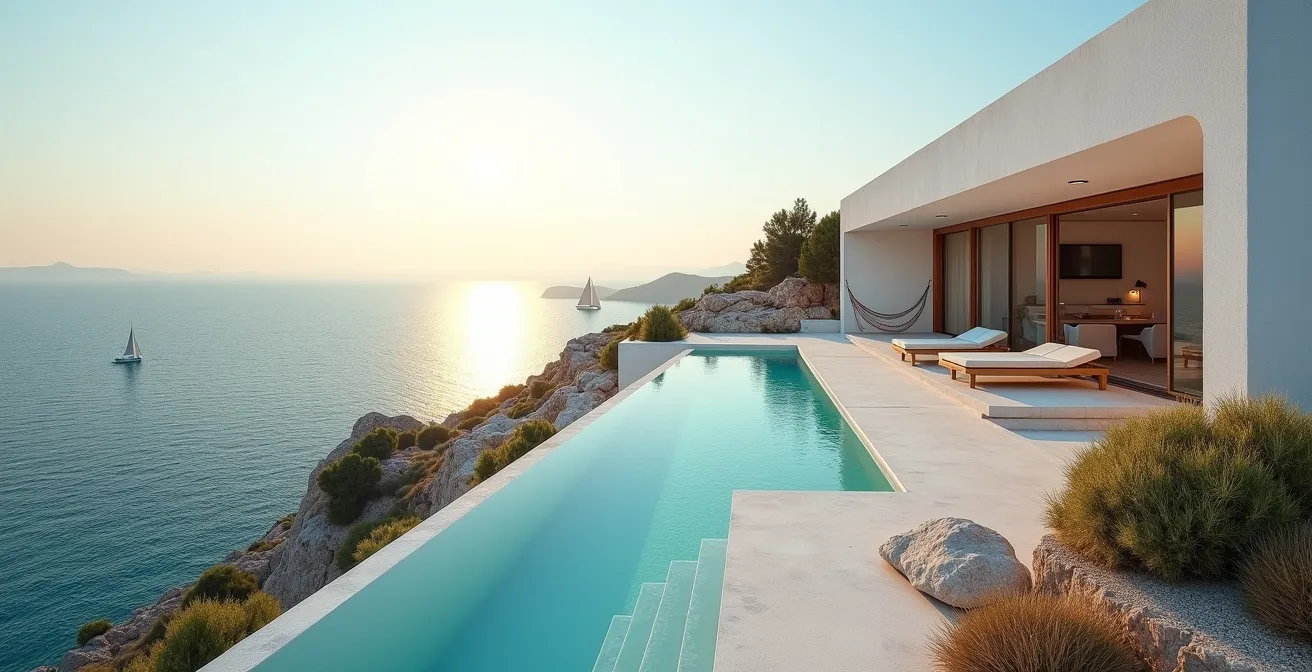
The pursuit of a quiet coastal escape often ends in disappointment, surrounded by the very crowds you sought to avoid.
- True seclusion is engineered through strategic choices, not found by chance.
- Focus on proximity (staying near hubs), access (choosing destinations with natural barriers), and timing (avoiding peak hours, not just peak season).
Recommendation: Shift your mindset from finding a location to designing an experience of privacy.
The promise is always seductive: a pristine stretch of sand, the gentle rhythm of waves, and the blissful solitude of a private coastal paradise. Yet, for the discerning couple, the reality is often a far cry from the brochure. The sought-after tranquility is shattered by the hum of jet skis, the search for a free sunbed becomes a competitive sport, and the romantic dinner is accompanied by the clatter of a thousand other diners. You’ve followed the standard advice—choosing so-called “hidden gems” or traveling just outside of peak season—only to find that the secret is already out.
The common approach to finding seclusion is flawed because it treats privacy as a destination to be discovered. It assumes that a remote dot on a map guarantees a peaceful experience. But in a hyper-connected world, true isolation is rarely accidental. The real key to unlocking quiet luxury lies not in finding a place, but in understanding a methodology. It requires a shift in thinking: from a passive tourist to an active strategist of your own solitude.
This is not about sacrificing convenience for the sake of remoteness. It is about engineered seclusion—a series of deliberate, intelligent choices that filter out the crowds and cultivate an atmosphere of authentic privacy. It’s an insider’s art, blending an understanding of local dynamics with a refusal to settle for the conventional. This guide will not give you a simple list of destinations. Instead, it will equip you with the strategic framework to design your own secluded coastal retreat, anywhere in the world.
Throughout this guide, we will deconstruct the core principles of engineering privacy. You will learn how to leverage geography, timing, and accommodation choices to build a protective bubble around your escape, ensuring your next beach holiday is defined by tranquility, not tourism.
Summary: A Strategic Guide to Engineering Coastal Privacy
- Why Choosing the Town Next to the Famous Resort Saves Your Sanity?
- How to Identify Truly Private Beaches vs Publicly Accessible Coasts?
- Villa Rental or Boutique Hotel: Which Offers Better Privacy for Couples?
- The Timing Error That Puts You in the Middle of 3000 Day-Trippers
- October Beach Holidays: Is the Water Still Warm Enough to Swim?
- Mubi or Criterion Channel: Which Subscription Suits Your Taste?
- Group Pace vs. Own Pace: Which Is Less Exhausting Mentally?
- How to Experience Local Traditions Authentically Without Being a Voyeur?
Why Choosing the Town Next to the Famous Resort Saves Your Sanity?
The magnetic pull of a famous resort town—with its Michelin-starred restaurants and glossy magazine features—is undeniable. Yet, this is the very epicenter of the tourist swarm you wish to avoid. The insider’s strategy, known as the Proximity Principle, is not to shun these hubs entirely but to use them as anchors. The real prize is the satellite village, the quiet cousin located just a 20-minute drive away. These towns offer the best of both worlds: easy access to the hub’s amenities when desired, and a peaceful, authentic base to retreat to.
These adjacent communities are naturally shielded from mass tourism. They lack the large-scale hotel infrastructure and are often overlooked by tour bus itineraries. Life here moves at a local pace, offering a glimpse into a more genuine way of living. You trade bustling promenades for quiet fishing harbors and souvenir shops for family-run bakeries. This strategic positioning allows you to dip into the vibrant energy of the main resort for a specific dinner or activity, then escape back to your tranquil haven before the crowds become overwhelming. This approach is gaining traction, as recent industry data shows that 78% of travel advisers report clients choosing shoulder season and other strategies to bypass peak crowds.
Identifying these satellite gems requires a bit of digital cartography but follows a clear methodology. The goal is to find a location that is close enough for convenience but disconnected enough for peace.
Action Plan: Finding Your Satellite Village
- Map Analysis: Identify the main tourist hub on Google Maps and zoom out to see surrounding areas within a 20-30km radius.
- Access Audit: Look for smaller towns without direct ferry terminals or major highway connections. Villages requiring two or more public transport transfers naturally deter casual visitors.
- Accommodation Check: Verify that accommodation options are primarily small B&Bs, boutique guesthouses, or villa rentals rather than large chain hotels.
- Forum Research: Scour local forums and expatriate communities for mentions of “locals-only” beaches or favorite quiet restaurants.
- Infrastructure Scan: The absence of large tour operator offices or international fast-food chains is often a positive indicator of a town’s authentic character.
How to Identify Truly Private Beaches vs Publicly Accessible Coasts?
The term “private beach” is one of the most misused in the travel industry. Often, it simply means a resort has placed its loungers on a public stretch of sand. True privacy, however, is not about ownership but about access control. A genuinely secluded beach is defined by the natural or man-made barriers that inherently limit the number of people who can reach it. For the discerning couple, seeking out these barriers is the key to guaranteed solitude.
These barriers can be physical, such as a beach accessible only via a steep, unmarked coastal path or a hidden cove that requires a short swim or kayak trip from a larger bay. They can also be logistical, like a shoreline that is only reachable by boat or via a private estate. The more effort required to get there, the fewer people you will share it with. This filter works far more effectively than any “private” sign.

As the image above suggests, a challenging path can be the gatekeeper to paradise. When researching, look for topographical clues on maps—coves enclosed by high cliffs are promising. Read travel blogs or hiking forums for mentions of “scrambling,” “unmarked trails,” or “boat access only.” This is the language of true seclusion.
Case Study: The Access-Gated Seclusion of Little Palm Island
A prime example of engineered privacy is the Little Palm Island Resort in Florida. Located on a 5.5-acre private island, its exclusivity is guaranteed by its access protocol. The resort, with only 30 bungalows, is reachable only via seaplane or boat. There are no roads connecting it to the mainland, and the island itself is reserved for guests. This logistical barrier ensures that the only other people you might encounter are fellow residents, effectively eliminating the possibility of day-trippers or beach vendors. It’s a masterclass in using access to create an impenetrable bubble of tranquility.
Villa Rental or Boutique Hotel: Which Offers Better Privacy for Couples?
The choice between a private villa and a boutique hotel is a critical decision in engineering your secluded escape. Both options are vastly superior to a large resort, but they offer different types of privacy. The ideal choice depends on your specific desires for solitude, service, and social interaction. A discerning traveler must weigh the nuances of acoustic, visual, and social privacy to make the right decision.
A private villa offers the most absolute form of privacy. You have complete control over your environment—no shared walls, no common areas, and no chance of overhearing other guests. It provides total autonomy over your schedule, from when you have breakfast to when you use the pool. However, this solitude comes with a trade-off: service is on-demand rather than ever-present. Housekeeping, private chefs, or maintenance staff arrive at scheduled times, momentarily puncturing your private bubble.
A boutique hotel, on the other hand, offers a more curated form of privacy. While you may share common areas like a garden or a small restaurant, the low room count ensures these spaces are never crowded. The primary benefit is effortless service; staff are available 24/7 to cater to your needs without you having to plan for it. The best boutique hotels are masters of discreet service, appearing when needed and vanishing when not. This model provides social privacy—freedom from unwanted interaction—without sacrificing the convenience of immediate hospitality.
| Privacy Aspect | Villa Rental | Boutique Hotel |
|---|---|---|
| Acoustic Privacy | Complete control over noise levels | Potential for neighboring room sounds |
| Visual Privacy | No shared spaces except entrance | Common areas require interaction |
| Social Privacy | Zero forced interactions | Staff presence for service |
| Service Model | On-demand, scheduled visits | 24/7 availability, regular housekeeping |
| Flexibility | Complete autonomy over schedule | Some adherence to hotel timings |
The Timing Error That Puts You in the Middle of 3000 Day-Trippers
Even on the most secluded beach, there is a window of vulnerability: roughly from 10:00 AM to 4:00 PM. This is the golden window for day-trippers, tour boats, and cruise ship excursions. The most common timing error is thinking that traveling in the “shoulder season” is enough. While it reduces the overall volume of tourists, it doesn’t eliminate the daily peak. Mastering Temporal Judo means being strategic not just with the month you travel, but with the hours you choose to be on the beach.
The difference between peak and shoulder season is significant. For instance, recent Bali tourism data reveals 625,665 tourist arrivals in the July peak versus 503,194 in the April shoulder season—a substantial drop, but still a massive number of people. The true luxury is having the beach to yourself during the magical hours of sunrise and late afternoon. Plan your days in reverse: use the midday peak for a long lunch, a spa treatment, an inland excursion, or simply relaxing in the privacy of your villa or hotel.
Head to the beach before 9:00 AM, and you’ll be rewarded with the best light, the calmest water, and a profound sense of peace. Return after 4:00 PM, and you’ll witness the day-trippers departing, leaving the sand once again to the few who remain. This simple shift in routine allows you to experience the most beautiful moments of the day in near-total solitude.
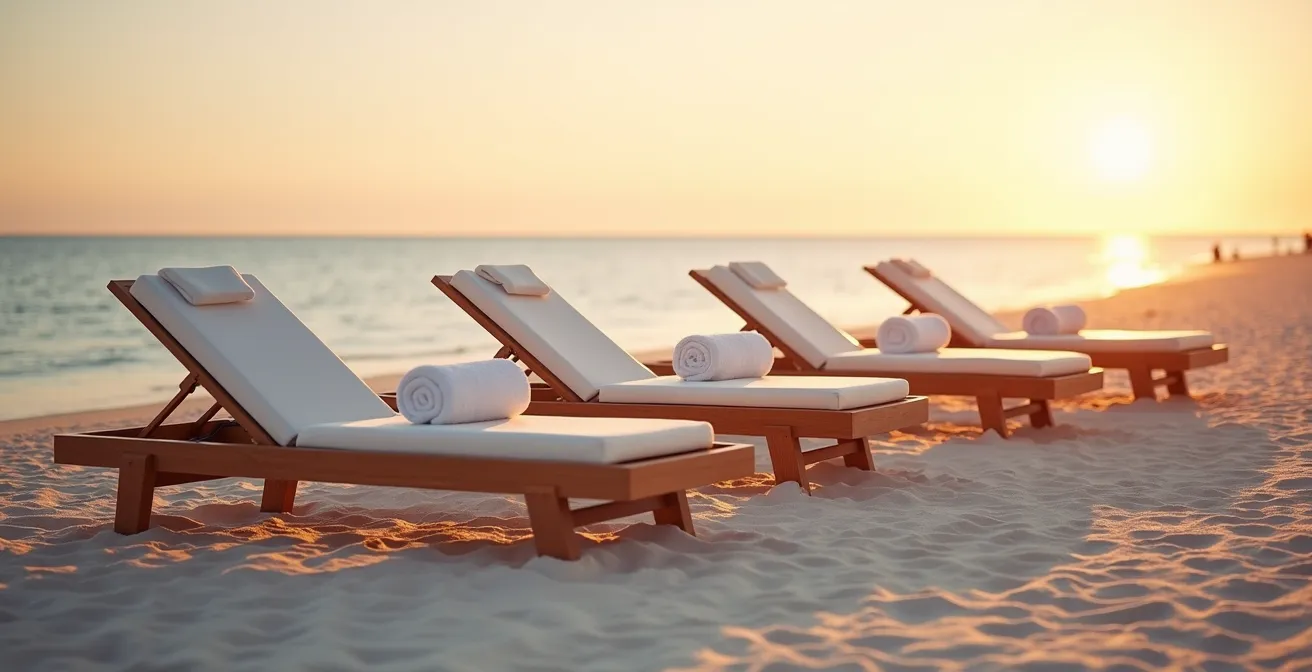
This is the reward for strategic timing: the luxury of emptiness, the feeling that this perfect corner of the world belongs only to you. It’s an experience that can’t be bought, only earned through intelligent planning.
October Beach Holidays: Is the Water Still Warm Enough to Swim?
For those practicing Temporal Judo, October presents a golden opportunity. The summer crowds have long since dispersed, flight and accommodation prices have softened, and a palpable sense of calm descends upon coastal regions. But the lingering question for any beach lover remains: is the water still warm enough for a comfortable swim? The answer is a resounding yes, provided you choose your destination with geographic intelligence.
Oceans and seas act as giant thermal batteries, absorbing heat all summer long. This means that in many regions, the water temperature in early to mid-October is often as warm, if not warmer, than it was in June. The key is to focus on large bodies of water with strong sun exposure. The Mediterranean coasts—particularly in Southern Italy, Greece, Cyprus, and the Balearic Islands—are prime candidates, typically maintaining water temperatures well above 70°F (21°C). Similarly, coastal areas like Southern California and, of course, the Caribbean islands remain comfortably swimmable year-round.
A discerning traveler should also look for microclimates. Protected coves and shallow bays will always be a few degrees warmer than exposed, open-ocean beaches due to reduced water circulation and faster solar heating. Before booking, you can verify real-time conditions using invaluable tools. Government-run portals like NOAA’s Sea Surface Temperature maps provide broad overviews, while specialized surf forecast sites offer granular, beach-specific hourly water temperature updates. This data-driven approach removes the guesswork, allowing you to book an October escape with full confidence.
Mubi or Criterion Channel: Which Subscription Suits Your Taste?
A secluded coastal retreat is as much about the quiet moments indoors as it is about the sun-drenched hours outside. When the sun sets or a rare afternoon shower rolls in, your choice of entertainment should reflect the same discerning, curated ethos as the rest of your trip. For the couple who appreciates cinema, the generic offerings of mainstream streaming services often feel as uninspired as a hotel buffet. The choice is more refined: a battle between two titans of curated film, Mubi and Criterion Channel.
This decision is not trivial; it’s about matching your entertainment to the rhythm of your vacation. Are you seeking serendipitous discovery with zero decision fatigue, or do you prefer to dive deep into the work of a specific auteur or cinematic movement? Your answer will determine which service is the perfect companion for your escape. Mubi is the choice for the traveler who wants to be surprised, while Criterion Channel is for the one who arrives with a plan.
To help you decide which service best complements your vacation style, the following comparison breaks down their core philosophies and features. This is about curating your solitude, ensuring every aspect of your retreat is intentional and enriching.
As this comparative analysis of retreat entertainment suggests, the right choice depends on your desired mental state during your downtime.
| Aspect | Mubi | Criterion Channel |
|---|---|---|
| Content Model | 30 films rotating, one new daily | 1000+ permanent collection |
| Best For Retreats | Serendipitous discovery, no decision fatigue | Deep dives into specific genres/directors |
| Offline Viewing | Limited downloads | Extensive download options |
| Curation Style | Editorial surprise | Scholarly depth |
| Ideal Vacation Length | Week-long escapes | Extended stays |
Group Pace vs. Own Pace: Which Is Less Exhausting Mentally?
Even when traveling as a couple, the subtle tension between shared activities and individual desires can create mental friction. One person may want to explore every historical site, while the other craves a quiet afternoon with a book. Forcing a single, unified pace is often the fastest route to exhaustion. True luxury is the freedom to move at your own rhythm. As Leigh Barnes, President of Intrepid Travel, wisely notes, the best travel moments happen when “destinations breathe a sigh of relief,” and the same is true for travelers.
The sweet spot on any travel calendar is shoulder season – when destinations breathe a sigh of relief
– Leigh Barnes, President of the Americas for Intrepid Travel
The most successful and rejuvenating retreats for couples (or small groups) employ the “Anchor and Explore” method. This strategy involves establishing a shared, comfortable base—your “anchor”—but deliberately scheduling periods for solo exploration. It’s a formal agreement to spend certain afternoons or mornings apart, pursuing individual interests without guilt or negotiation. One partner might go kayaking while the other visits a local art gallery. They then reconnect in the evening to share their experiences.
This approach isn’t about separation; it’s about preserving individual energy and bringing fresh perspectives back to the shared experience. The results are powerful. In settings that facilitate this model, such as the Sheen Falls Lodge in Ireland which offers a vast private estate for varied activities, groups report 40% higher satisfaction when they combine a shared accommodation base with scheduled solo exploration days. This structure prevents the mental fatigue of constant compromise and ensures that both partners feel their needs are being met. It transforms the trip from a shared itinerary into a collection of personal and mutual discoveries.
Key Takeaways
- True seclusion is not found, it is engineered through a series of strategic choices.
- The Proximity Principle: Stay in a quiet satellite town to access a famous hub’s amenities without its crowds.
- Access Control is Key: Prioritize destinations with natural or logistical barriers (boat-only access, cliffside paths) to guarantee privacy.
- Practice Temporal Judo: Avoid the 10 AM to 4 PM day-tripper peak by enjoying beaches at sunrise and late afternoon.
How to Experience Local Traditions Authentically Without Being a Voyeur?
The final piece of the quiet luxury puzzle is engaging with the local culture in a way that is both meaningful and respectful. The discerning traveler seeks connection, not spectacle. The goal is to move beyond the role of a passive observer—a voyeur watching from the sidelines—and become a temporary, respectful participant in the local rhythm of life. This requires a shift from consuming culture to contributing to it, however modestly.
Authentic engagement is found in small, interactive experiences. Instead of watching a “cultural show,” consider hiring a local chef for a private cooking class in your villa. You not only learn to prepare regional dishes but also share stories and forge a genuine human connection. Rather than buying mass-produced souvenirs, seek out a local artisan and inquire about a private workshop. Learning the basics of a local craft, whether it’s pottery, weaving, or painting, provides a much deeper appreciation for the tradition and supports the artist directly.
Another powerful strategy is to engage with the local economy on its own terms. Visit the local market during the hours when residents do their shopping, not when the tour buses arrive. Purchase fresh produce, cheeses, and bread for your own meals. Furthermore, learning a few key phrases in the local language—”hello,” “please,” “thank you,” “that is beautiful”—is a fundamental sign of respect that opens doors and hearts far more effectively than any currency. These small acts of participation transform you from an outsider looking in to an appreciated guest, making your experience richer and more memorable.
Your next truly private getaway doesn’t start with a booking, but with a strategy. Begin designing your secluded escape today by applying these principles to create an experience of authentic, quiet luxury that is entirely your own.
Frequently Asked Questions About Secluded Coastal Holidays
Which coastal areas maintain swimmable temperatures in October?
Mediterranean coasts, Southern California, and Caribbean islands typically maintain water temperatures above 70°F (21°C) in October, while protected coves and shallow bays can be 3-5°F warmer than open ocean beaches.
How can I check real-time sea temperatures before traveling?
Use NOAA’s Sea Surface Temperature maps or specialized surf forecast sites like Surfline and Magicseaweed, which provide hourly water temperature updates for specific beaches worldwide.
What are the advantages of October beach holidays besides swimming?
October offers ideal conditions for coastal hiking with clear visibility, dramatic storm watching, beachcombing after summer crowds, and enjoying seaside restaurants without reservations.