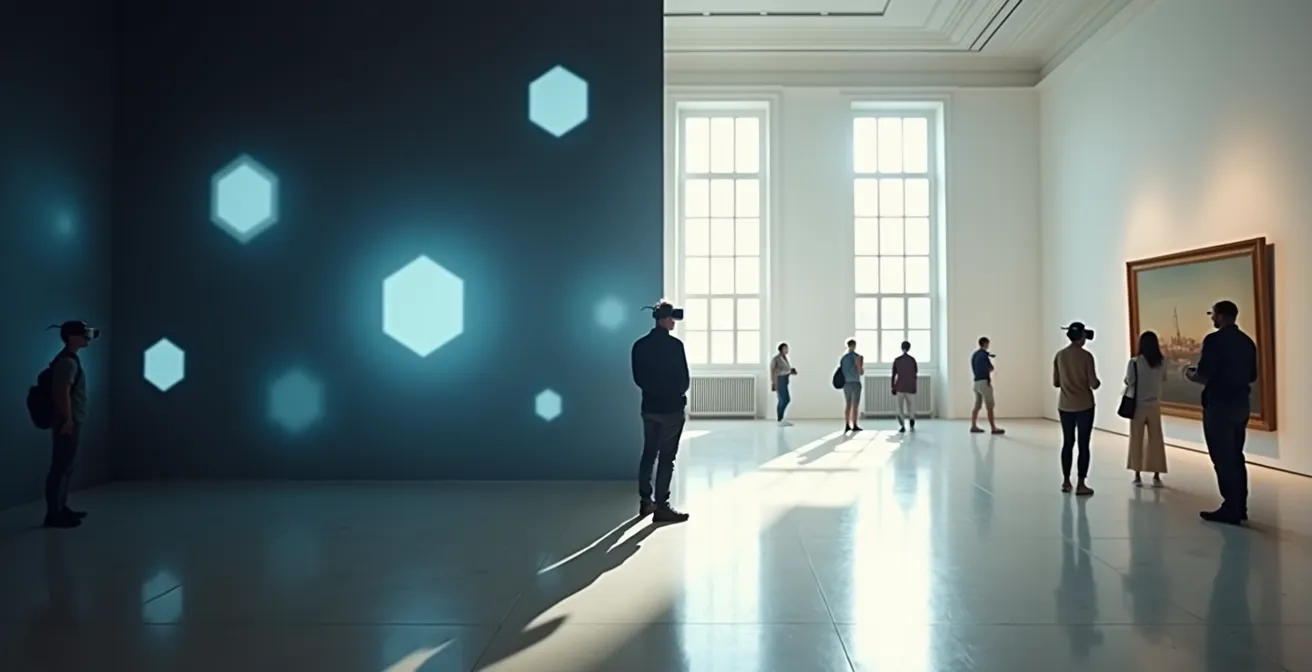
The debate isn’t about replacing physical art, but about understanding VR’s true operational cost and unique artistic potential as a separate medium.
- Virtual reality introduces significant ‘experiential friction,’ including motion sickness and complex sanitization logistics, impacting the visitor journey.
- High-tech exhibitions carry hidden ‘operational drag,’ with steep, ongoing costs for software maintenance and hardware refreshes that are often underestimated.
Recommendation: Evaluate VR proposals not as substitutes for physical exhibitions, but as entirely separate projects with their own complex budgets, staffing needs, and success metrics based on digital-native quality.
The glowing, swirling projections of a Van Gogh masterpiece surrounding you in a cavernous warehouse; the chance to walk through a digital reconstruction of ancient Rome. Immersive experiences are pulling in crowds and generating significant revenue, prompting a pivotal question in boardrooms and curatorial meetings: Is this the future? The conversation around virtual reality in cultural spaces often gets stuck in a familiar binary. On one side, advocates praise its power to democratize access, allowing anyone, anywhere, to visit the Louvre. On the other, purists defend the irreplaceable “aura” of the physical object—the texture of canvas, the sheer scale of a sculpture, the shared hush of a gallery.
But this debate, focusing on accessibility versus authenticity, misses the more critical, practical questions that museum directors and culture lovers must ask. The challenge isn’t deciding if a VR headset can replace a masterpiece, because it can’t. The real task is to look past the “wow” factor and rigorously assess VR as a distinct medium with its own profound strengths and significant, often hidden, operational burdens. What if the key to a successful digital strategy lies not in trying to replicate the physical, but in understanding the true costs—from user discomfort and logistical headaches to the very definition of quality in a digital-native artwork?
This article moves beyond the hype to provide a grounded analysis for decision-makers. We will dissect the tangible realities of implementing high-tech exhibitions, exploring the physiological barriers for users, the often-overlooked financial and logistical strains, and finally, a framework for evaluating digital art on its own powerful terms.
To set the stage, the following video offers a glimpse into the creative process of artist Marina Abramović as she developed ‘Rising,’ a work that could only exist in virtual reality. It provides a crucial perspective on how artists are embracing the medium’s unique properties, a theme we will explore in depth.
To navigate this complex landscape, we’ve structured this analysis to address the most pressing operational, experiential, and curatorial questions. The following sections break down each challenge and opportunity, offering a clear-eyed view for leaders charting their institution’s course into the digital future.
Summary: Navigating the Hype and Reality of VR in Cultural Spaces
- Why VR Still Causes Motion Sickness for 30% of Users?
- Active vs. Passive: Do Students Learn More in VR History Lessons?
- Shared Experience or Solo Trip: The Social Cost of Headsets in Museums
- The Hidden Maintenance Costs of High-Tech Exhibitions
- Sanitizing Headsets: The Logistical Nightmare of Public VR
- Why “I Spy” Games Work Better Than Audio Guides for Kids?
- IMAX vs. Dolby Cinema: Which Premium Format Justifies the $25 Ticket?
- Understanding Digital Art: How to Evaluate Quality Beyond the Screen?
Why VR Still Causes Motion Sickness for 30% of Users?
The most immediate and personal barrier to widespread VR adoption in public spaces is a physiological one: cybersickness. While proponents celebrate immersion, a significant portion of the audience simply cannot tolerate the experience. Research shows that virtual reality induces nausea in 40% to 70% of people, presenting a major challenge for any institution aiming for inclusivity. This isn’t a minor inconvenience; it’s a form of experiential friction that can ruin a visitor’s day. The symptoms represent the body’s physiological rejection of a sensory conflict, ranging from eye strain and headaches to disorientation, vertigo, and acute nausea.
The root cause is a mismatch between what the eyes see (movement in the virtual world) and what the inner ear feels (a stationary body). This sensory dissonance is exacerbated by technical and design flaws. As University of Wisconsin-Madison psychologist Bas Rokers explains, even the hardware itself can be a problem. He notes, “The default for the headset is somewhat larger than the average [interpupillary distance] of the population … [which] matches very nicely with the average male [interpupillary distance]. It doesn’t do it so well for females.” This built-in bias means a large segment of the audience is predisposed to discomfort before the experience even begins.
For a museum director, this is a critical risk. Offering an experience that a large percentage of visitors may be physically unable to enjoy undermines the core mission of accessibility and hospitality. It forces a difficult calculation: is the “wow” factor for some worth the potential physical distress for many others?
Active vs. Passive: Do Students Learn More in VR History Lessons?
One of the most compelling arguments for VR in museums is its educational potential. Unlike passive audio guides or static displays, VR promises to transform learning into an active, exploratory process. The goal is to move beyond rote memorization and foster a deeper, more intuitive understanding of a subject. When designed thoughtfully, a VR experience can become a powerful tool for comparative learning, allowing students to inhabit a subject rather than just observe it from a distance.
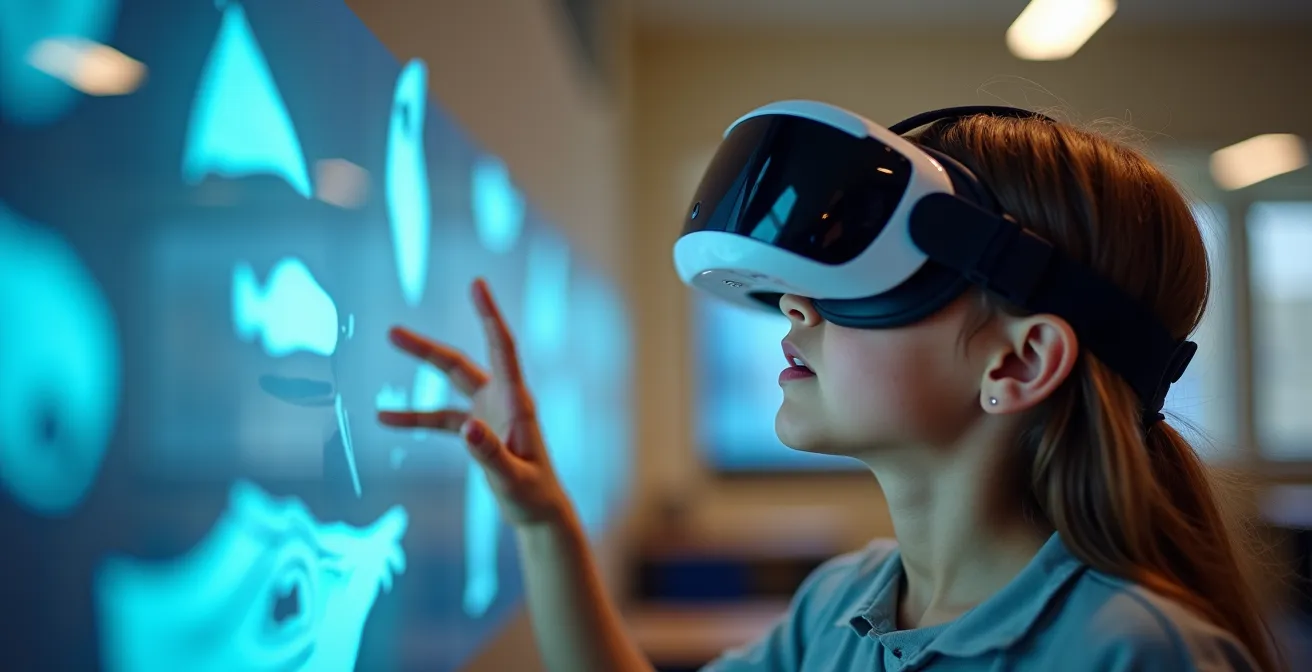
A prime example of this is the Smithsonian American Art Museum’s “Beyond the Walls” experience. Here, students can interact with educational hotspots within a virtual gallery. They can, for instance, be viewing Frederic Church’s painting *Aurora Borealis* one moment and then teleport to actual 360-degree footage of an aurora in Iceland the next. This act of active exploration—triggering information and making visual comparisons—cements the connection between the artwork and its real-world inspiration in a way a simple wall text never could. It fosters curiosity and rewards it instantly, a key principle of effective learning.
However, the success of educational VR hinges entirely on its design. A poorly executed experience can easily become a passive “VR movie,” offering little more agency than a traditional film. The key is interactivity that encourages critical thinking and observation, rather than simply presenting information in a new format. The technology itself is not a panacea for engagement; it is the pedagogical strategy behind it that determines its value.
Shared Experience or Solo Trip: The Social Cost of Headsets in Museums
Museums have always been more than just repositories for objects; they are social spaces. They are places for discussion, shared discovery, and human connection. A family points out details in a painting, a couple debates the meaning of a sculpture, a school group buzzes with questions. This social architecture is a fundamental part of the museum’s value. The introduction of VR headsets, however, fundamentally alters this dynamic. It shifts the visitor from a participant in a shared public experience to a subject on an isolated, individual journey.
When a visitor dons a headset, they are effectively removed from the physical and social environment of the gallery. The spontaneous conversations, the shared glances of wonder, the simple act of experiencing something together—all are replaced by a solitary digital immersion. While the internal experience might be rich, it comes at the cost of external connection. For institutions that pride themselves on being community hubs, this is a significant trade-off. It poses a philosophical question: are we designing spaces for people to connect with art, or for individuals to connect with technology?
Despite this, the push towards digital is strong, with a recent survey from the University of Glasgow’s “Museums in the Metaverse” project revealing that 77% of museums are exploring projects in the metaverse or using VR/AR. Yet, many professionals remain cautious. As one noted in an interview, “People are coming to a museum to see real objects because real objects are emotional.” The power of the authentic, tangible object is that it exists in the same shared space as we do, creating a common ground for emotional and social connection that a headset, by its very nature, precludes.
The Hidden Maintenance Costs of High-Tech Exhibitions
For any museum director, the initial price tag of a new technology is only the beginning of the story. The true cost of ownership is revealed over time through maintenance, updates, and staffing. High-tech exhibitions, particularly those involving VR, introduce a significant and continuous operational drag that can strain budgets long after the initial launch. While developing VR museum applications can be a one-time expense, the figures are already substantial, with a basic experience typically costing between $10,000 and $30,000 to develop, and far more for complex projects.
Beyond this initial development, the ongoing maintenance creates a completely different financial model than that of a traditional exhibition. A physical installation might run for years with minimal changes, supported by conservation specialists. A digital exhibition, however, is subject to the relentless cycle of technological obsolescence. It requires constant software patching, OS compatibility updates, and a full hardware refresh every few years. A server failure can render the entire exhibition inaccessible globally, a far more catastrophic point of failure than a single broken projector in a gallery.
This comparison highlights a fundamental shift in resource allocation. The investment moves away from physical conservation and security toward IT specialists, software licenses, and a recurring capital expense for new hardware. This table, based on an analysis of museum tech costs, starkly illustrates the different cost structures.
| Cost Category | VR Exhibition | Traditional Museum |
|---|---|---|
| Initial Setup | $300-$600 per headset (standalone) | Climate control installation |
| Ongoing Maintenance | Software updates, hardware refresh (3-year cycle) | Conservation specialists, physical security |
| Content Updates | Constant patching, OS compatibility | Static exhibitions can run for years |
| Failure Impact | Server failure = global inaccessibility | Single projector = partial exhibit down |
For decision-makers, this means budgeting for a VR exhibit requires a long-term strategy that accounts for this constant, resource-intensive cycle of upgrades and support.
Sanitizing Headsets: The Logistical Nightmare of Public VR
Beyond the grand concepts of immersion and digital art lies a far more mundane, yet critical, challenge: hygiene. In a post-pandemic world, public sanitation standards are under intense scrutiny, and the VR headset—a device worn directly on the face, covering the eyes, nose, and mouth area—presents a unique logistical nightmare. The process of ensuring every headset is safe and clean for every single user adds another layer of experiential friction and significant operational drag.
The visitor journey for a public VR experience is fraught with potential delays and complexities that are absent from a traditional walk-through exhibition. It’s not as simple as handing someone a device. A successful and safe deployment requires a multi-step, staff-intensive process that erodes the seamlessness the technology promises. This journey often includes:
- Waiting in line: Queuing for an available and sanitized headset station.
- Assisted fitting: Requiring staff assistance to ensure the headset is worn correctly and comfortably.
- Calibration: Adjusting settings like interpupillary distance to minimize discomfort.
- Controller training: A brief tutorial on how to navigate the virtual environment.
- The experience itself: Often limited to a short time slot to manage throughput.
- Sanitization cycle: Returning the equipment to be thoroughly cleaned with UV-C light or chemical wipes before it can be used again.
Each of these steps requires staff time, dedicated physical space, and specialized equipment. The need for robust sanitization protocols not only slows down visitor throughput but also increases staffing costs and the risk of bottlenecks. This unglamorous, behind-the-scenes work is a non-negotiable part of offering public VR, and its complexity and cost must be factored into any project plan from day one.
Why “I Spy” Games Work Better Than Audio Guides for Kids?
Engaging the youngest museum visitors has always been a unique challenge. While adults may appreciate the quiet contemplation of a gallery, children thrive on interaction, play, and discovery. Traditional audio guides, which require passive listening and sustained attention, often fail to capture their imagination. This is where the principles of gamification, exemplified by a simple game like “I Spy,” offer a more effective model—a model that VR, when used correctly, can elevate to a new level.
“I Spy” works because it is an active, search-and-find process. It gives the child a mission, directs their focus to specific details within a work of art, and provides the satisfaction of discovery. This is active recall and visual searching, which are far more engaging than passive listening. VR has the potential to become a “super-powered I Spy,” guiding a child’s attention not with a verbal prompt but with interactive visual cues, transforming art education into a captivating game.
The Crystal Bridges Museum’s VR experience based on Kerry James Marshall’s painting ‘Our Town’ is a perfect illustration. Instead of just looking at the painting, children can virtually step inside it. Once there, they can peel back layers of the artwork to highlight hidden details and understand its symbolism. This gamified approach grounds them in focused observation, turning the act of looking into an adventure. It maintains the playful simplicity that engages young learners while using technology to reveal a depth of content they might otherwise miss. It succeeds not by being technologically flashy, but by using the technology to enhance a proven, simple, and effective method of engagement.
Key Takeaways
- VR’s physical discomfort, especially motion sickness, is a significant barrier that can exclude a large portion of the potential audience.
- The hidden operational costs, including constant software maintenance and rigorous sanitization logistics, often outweigh the initial hardware investment.
- VR technology tends to isolate visitors, fundamentally altering the shared social experience that is core to the mission of many museums.
IMAX vs. Dolby Cinema: Which Premium Format Justifies the $25 Ticket?
The discussion around VR’s place in museums can be clarified by reframing it. Instead of a binary choice between “physical” and “virtual,” it’s more productive to see VR as one of several options in a growing ecosystem of premium, ticketed experiences. Just as cinemas offer upgraded formats like IMAX and Dolby for a higher price, museums are now presenting a menu of experiences, each with a distinct value proposition. The question for a director is not “VR or no VR?” but “What unique value does this specific premium format offer, and does it justify the cost for the visitor?”
A blockbuster physical exhibition offers the undeniable power of authentic objects and a vibrant social atmosphere. An IMAX film at a science museum delivers educational narrative on a spectacular scale. Free 360° virtual tours provide basic access with lower fidelity. Premium VR fits into this landscape as a deeply personal, immersive format. A digital art critic aptly captured the importance of context, stating that “viewing a masterpiece in VR can be a betrayal of the medium, just as watching an IMAX film on a phone is.” The value is tied to the appropriate delivery.
This comparative table helps contextualize the various offerings, clarifying where a premium VR experience might fit within an institution’s broader strategy.
| Experience Type | Cost | Duration | Value Proposition |
|---|---|---|---|
| Blockbuster Physical Exhibition | $25-35 | 2-3 hours (one-time) | Authentic objects, scale, social atmosphere |
| Premium VR Experience | $5-30 | Unlimited replays | Personalized immersion, permanent access |
| IMAX Museum Film | $20-25 | 45-60 minutes | Large-format spectacle, educational narrative |
| Free VR/360° Tours | $0 | Unlimited | Basic access, lower resolution, limited interactivity |
Ultimately, a successful strategy may involve a mix of these formats, each targeted to a different audience and purpose. A VR experience doesn’t have to compete with a physical exhibition; it can complement it, offering a different kind of value that justifies its own place—and price—in the museum’s portfolio.
Understanding Digital Art: How to Evaluate Quality Beyond the Screen?
Perhaps the most profound shift demanded by VR is in how we evaluate art itself. For centuries, quality has been tied to physical mastery: the artist’s brushstroke, the sculptor’s chisel. When an institution acquires or commissions a VR work, what are the new criteria for “quality”? The answer lies in judging the work based on medium specificity—evaluating it not on how well it mimics the physical world, but on how powerfully it uses the unique affordances of the virtual medium.
A simple 3D scan of a sculpture, while technologically interesting, is not natively digital art. It’s a reproduction. True digital art is conceived for the medium. A stellar example is Marina Abramović’s ‘Rising,’ a VR work created with Acute Art where users interact with the artist’s avatar inside a glass tank that slowly fills with water. This experience—centered on presence, user agency, and empathy—could not exist in any other form. Its quality is judged by the ingenuity of its world-building, the emotional impact of its interactivity, and the conceptual depth of its use of virtual presence. It is a work born of the medium.
For curators and directors, this requires developing a new language of critique and a new framework for evaluation. It means asking different questions: Does this work leverage the sense of presence unique to VR? Is the interactivity meaningful or merely a gimmick? Is the artist using the virtual space to explore concepts that would be impossible in physical reality? Answering these questions is the final and most important step in navigating the world of digital exhibitions.
Your Action Plan: Framework for Evaluating VR and Digital Art
- Assess world-building: Evaluate the quality and ingenuity of the spatial design unique to the VR environment.
- Analyze interactivity: Judge the meaningfulness of user agency. Is it integral to the concept or a superficial feature?
- Determine medium-specificity: Consider whether the work is ‘natively digital’ or merely a 3D scan of a physical object.
- Examine technical execution: Look at the innovation and difficulty involved in the programming and asset creation.
- Understand conceptual intent: Analyze the artist’s statement and how the virtual medium serves their core idea.
By shifting the focus from technological novelty to artistic and conceptual integrity, institutions can make informed decisions, championing works that truly advance the form rather than simply digitizing the past.
To move forward, apply this evaluation framework to your next digital proposal. It will enable you to look beyond the hype and invest in experiences that offer genuine, lasting value to your audience and your institution.
Frequently Asked Questions About VR in Museums
What age is recommended for VR museum experiences?
Although VR headsets can be used at any age, museums typically recommend experiences for ages 13 and older due to both content complexity and headset fit considerations.
How does VR compare to traditional audio guides for engagement?
VR provides visual search and active recall similar to ‘I Spy’ games, while audio guides promote passive listening. VR can become a ‘super-powered I Spy’ by highlighting hidden details.
Can parents participate with children in VR experiences?
Most VR experiences are individual, but some museums offer multi-user experiences or companion apps that allow parents to see what their child is viewing on external screens.