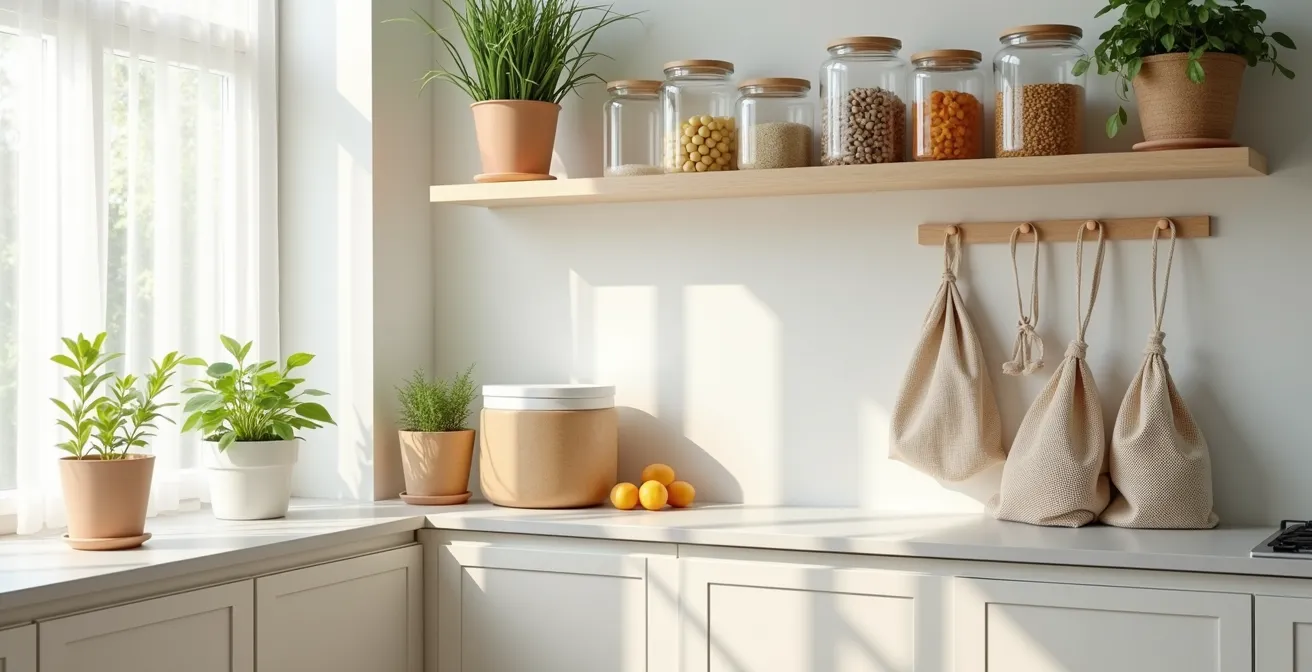
Going zero waste in an apartment often fails not from a lack of effort, but from a lack of systems designed for small spaces.
- The key isn’t just buying reusable items, but creating efficient workflows for composting, shopping, and cleaning that prevent waste from ever entering your home.
- Success comes from identifying and solving small “friction points”—like compost smell, container storage, or food spoilage—before they derail your progress.
Recommendation: Instead of trying everything at once, start by mastering one system, like a food-waste-triage in your fridge, to build momentum.
The dream of a zero-waste lifestyle often conjures images of sprawling gardens with bubbling compost piles and pantries stocked with farmer’s market hauls. For the apartment dweller, the reality is… different. It’s a world of limited counter space, strict building rules, and no backyard to be seen. It’s easy to feel like the movement wasn’t designed for you. Many start with enthusiasm, buying reusable coffee cups and tote bags, only to find their kitchen overflowing with smelly food scraps and a confusing jumble of containers.
The common advice to “just compost” or “buy in bulk” often ignores the very real logistical hurdles. Where does the compost go? How do you manage ten different glass jars in a tiny kitchen? These unresolved friction points are why so many well-intentioned efforts fizzle out, leaving you with more clutter and a sense of guilt.
But what if the secret to apartment zero waste wasn’t about willpower or having the perfect set of eco-gadgets? What if it was about thinking like a systems designer? The true path to reducing trash in a small space lies in creating clever, non-judgmental, and practical systems that work with your limitations, not against them. It’s about strategically managing the flow of resources through your home, from food and packaging to clothing and personal care items.
This guide breaks down those systems. We’ll move beyond the basics to tackle the specific challenges of apartment living, offering ingenious solutions for the most common roadblocks. From choosing a genuinely odor-free compost method to mastering the art of the bulk aisle without losing your mind (or your security deposit), you’ll learn how to build a resilient, low-waste home, one practical system at a time.
To help you navigate these solutions, this article is structured to tackle each major pain point of apartment-based zero waste. The following summary outlines the key systems we will build together.
Summary: A Systems-Thinking Guide to Less Trash in Your Apartment
- Bokashi vs. Vermiculture: Which Indoor Compost Smells Less?
- Bulk Aisle Strategy: How to Shop Without Plastic Bags?
- Paper Towels vs. Swedish Dishcloths: Which Is More Hygienic and Eco-Friendly?
- The “Eat Me First” Box: Organizing the Fridge to Stop Throwing Away Food?
- Buy Nothing Groups: How to Get Free Stuff and Declutter Responsibly?
- The Recycling Myth That Encourages You to Buy More Clothing
- Rethinking the Bathroom: Personal Care Waste Beyond the Bin
- Car-Free Commuting: How to Ditch the Vehicle for Work in the Suburbs?
Bokashi vs. Vermiculture: Which Indoor Compost Smells Less?
The single biggest fear for any apartment composter is the smell. The idea of rotting food in a small, enclosed space is a non-starter. This is where choosing the right closed-loop system is critical. The two most popular indoor methods, Bokashi and vermiculture (worm composting), operate on entirely different principles, leading to very different experiences with odor and maintenance. Vermiculture is a decomposition process, while Bokashi is a fermentation process.
Vermiculture uses worms to break down food scraps into rich castings. When managed correctly, a worm bin has a pleasant, earthy smell. However, it can attract fruit flies if not maintained, and the worms are picky eaters—no meat, dairy, or oily foods. Bokashi, on the other hand, is an anaerobic process that pickles your food scraps using a special bran. It can handle almost any food waste, including meat and dairy. The primary smell is a tangy, fermented scent, but it’s only noticeable when you open the airtight bucket.
The crucial question then becomes, what do you do with the final product? A common friction point for apartment dwellers is having nowhere to put the finished compost. This is where community solutions shine. An apartment dweller in one case study found a perfect solution by using a local network. They used ShareWaste.com and discovered someone with a worm composter just 10 minutes away who was happy to accept their bokashi pre-compost. This creates a symbiotic relationship, solving the “final product” problem entirely. Others create a “soil factory” on a balcony, mixing the fermented bokashi with old potting soil to create nutrient-rich earth for houseplants.
To help you decide, this table breaks down the practical differences between the two leading indoor composting systems.
| Factor | Bokashi | Vermiculture |
|---|---|---|
| Odor Level | Mild fermented/pickled smell when opened | Earthy, minimal when properly maintained |
| Daily Tasks | Add scraps, sprinkle bran, press down | Add scraps 2-3x weekly |
| Weekly Tasks | Drain liquid ‘tea’ 2-3 times | Check moisture, add bedding if needed |
| Monthly Tasks | Empty full bin after 2-week fermentation | Harvest castings every 2-3 months |
| Pest Risk | Very low (sealed system) | Low-moderate (fruit flies possible) |
| Space Required | 1-2 buckets (5 gallons each) | Single bin (similar footprint) |
Bulk Aisle Strategy: How to Shop Without Plastic Bags?
The bulk aisle is a zero-waste haven, but for an apartment dweller, it can feel like a logistical nightmare. Juggling jars, figuring out tare weights, and finding storage space can be major friction points. The key is to develop a streamlined system before you even leave your apartment. This starts with creating a minimalist, lightweight bulk shopping kit. Forget lugging a heavy box of empty mason jars; think cloth drawstring bags for grains and beans, mesh bags for produce, and just one or two small jars for liquids like oil or honey.
The next hurdle is the tare weight (the weight of your empty container). Without this, you’ll be paying for the weight of your jar. One of the most effective systems is to weigh your containers at home and mark the weight on the bottom with a piece of masking tape. Some co-ops have a customer service scale to do this for you, but having them pre-marked saves time. This simple prep work transforms the checkout process from a frantic scramble into a smooth, organized flow.

Once you get your bulk goods home, storage becomes the challenge. A brilliant solution for small kitchens is the vertical pantry. Instead of taking up precious cabinet real estate, use wall-mounted shelving to store your matching jars. This not only saves space but creates a visually appealing and highly organized system. One studio apartment dweller successfully transformed their 400 sq ft space by swapping bulky plastic containers for mason jars on vertical shelves, which actually freed up room while eliminating packaging waste.
Your Action Plan: The Complete Tare Weight Guide
- Before shopping: Weigh your empty containers at home and clearly mark the weights on the bottom with masking tape or a grease pencil.
- At co-ops: Use the scale at the customer service desk to get official tare weights recorded in their system if they offer this service.
- At chain stores: Politely ask the cashier to tare your container’s weight before you fill it, or have your pre-weighed containers ready.
- Pro tip: Take a quick photo of your container on the store’s scale displaying its weight. This serves as a handy reference for future trips.
- Checkout etiquette: Group your containers by similar tare weights to help the cashier move through them efficiently, and always be patient.
Paper Towels vs. Swedish Dishcloths: Which Is More Hygienic and Eco-Friendly?
The debate between disposable paper towels and reusables often centers on convenience versus eco-friendliness. But for apartment living, two other factors are just as important: hygiene and cost. Swedish dishcloths, which are super-absorbent cloths made of cellulose and cotton, are a popular alternative. They can be sanitized and reused for months, but are they truly hygienic for every task?
The answer lies in creating a waste triage system for your cleaning cloths, not in a one-size-fits-all replacement. While a Swedish dishcloth is excellent for general spills and wiping counters, you might want a designated, color-coded cloth for riskier jobs like cleaning up after raw meat. The key to hygiene with any reusable cloth is proper sanitization. Most can be run through a hot dishwasher cycle or zapped in the microwave (when damp) for two minutes to kill bacteria. For heavy-duty disinfection, boiling for five minutes is a foolproof method.
Beyond hygiene, the financial and environmental costs are stark. A simple cost analysis shows that the average household spends $150-200 per year on disposable paper towels. A set of Swedish dishcloths or microfiber towels that lasts a year or more costs only $20-30. By creating a system with the right tool for each job, you not only reduce waste but also save a significant amount of money.
The table below outlines a task-specific system, moving beyond a simple “paper towel vs. cloth” binary to a more nuanced and hygienic approach.
| Task | Best Reusable Option | Sanitization Method |
|---|---|---|
| Greasy Spills | Microfiber cloth | Hot water wash + dishwasher cycle |
| Glass Cleaning | Lint-free cotton cloth | Machine wash hot |
| Raw Meat Cleanup | Designated color dishcloth | Boiling water 5 mins or bleach solution |
| Dusting | Old t-shirt rags | Regular machine wash |
| General Kitchen | Swedish dishcloth | Dishwasher top rack or microwave damp 2 mins |
The “Eat Me First” Box: Organizing the Fridge to Stop Throwing Away Food?
Food waste is one of the largest and most frustrating sources of household trash. It feels like throwing money directly into the bin. The EPA confirms this on a national scale, stating that 24% of all material going to US landfills is food scraps. In an apartment, where fridge space is at a premium, leftovers and produce can easily get lost in the back, only to be rediscovered when it’s far too late. The “Eat Me First” box is a brilliantly simple system to combat this.
The concept is a form of resource flow management. You designate one clear container or a specific shelf in your fridge as the “triage zone.” Anything that needs to be eaten soon—half an onion, leftover pasta, yogurt nearing its expiration date, wilting greens—goes into this box. It becomes the first place you look when you’re hungry. This simple visual cue prevents perfectly good food from being forgotten and ultimately wasted.
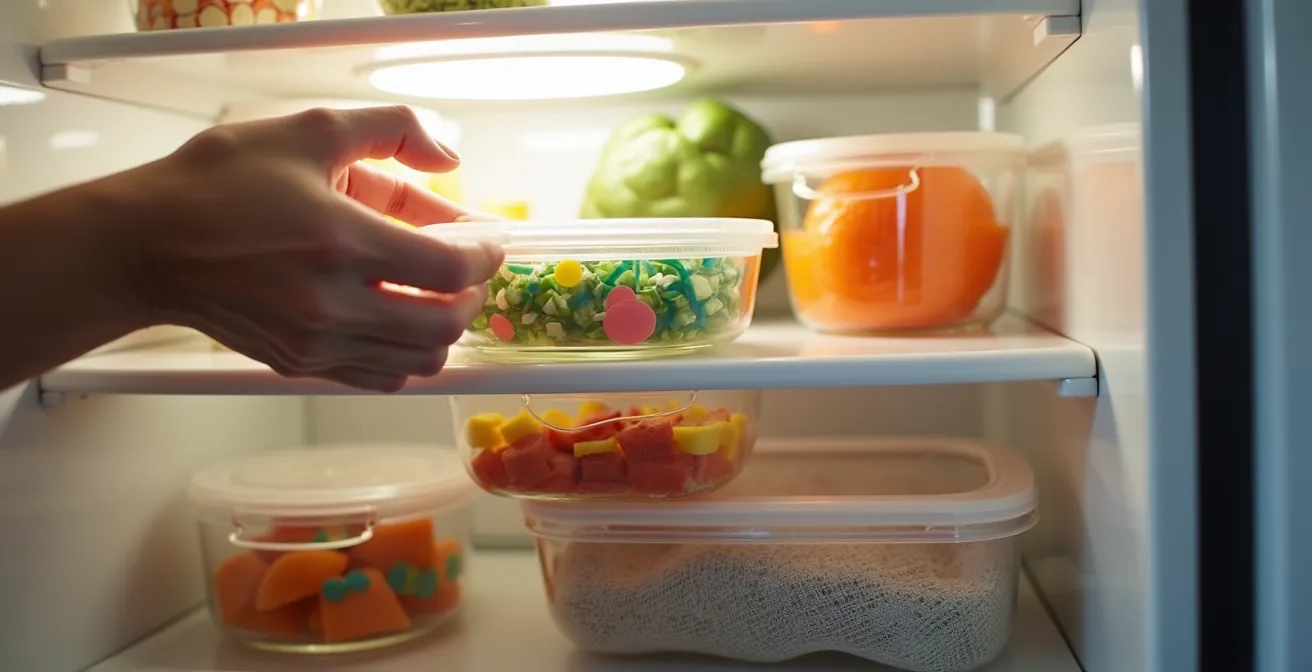
To make this system even more powerful, you can pair it with a low-tech inventory. A small whiteboard on the fridge door listing the contents of the “Eat Me First” box and freezer provides an at-a-glance view of what you have. This prevents you from buying duplicates and helps with meal planning. The impact is significant; one study showed that apartment dwellers using a simple whiteboard system to track their “Eat Me First” items reported reducing their food waste by up to 50%. It’s not just about saving food; it’s about saving all the energy and resources that went into growing and transporting it.
This strategy is about making the right choice the easiest choice. When you’re hungry and looking for a snack, the food that needs to be eaten is front and center, not hidden behind a carton of milk. It transforms your fridge from a passive storage unit into an active food management system.
Buy Nothing Groups: How to Get Free Stuff and Declutter Responsibly?
A core tenet of zero waste is to reduce consumption, but what about the things you genuinely need or the items you no longer want? This is where Buy Nothing groups, typically hosted on Facebook, become an essential part of an apartment dweller’s zero-waste system. These hyperlocal groups facilitate a gift economy where neighbors can offer items they no longer need (an “Offer”) or ask for things they are seeking (an “ISO” – In Search Of).
For someone in a small apartment, this is a game-changer. Instead of buying a new stand mixer you’ll only use twice a year, you can borrow one from a neighbor. Instead of sending a perfectly good lamp to the landfill because it doesn’t match your decor, you can gift it to someone who will love it. One user reported acquiring two nightstands, a bookstand, and even a portable treadmill through their local group. The movement is massive; the Buy Nothing Project has expanded to include over 6 million members globally, proving the power of community-based sharing.
Participating effectively requires understanding the group’s etiquette. Clear, concise posts work best. When offering an item, include a photo, a brief description of its condition, and clear pickup instructions. When asking for something, be specific about what you need and flexible on the condition. This system isn’t just about getting free stuff; it’s about building community and creating a closed-loop system for physical goods within your own neighborhood, diverting countless items from the landfill.
Here are some templates for creating effective posts that get results:
- ISO (In Search Of) Template: “ISO: [specific item, e.g., a small bookshelf] for [brief reason, e.g., organizing my new apartment]. I can pick up any evening this week. Happy to take one that’s a bit wobbly or scratched!”
- OFFER Template: “OFFER: [item + condition, e.g., Set of 4 coffee mugs, no chips]. Must be picked up by Friday. Porch pickup available at [cross-streets or general location].”
- Pro Tip: Always include photos when offering items, as it can increase the response rate dramatically. Being prompt in your replies and closing the loop by commenting “TAKEN” or “FOUND” maintains goodwill within the group.
The Recycling Myth That Encourages You to Buy More Clothing
“It’s okay, I’ll just recycle it.” This phrase is often used to justify fast fashion purchases, but it’s built on a pervasive myth. While we diligently sort our plastics and papers, textile recycling is a different beast. The comforting idea that your old t-shirt will be magically transformed into a new one is almost entirely false. In reality, industry data reveals that less than 1% of clothing is actually recycled into new garments. Most of it is downcycled into lower-value products like industrial rags, insulation, or carpet padding before eventually ending up in a landfill.
This “wishcycling” encourages more consumption, not less. The most powerful zero-waste action you can take with clothing is not at the end of its life, but at every stage before that. This means embracing a hierarchy of actions that prioritizes longevity. For apartment dwellers, this system must be space-efficient and practical. A great solution for managing microplastic pollution from synthetic clothing is using a Guppyfriend washing bag, which can capture a huge percentage of the plastic microfibers that would otherwise enter our water systems with every wash.
The most sustainable wardrobe is the one you already have. Instead of relying on a broken recycling system, adopt a more resilient, circular approach to your closet. This framework prioritizes keeping items in their highest-value state for as long as possible:
- Repair: The first line of defense. Learn basic mending skills like sewing a button or fixing a seam. “Visible mending” has even become a stylish way to give clothes a second life.
- Swap: If an item no longer serves you, trade it. Organize a clothing swap with friends or use swapping apps to refresh your wardrobe without buying anything new.
- Consign/Sell: For high-quality items, use platforms like Poshmark or ThredUp. This extends the life of the garment and puts cash back in your pocket.
- Repurpose: When a garment is truly at the end of its life, cut it into cleaning rags, use it as stuffing for a craft project, or find other creative uses around the apartment.
- Last Resort Recycling: Only after all other options are exhausted, seek out a dedicated textile recycling program. Some retail stores or local municipal services offer this, but it should always be the final step.
Rethinking the Bathroom: Personal Care Waste Beyond the Bin
The bathroom is a hidden generator of single-use waste. From cotton swabs and floss containers to disposable razors and menstrual products, the small trash can fills up surprisingly fast. Creating a zero-waste system here requires looking at each product and finding a durable, reusable alternative that works in a tight space. For many, the biggest impact comes from rethinking period care.
Disposable pads and tampons create a significant amount of waste over a lifetime. Reusable options like menstrual cups, period underwear, and cloth pads have become mainstream, reliable, and apartment-friendly. A menstrual cup, for example, is made of medical-grade silicone, can be worn for up to 12 hours, and lasts for up to ten years. The impact is staggering: research indicates that one menstrual cup can replace over 200 disposable products per year, saving the user $100-150 annually and diverting thousands of items from the landfill over its lifespan.
The concern for many apartment dwellers is cleaning and storage. However, the systems are simple. A menstrual cup just needs to be rinsed between uses and boiled for a few minutes once a month for sanitization. Period underwear can be rinsed in cold water and then tossed into your regular laundry. The key is finding the product that best fits your body and lifestyle.
This table breaks down the most popular reusable options, highlighting their apartment-friendly features to help you find the right fit for your personal care routine.
| Product Type | Apartment-Friendly Features | Cleaning Method | Lifespan |
|---|---|---|---|
| Menstrual Cup | Compact storage, no waste bin needed | Rinse and boil monthly | 5-10 years |
| Period Underwear | Works like regular underwear | Rinse cold, machine wash | 2-3 years |
| Cloth Pads | Folds small for storage | Soak, then machine wash | 3-5 years |
| Reusable Discs | Can be worn during intimacy | Wash with soap and water | 2+ years |
Key Takeaways
- Zero waste in an apartment is achieved by building smart systems, not just by buying eco-products.
- Focus on solving real-world “friction points” like odor, storage, and convenience to make sustainable habits stick.
- Community resources like Buy Nothing groups and compost-sharing apps are powerful tools for apartment dwellers.
Car-Free Commuting: How to Ditch the Vehicle for Work in the Suburbs?
Once you’ve implemented systems to drastically reduce waste inside your apartment, you may start looking at the other major sources of your environmental footprint. For many, the biggest one is transportation. While this topic extends beyond the four walls of your home, it’s the logical next frontier in a holistic low-impact lifestyle. The principles are the same: identify the friction points and design a system to overcome them.
Ditching a car, especially in the suburbs, seems daunting. The “last mile” problem—the distance from the bus stop or train station to your office or home—is often the biggest barrier. The solution is to build a multi-modal transit system. This could mean combining a bus ride with a foldable bike or electric scooter that you can easily carry onboard. Planning your route with apps that integrate public transit, bike paths, and walking times is the first step.
Another major friction point is weather. Having the right gear—waterproof pants, good gloves, a reflective jacket—is not an expense, but an investment in the viability of your car-free system. Similarly, if your workplace doesn’t have showers, you can create a “refresh kit” with dry shampoo and body wipes to make a bike commute practical. It’s about proactively solving the problems that would otherwise become easy excuses to take the car.
Ultimately, this is the final evolution of the zero-waste mindset: applying the same systematic, problem-solving approach you used for your kitchen scraps and clothing to the larger resource flows in your life. It’s about seeing your commute not as a single choice, but as a system you can design for efficiency, health, and sustainability.
Start by auditing your most common trips for one week. By applying the same ingenious and practical mindset you’ve used to reduce waste inside your home, you can begin to design a transportation system that aligns with your values and frees you from reliance on a car.