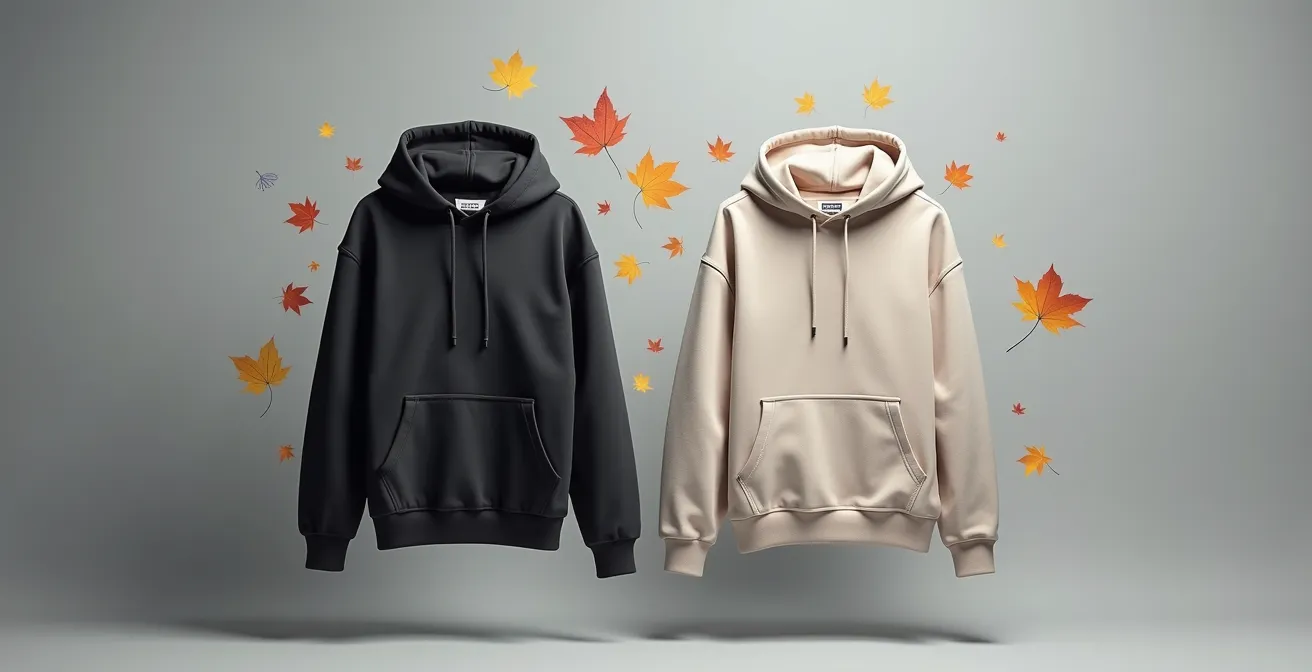
The true performance of a hoodie isn’t defined by its GSM number, but by how its fabric structure and construction function within a dynamic layering system.
- Heavyweight hoodies (400+ GSM) often cause overheating indoors by trapping heat and moisture, compromising their role as a versatile mid-layer.
- Fabric type is critical: French terry offers superior breathability and moisture wicking for active use, while fleece provides static insulation for dry, cold conditions.
Recommendation: Prioritize mid-weight (280-380 GSM) hoodies with technical features like French terry construction and zip-up fronts to build a modular system that adapts to changing temperatures.
For any streetwear enthusiast living in a climate with fluctuating temperatures, the daily battle is real: you leave the house perfectly comfortable, only to find yourself either shivering in the shade or sweating on public transport. The common wisdom points to fabric weight, measured in Grams per Square Meter (GSM), as the ultimate solution. A high GSM for cold days, a low GSM for warm ones. But this simplistic view is the primary cause of thermal discomfort. It ignores the complex interplay between fabric, construction, and the other clothes you wear.
This approach often leads to owning a closet full of hoodies that are individually impressive but functionally useless as part of a versatile wardrobe. The 500 GSM heavyweight piece feels like a fortress against the wind but becomes a personal sauna the moment you step inside. This guide moves beyond the platitudes of “heavier is warmer.” We will deconstruct the hoodie and analyze it not as a single garment, but as a critical component in a personal thermal regulation system. It’s time to stop thinking about a hoodie’s weight and start thinking about its technical performance.
By understanding the material science behind different textiles and the architectural details of garment construction, you can master the art of layering. We will explore why fabric structure often matters more than raw weight, how to choose between different materials for specific activities, and which construction details signal a truly premium, functional garment. This is your blueprint for achieving perfect comfort, no matter what the day throws at you.
To navigate this technical deep-dive, here is a breakdown of the key specifications we will analyze to build your ideal layering strategy.
Summary: A Technologist’s Guide to Hoodie Fabric Weight
- Why a 500 GSM Hoodie Is Too Hot for Indoor Layering?
- How to Choose Between French Terry and Fleece for Moisture Management?
- Zip-Up or Pullover: Which Works Better Under a Denim Jacket?
- The Dryer Mistake That Ruins the Elasticity of Your Cuffs
- Double-Lined Hoods: The Detail That Define a Premium Silhouette
- How to Manage Sweat When the Air Temp Is Freezing?
- Vest or Handheld: Which Hydration System Won’t Chafe on Long Runs?
- Tailored Joggers: The Secret to Staying Comfortable While Looking Sharp on Zoom
Why a 500 GSM Hoodie Is Too Hot for Indoor Layering?
The allure of a heavyweight hoodie is undeniable. A high GSM number, often north of 450 or even 500, suggests durability, luxury, and supreme warmth. While it excels as a standalone outer layer in crisp, dry cold, its utility plummets the moment it’s used as a mid-layer in a variable environment. The problem lies in its lack of adaptability. Its dense, heavy fabric is engineered for maximum heat retention, a property that becomes a liability indoors. This creates a “static insulation” trap, where the garment cannot effectively vent the excess heat and moisture your body generates, even during low-level activity like walking around an office or a store.
This leads to a rapid “soak out,” where your own perspiration gets trapped against your skin, making you feel clammy and uncomfortable. When you eventually step back outside into the cold, that trapped moisture accelerates heat loss, leaving you colder than you would have been with a lighter, more breathable system. The core principle of effective layering is modularity—the ability to make small adjustments to manage your micro-climate. A 500 GSM pullover offers only two options: on (too hot) or off (too cold).
For a streetwear enthusiast whose day involves moving between heated interiors and cold exteriors, a mid-weight hoodie (around 280-380 GSM) is a technically superior choice. It provides a solid baseline of insulation that can be easily augmented with a base layer or an outer shell, without overwhelming the system. The goal isn’t maximum warmth; it’s dynamic thermal regulation, and in that context, the ultra-heavyweight hoodie often fails.
Action Plan: Building a Modular Layering System
- Base Layer Focus: Start with a 180 GSM merino wool or technical fabric base layer. Its primary job is moisture management, not insulation.
- The Adjustable Mid-Layer: Add a 280-350 GSM French terry zip-up hoodie. This is your primary thermal control unit.
- Ventilation Control: Use the zip to create ventilation zones. Partially unzipping allows for rapid micro-climate adjustment without removing your outer jacket.
- Activity-Based Adjustment: Remove or add layers based on your activity level. A modular system allows this without a full “de-layering” reset.
- Friction Reduction: Choose smooth-faced fabrics for your mid-layer to prevent bunching and friction when worn under a shell or jacket.
How to Choose Between French Terry and Fleece for Moisture Management?
While GSM tells you a fabric’s weight, its structure dictates how it handles heat and moisture. For a hoodie acting as a mid-layer, this is a far more critical specification. The two most common materials, French terry and fleece, offer fundamentally different approaches to thermal regulation, making them suitable for very different conditions.
French Terry is a knit fabric characterized by its smooth outer face and a looped, absorbent pile on the inside. These loops create tiny air channels, which makes the fabric exceptionally breathable. More importantly, they function like a towel, actively pulling moisture (sweat) away from your skin and distributing it across a wider surface area to facilitate evaporation. This defines its role as a superior material for active layering, where you anticipate generating sweat. It manages the moisture pathway effectively, moving perspiration outward and preventing that clammy feeling.
Fleece, on the other hand, is typically a synthetic polyester fabric where the surface has been brushed to create a dense, fuzzy texture. This process traps a significant amount of air, making it an excellent insulator for its weight. However, its fibers are hydrophobic (they repel water) and its dense structure offers limited breathability. While it does wick moisture away from the skin, it doesn’t absorb it. This makes fleece an ideal choice for static insulation in very cold, dry conditions where you are not physically active and the primary goal is to retain body heat. When you start to sweat in fleece, it can quickly feel swampy.
The following table, based on common fabric properties, breaks down their performance characteristics. As a study published on the differences between French terry and fleece explains, the choice depends entirely on the intended use case.
| Property | French Terry | Fleece |
|---|---|---|
| Breathability | Excellent – looped structure creates air channels | Limited – dense brushed surface traps heat |
| Moisture Absorption | High – cotton loops absorb up to 27% of weight | Low – synthetic fibers repel moisture |
| Moisture Wicking | Superior – actively moves sweat outward | Moderate – wicks but doesn’t absorb |
| Drying Time | Moderate – cotton takes time to dry | Fast – synthetic polyester dries quickly |
| Best Use Case | Active mid-layer under shell jacket | Static insulation layer in dry cold |

As the visual comparison shows, the physical structure of the fabric is the key determinant of its performance. The open, looped architecture of French terry is engineered for moisture transport, while the dense, brushed pile of fleece is engineered for heat capture.
Zip-Up or Pullover: Which Works Better Under a Denim Jacket?
When a hoodie is part of a layered outfit, its closure system—zip-up or pullover—becomes a primary feature for thermal regulation. Under a semi-rigid outer layer like a denim jacket, the choice has significant implications for comfort and practicality. While the pullover offers a clean, uninterrupted aesthetic, the zip-up is technically superior for dynamic layering.
A study of urban commuters highlighted the concept of “dynamic thermal regulation,” finding that zip-up hoodies allow for rapid temperature adjustments without the need to remove the outer jacket. This is invaluable when transitioning between environments, such as stepping from a cold street into a warm subway car. The ability to simply unzip the hoodie provides an immediate ventilation channel, releasing trapped heat and moisture. A pullover, by contrast, forces an “all-or-nothing” approach; your only option to cool down is to remove the entire denim jacket and hoodie, which is often impractical.
The zip-up also offers more stylistic versatility in a layered context. It can be worn fully zipped for a clean look, partially unzipped to show a base layer tee, or fully open like a cardigan, creating three distinct silhouettes. A pullover offers only one. This functional advantage makes the zip-up the more strategic choice for anyone navigating a variable climate. Regional preferences often reflect these climate realities. As the HC Activewear Manufacturing Guide notes, there’s a clear trend:
North America and Europe prefer thicker hoodies (350gsm+), while Southeast Asia and the Middle East favor lightweight breathable fabrics (200-300gsm)
– HC Activewear Manufacturing Guide, Choosing the Right Hoodie Fabric Weights
This highlights how local climate dictates technical needs. In a place with wide temperature swings, the regulatory function of a zip-up becomes paramount, allowing a single mid-layer to perform across a broader range of conditions.
The Dryer Mistake That Ruins the Elasticity of Your Cuffs
One of the most common points of failure on a well-loved hoodie is the loss of elasticity in the cuffs and hem. They become loose, stretched-out, and lose their ability to create a snug seal against the cold. While wear and tear play a role, the primary culprit is often a simple laundering mistake: excessive heat in the dryer. Most ribbed cuffs are knit with a blend of cotton and a small percentage of elastane (also known as Spandex or Lycra) to provide stretch and recovery.
Elastane is a polymer that is highly sensitive to heat. Technical data shows that elastane fibers can be permanently damaged when exposed to temperatures above 65°C (149°F), the point at which they begin to shrink and lose their elastic properties. A standard “hot” cycle on a household dryer can easily exceed this threshold, essentially “cooking” the elastane fibers with each wash. Over time, they become brittle and snap, leaving the cotton structure without its elastic backbone. The result is a permanently stretched-out cuff.

To prevent this, the single most effective method is to air-dry your hoodies or use a “no heat” or “air fluff” setting on your dryer. If you must use heat, always choose the lowest possible setting. If the damage is already done, there is a recovery technique that can partially restore the shape, though it cannot repair the broken elastane fibers themselves. The process involves using hot water to shrink the cotton fibers around the damaged elastane.
To attempt a recovery:
- Submerge only the damaged cuffs in very hot (not boiling) water for 10-15 minutes.
- Gently squeeze out the excess water without wringing or twisting.
- Manually reshape the cuffs to your desired tightness while they are still damp.
- Let them air dry completely at room temperature, away from direct heat.
Double-Lined Hoods: The Detail That Define a Premium Silhouette
Beyond fabric type and weight, certain construction details elevate a hoodie from a basic staple to a premium garment. Perhaps the most significant of these is the double-lined hood. This feature, where the hood is constructed from two layers of fabric instead of one, has a profound impact on the garment’s structure, comfort, and overall aesthetic—what can be called its architectural integrity.
A single-layer hood, especially on a mid-weight hoodie, tends to be flimsy. It collapses when worn down and lacks the structure to frame the face properly when worn up. A double-lined hood, by contrast, has the necessary weight and substance to maintain its shape. It sits neatly on the shoulders and back when down, avoiding the crumpled look of a lesser-quality piece. When pulled up, it creates a more defined, protective silhouette that offers better insulation and a degree of sound dampening, creating what some designers call a “cocoon effect.”
Case Study: The SANVT Perfect Sweatshirt
The German brand SANVT provides an excellent example of this principle. A look at their product philosophy reveals that their Perfect Sweatshirt, built from a 400 GSM French Terry, features a double-lined hood as a core design element. According to information available from SANVT, this architectural detail is crucial for elevating perceived quality. The brand emphasizes that the double layer ensures the hood maintains its structure, frames the face elegantly, and distributes weight evenly across the shoulders, demonstrating how a construction choice directly translates to a superior user experience.
This detail is particularly relevant for the modern “Work From Home” uniform, where looking sharp on video calls is key. A structured hood creates a more polished and intentional silhouette than a flimsy, collapsed one. As one industry source notes:
Startup brands report that hoodies with double-lined hoods in the 340-380 GSM range achieve the perfect balance for ‘WFH power uniforms’ – substantial enough to look premium on video calls while avoiding the bulkiness that can overwhelm tailored joggers.
– MHQ Hoodies, Hoodie Fabric GSM Guide
Therefore, when assessing a hoodie’s quality, the construction of the hood is a non-negotiable checkpoint. It is a clear indicator of whether the garment was designed with purely cost in mind or with a focus on structure, longevity, and silhouette.
How to Manage Sweat When the Air Temp Is Freezing?
One of the greatest challenges in cold-weather activity is managing the sweat produced during exertion. This phenomenon, often called “sweating out,” can lead to a dangerous and rapid loss of body heat once the activity stops. The air temperature may be freezing, but your body is generating a tropical micro-climate inside your layers. If that moisture isn’t managed effectively, your insulation becomes compromised. Cotton is the primary enemy here; when it gets damp, it loses nearly all of its insulating properties and actively pulls heat from your body.
The solution is a two-pronged strategy: using the right materials during activity and having a plan for the immediate cooldown period. During high-output activities like running or hiking in the cold, your mid-layer hoodie must be chosen for maximum breathability. For this purpose, technical fabrics in a lighter weight class are optimal. Studies on athletic apparel suggest that for active use, athletic hoodies perform best for moisture-wicking and breathability at 200-250 GSM. A lightweight, grid-pattern fleece or a merino-blend French terry will actively move moisture away from your base layer without trapping excessive heat.
Equally important is the post-activity transition. As soon as you stop moving, your body’s heat production plummets, but you are still covered in damp clothing. This is the most critical moment for heat loss. Having a dedicated, dry “cooldown hoodie” is a pro-level technique to prevent post-exercise chill. The protocol is simple but effective:
- Pack a Dry Layer: Carry a dry, lightweight (250-350 GSM) merino wool or grid fleece hoodie.
- Immediate Swap: The moment your activity ends, remove your wet base layer if possible.
- Apply Dry Insulation: Put on the dry technical hoodie while your body is still warm. This traps the residual heat.
- Trap Head Heat: Use the hood immediately to prevent the significant heat loss that occurs from the head.
- Add a Shell: Once your core temperature begins to stabilize, layer your outer shell jacket over the dry hoodie to block wind and lock in warmth.
Vest or Handheld: Which Hydration System Won’t Chafe on Long Runs?
For runners, chafing is a persistent enemy, and the friction between clothing layers and gear is the primary cause. While the design of a hydration vest or handheld system is important, a frequently overlooked factor is the technical specification of the hoodie worn underneath it. The wrong hoodie can turn a high-performance hydration vest into an instrument of torture over the course of a long run. The key variables are fabric weight (GSM), fit, and seam construction.
A heavyweight hoodie is the worst possible choice to wear under a hydration vest. Its bulk creates excessive material that can bunch up under the vest’s straps, creating intense pressure points and friction zones. A mid-weight hoodie (280-350 GSM) can be manageable, but it requires careful adjustment of the vest to ensure a snug fit without being restrictive. Any looseness will allow the layers to rub against each other and your skin, leading to chafing.
The optimal choice is a lightweight, technical running hoodie, typically in the 150-250 GSM range. These garments are designed specifically for this use case. They have a slim, athletic fit that minimizes excess fabric, and most importantly, they feature flatlock seams. Unlike traditional raised seams, flatlock seams lie completely flat against the fabric, presenting a smooth surface that drastically reduces the risk of rubbing under the pressure of a vest’s straps. The material itself, often a polyester/elastane blend, has a smooth face that glides rather than grabs against the nylon of the vest.
The relationship between a hoodie’s weight and its compatibility with a running vest is a critical technical consideration for any athlete. The data on this is clear, as shown by analysis from sources like Garment Printing’s hoodie weight guide.
| Hoodie Weight | GSM Range | Vest Compatibility | Chafing Risk |
|---|---|---|---|
| Lightweight | 200-280 | Excellent | Low – thin profile minimizes friction |
| Midweight | 280-350 | Good | Moderate – requires proper fit adjustment |
| Heavyweight | 350+ | Poor | High – bulk creates pressure points |
| Technical Running | 150-250 | Optimal | Minimal – flatlock seams prevent rubbing |
Key Takeaways
- A hoodie’s function is determined more by its fabric structure (French terry vs. fleece) and construction (zip vs. pullover) than by its GSM alone.
- For variable climates, a mid-weight (280-380 GSM) French terry zip-up hoodie offers the best balance of insulation and dynamic thermal regulation.
- High heat from a dryer is the primary cause of lost elasticity in cuffs; air-drying is the best practice for preserving garments with elastane.
Tailored Joggers: The Secret to Staying Comfortable While Looking Sharp on Zoom
The rise of remote work has created a new dress code: the “WFH Power Uniform,” which combines the comfort of loungewear with a professional appearance for video calls. Tailored joggers have become the foundation of this look, but the secret to pulling it off lies in the top half of the equation—specifically, pairing them with the right hoodie. The goal is to achieve a look that is structured and sharp on camera without sacrificing all-day comfort. This is a balancing act of GSM, fabric, and fit.
For on-camera presence, a hoodie needs structural integrity. A flimsy, lightweight hoodie can look sloppy. This is where mid-to-heavyweight fabrics (350-450 GSM) excel. Their substance allows the garment to drape cleanly and maintain its shape. A double-lined hood is non-negotiable in this context, as it frames the head and shoulders, creating a powerful, deliberate silhouette rather than a slumped, casual one. Fabric choice is also key; French terry is generally preferred over fleece for this application, as its smoother surface is less prone to pilling that can be visible on high-resolution webcams.
The fit of the hoodie must complement the tailored joggers. As a general rule from apparel manufacturing guides, the silhouette should be balanced. As HC Activewear advises, “Slim fits work better with medium weights (280-350gsm), while oversized fits suit heavy weights (400gsm+).” For a sharp WFH look with tailored joggers, a classic or slightly slim-fit hoodie in a substantial fabric creates a cohesive and polished aesthetic. The rules for achieving this look are specific:
- Choose a Substantial Fabric: Opt for a 350-450 GSM hoodie for a premium, structured appearance on camera.
- Demand a Double-Lined Hood: This is critical for creating a strong frame and silhouette behind the head.
- Select French Terry: Its smooth face resists pilling and looks cleaner on video than fleece.
- Consider Color and Lighting: Match the hoodie’s color tone to complement your skin tone under your typical video call lighting.
- Minimize Branding: Opt for minimal branding or subtle, tonal logos for a more professional and less distracting look.
Armed with this technical knowledge of GSM, fabric structure, and construction, you are now equipped to audit your own collection and invest in pieces that function as a cohesive system. Move beyond the hype of heavyweight fabrics and start building a truly versatile wardrobe that delivers thermal comfort and style in any situation.