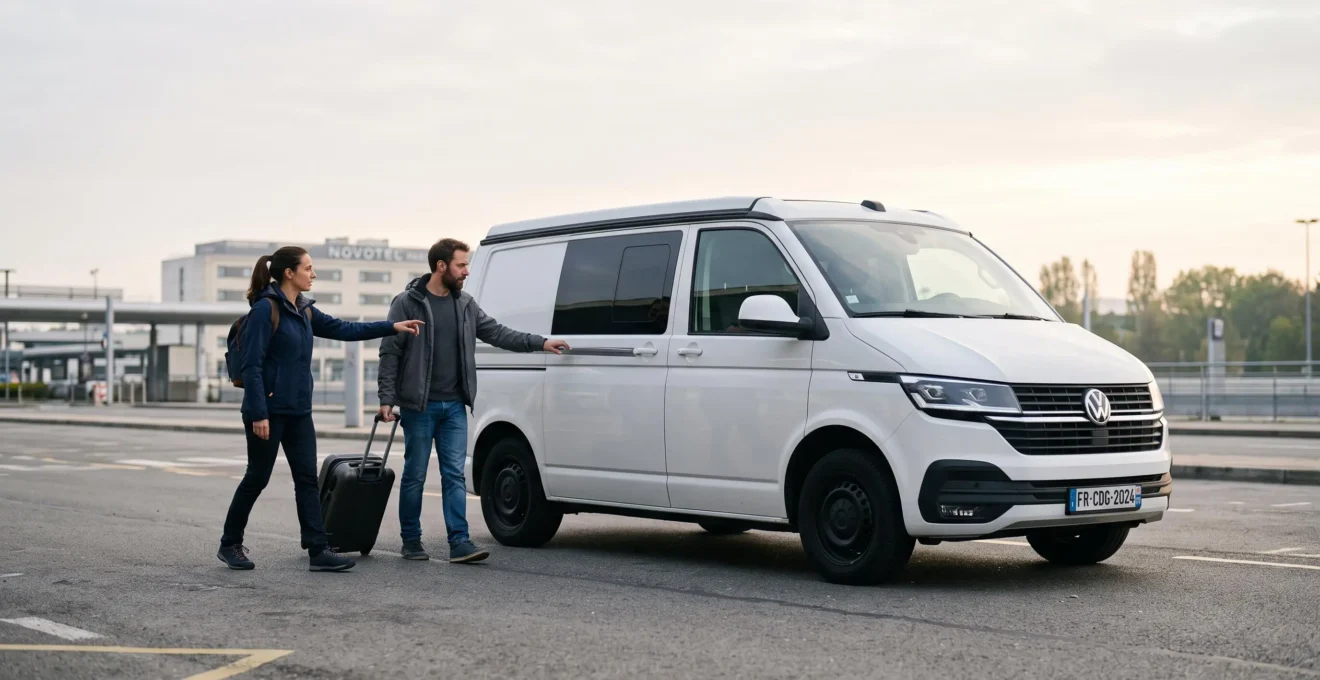
For international travellers landing at Paris-Charles de Gaulle, the prospect of starting a road trip without first navigating Paris city traffic holds obvious appeal. The airport sits at the northern edge of the Île-de-France region, making it a natural departure point for routes towards Normandy, the Hauts-de-France, Alsace or even Belgium and the Netherlands. The question that follows is straightforward: can you collect a campervan directly at the airport, and if so, where exactly does the handover take place?
This article sets out the practical details: the precise pick-up location near CDG, how the handover process works step by step, the choice between airport delivery and agency collection, which vehicle suits a group of two to five travellers, and which destinations become immediately accessible once you leave the airport perimeter. The information that follows is grounded in the operational details provided by rental operators and is designed to answer the logistical uncertainties that arise when planning a campervan trip from an international airport.
Can you really pick up a campervan at Paris-Charles de Gaulle airport?
Direct answer: Yes, it is possible to collect a campervan upon arrival at Paris-Charles de Gaulle airport through a delivery or pick-up service arranged with certain rental operators. The handover does not take place inside the airport terminals themselves, but at a designated meeting point nearby, which can be reached quickly after clearing arrivals.
WeVan, a French campervan rental provider, offers campervan hire at Paris-Charles de Gaulle with a meeting point located in front of the Ibis hotel on rue de Bruxelles, just outside the airport perimeter. The service operates seven days a week, though public holidays require advance booking. The GPS coordinates provided by the operator place the meeting point at 49.01077, 2.56037, which corresponds to the confirmed address of the Ibis Paris CDG Airport at 3 rue de Bruxelles, Roissy Charles de Gaulle.
This location sits within walking distance of Terminal 3 and the Roissy CDG 3 train station, meaning travellers arriving at CDG can reach the pick-up point without needing a separate transfer. Paris-Charles de Gaulle passengers handled handled nearly 72 million passengers in 2025 according to Groupe ADP, making it the busiest airport in France, with direct connections to more than 311 cities worldwide. For international visitors landing from Europe, North America or Asia, the option to bypass central Paris and head directly north, west or east represents a tangible time saving.
The appeal of this arrangement lies in the directness it offers: after a long-haul flight, the campervan becomes accessible within a short walk or shuttle ride from the terminal, allowing the road trip to begin without first navigating urban traffic or transferring to a city-centre rental branch. For travellers continuing towards Normandy, Brittany or the Channel ports, the route from CDG avoids the Paris ring roads entirely.
How the airport pick-up works step by step
The handover process begins once the rental booking is confirmed and the arrival flight details are communicated to the operator. On the day of arrival, after clearing baggage reclaim and customs, travellers make their way to the designated meeting point. In the case of WeVan’s service, this means heading to the Ibis hotel on rue de Bruxelles, either on foot from Terminal 3 or via a short shuttle connection from other terminals.
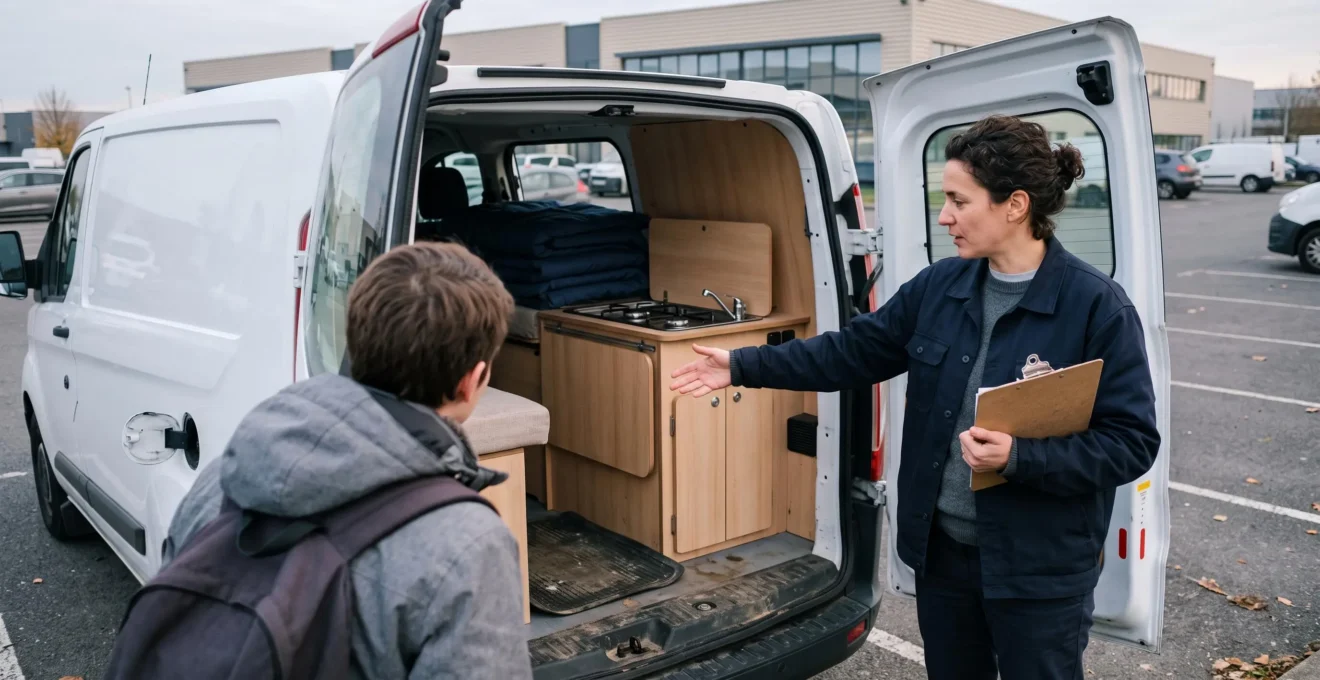
At the meeting point, a representative conducts the vehicle handover. This typically includes a walk-through of the campervan’s fittings—kitchen unit, sleeping arrangements, storage compartments, fuel type, and any specific operational features such as gas hob ignition or water tank location. The handover also covers the vehicle’s documentation, insurance details, and emergency contact information. Once the inspection is complete and the rental agreement signed, the keys are handed over and the traveller is free to depart.
Airport delivery versus pick-up at the Paris-Nord agency
WeVan offers two collection options: delivery to the airport meeting point, or pick-up directly from the company’s Paris-Nord agency in Roissy. The agency pick-up option is presented by the operator as a way to save €50 on the rental, though this saving is conditional and applies only when the customer collects the vehicle from the agency rather than requesting airport delivery.
The trade-off is straightforward. Airport delivery prioritises convenience, particularly for travellers arriving with significant luggage or after a long flight, as it minimises the transfer distance. Agency pick-up, by contrast, requires a short additional journey from the airport to the rental depot, but may suit travellers on a tighter budget or those comfortable organising their own onward transport to the agency location.
The choice depends on individual priorities: whether the immediate access offered by airport delivery justifies the additional cost, or whether the €50 saving makes the short detour to the agency worthwhile. Both options are available seven days a week, with public holidays requiring prior arrangement.
Which campervan should you choose for 2 to 5 travellers?
The choice of campervan depends primarily on the number of passengers and the level of comfort expected during the trip. WeVan’s fleet includes several models designed to accommodate between two and five travellers, with differences in sleeping capacity, interior layout and transmission type.
For couples or two adults travelling together, the Volkswagen California offers a compact layout with sleeping space for two and a functional kitchenette. The vehicle’s smaller footprint makes it easier to manoeuvre on narrow rural roads and park in town centres. The California is available with both manual and automatic transmission, the latter being a consideration for drivers less familiar with manual gearboxes or those who prefer a more relaxed driving experience after a long flight.
Groups of four or five passengers require more space, both for sleeping and for storing luggage. The Volkswagen Grand California and the Renault Hanroad Trek 5 are configured to sleep up to five people, with layouts that typically include a rear double bed and either an elevating roof bed or a convertible seating area. These larger models provide additional headroom and storage but require more confidence when navigating tighter roads or car parks.
The Ford Panama Peak sits between the compact and larger categories, offering flexibility for small families or groups of three to four travellers. Transmission options vary by model, and it is worth confirming whether automatic gearboxes are available for a specific vehicle at the time of booking, as availability can differ.
Quick model comparison by capacity
- 2 travellers: Volkswagen California (compact, easier parking, manual or automatic)
- 3–4 travellers: Ford Panama Peak (mid-size, balanced layout)
- 4–5 travellers: Volkswagen Grand California or Renault Hanroad Trek 5 (larger, more storage, sleeps up to 5)
When selecting a vehicle, consider not only the official sleeping capacity but also the practical space required for luggage, outdoor equipment and supplies. A campervan rated for five passengers may feel cramped if all five bring full-sized suitcases, so it is worth planning luggage in advance or opting for a slightly larger model if the group is at the upper limit of a vehicle’s stated capacity.
Where to go from Roissy: road trip ideas across France and Northern Europe
Paris-Charles de Gaulle’s location in the northern suburbs of Paris opens up several distinct travel directions, each avoiding the need to drive through central Paris. The motorway network radiating from the airport provides direct access to Normandy, the Hauts-de-France, Brittany, Alsace and routes towards Belgium, the Netherlands and Scandinavia.
Normandy lies roughly 200 kilometres to the west of CDG and can be reached in under three hours via the A13 motorway. The coastline between Honfleur and the Cotentin Peninsula offers a mix of historic ports, sandy beaches and rural hinterland, making it a suitable destination for a week-long trip. Travellers continuing west can extend into Brittany, where the coastal landscape becomes more rugged and the Atlantic influence more pronounced.
The Hauts-de-France region, immediately north of Paris, provides a shorter journey for those with limited time. Towns such as Amiens, Lille and Arras can be reached within 90 minutes, and the region’s proximity to Belgium makes cross-border itineraries straightforward. From Lille, the route continues north into Flanders or northeast towards Brussels and Bruges.
Alsace, to the east, requires a longer drive of around four hours but rewards with a distinct landscape of vineyards, half-timbered villages and the Vosges mountains. The route follows the A4 motorway past Reims and continues towards Strasbourg. This direction suits travellers with more time or those planning to cross into Germany or Switzerland.
Extending into Belgium, the Netherlands and Scandinavia
For travellers planning longer trips, CDG serves as the starting point for routes extending well beyond France. Belgium can be reached in under two hours, with Brussels, Ghent and Antwerp all accessible within a day’s drive. From Belgium, the Netherlands lies a short continuation north, with Amsterdam roughly five hours from CDG depending on traffic and border conditions.
Scandinavia represents a more ambitious itinerary but remains feasible for trips of two to three weeks. The route north typically passes through Belgium and the Netherlands before entering Germany and continuing via Denmark into Sweden and Norway. Such a journey requires careful planning around ferry crossings, camping regulations and seasonal weather, but the access from CDG to the northern European road network makes it a viable long-haul campervan route.
Travellers interested in minimising environmental impact during their trip may consider protected natural parks as destinations, where low-impact camping and slower travel align with the rhythm of a campervan journey.
Practical tips before starting your road trip from CDG
Before leaving the airport area, a few preparatory steps help ensure the journey begins smoothly. First, confirm the meeting time and location with the rental operator in advance, particularly if arriving on a public holiday when handover arrangements may differ. WeVan’s standard service operates seven days a week, but public holidays require prior booking, so it is worth double-checking this detail when finalising the reservation.
Luggage should be packed with the campervan’s storage capacity in mind. Soft bags and backpacks typically fit more easily into the vehicle’s compartments than hard-shell suitcases, and minimising the volume of luggage leaves more usable space inside the living area. If travelling with outdoor equipment such as bicycles or kayaks, check in advance whether the chosen vehicle includes roof racks or rear-mounted carriers, as not all models come equipped with these fittings as standard.
Supplies for the first 24 hours are best purchased before leaving the CDG area. While the airport itself offers limited grocery options, several supermarkets and service stations lie within a short drive of the airport perimeter. Stocking up on water, basic food supplies and any essential items immediately after collecting the van avoids the need to search for shops once on the road, particularly if heading into rural areas where stores may close early or operate limited Sunday hours.
First-night planning: Decide on the first overnight stop before departing CDG. Whether wild camping, using a dedicated campervan site or staying at a municipal aire, knowing the destination for the first night reduces decision fatigue after a long travel day and ensures arrival before dark.
For those setting out on their first campervan trip, or for international visitors unfamiliar with French road regulations, the airport guide provides additional logistical context around CDG’s layout and transport links. Familiarising yourself with the vehicle’s controls, checking fuel levels and confirming that all equipment is present and functional before leaving the handover point saves time and avoids uncertainty later.
After the logistics are settled, the road trip itself begins. For those seeking a quieter first destination away from busier tourist routes, exploring coastal retreats along Normandy’s less-travelled shoreline or the estuaries of the Hauts-de-France can offer an immediate contrast to the airport environment and a gentle introduction to the rhythm of campervan travel.