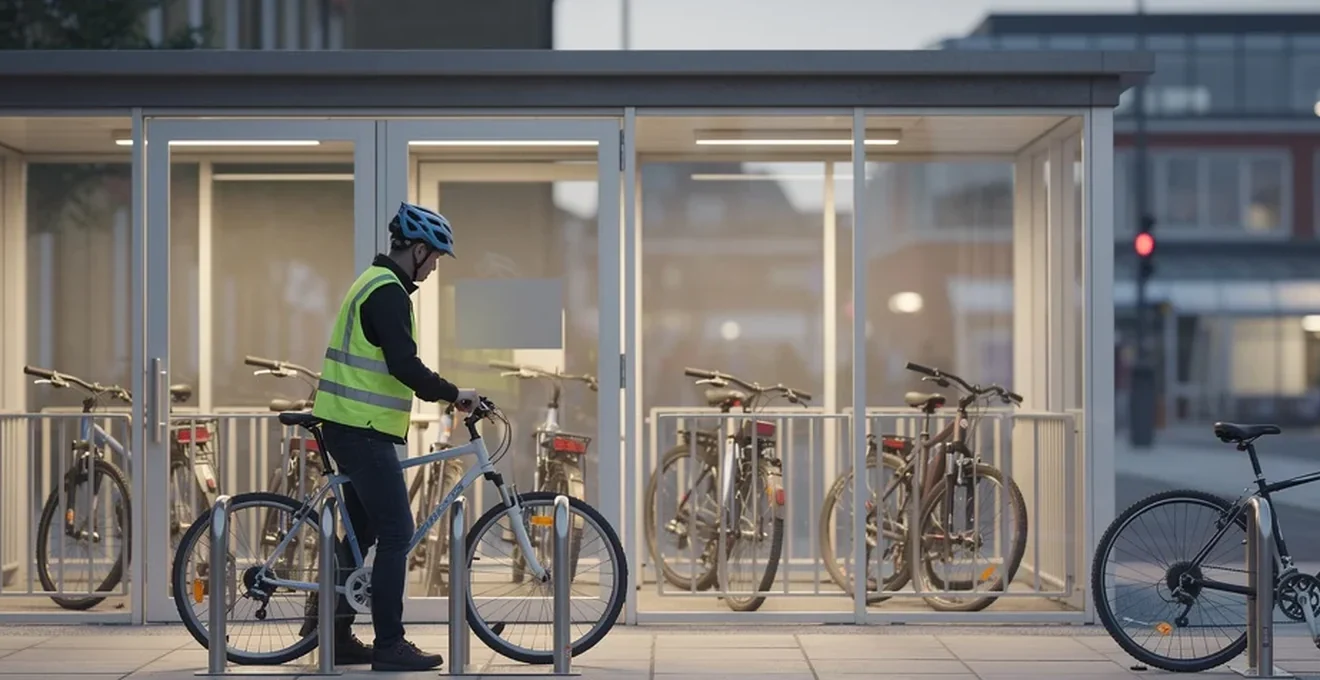
Cycling has become a mainstream mode of transport across the UK, with people making roughly 0.9 billion cycle trips in 2023 and the average adult completing around 15 trips per year. In cycling hubs such as Cambridge, almost half of adults cycle at least once a week, and in London’s financial district the daily number of cyclists in 2024 exceeded the number of cars on the streets during peak hours. Yet this growth has a shadow side: bikes have become more valuable, and theft remains one of the biggest barriers to everyday cycling. Understanding the scale of the theft problem, the range of parking typologies available, and the design standards that underpin good provision is essential for anyone planning cycling infrastructure, from councils and developers to building managers and transport operators.
Bicycle theft statistics and urban mobility trends
National cycle theft data from the office for national statistics
Bike theft in England and Wales is common, poorly resolved, and often under-reported. Across the period from June 2021 to July 2022, some 74,421 bike thefts were reported to police, yet no suspect was identified in 66,769 of those cases. Overall, roughly 90% of reported thefts failed to result in a perpetrator being caught, equating to a conviction rate of just 1.7%. In London alone, 162,943 bikes were reported stolen between 2017 and 2021 — an incident roughly every 16 minutes — with a combined value of around £93 million and an average value per bike of about £570. Only 2.5% of these cases led to an arrest, and of the bikes recovered, 4,278 were retrieved, with 608 either damaged or only partially recovered.
Sold secure and insurance claim patterns across UK cities
Bike theft is attractive to criminals precisely because it is low-risk and high-reward: it is easily concealed, quick to execute even in busy, visible spaces, and stolen bikes are simple to resell via online platforms. This dynamic has pushed independent security testing to the forefront of infrastructure specification. Accreditation schemes such as Sold Secure test products rigorously against attempted theft, giving developers, transport operators and cyclists confidence that a rack or locker has been verified rather than simply assumed to be secure. Products such as the CapaCity Two Tier Bike Rack, which has achieved Sold Secure Silver-level certification, and the Cyclepod Hangar, which carries Sold Secure Diamond-rated protection, illustrate how independent verification is increasingly built into procurement decisions. Alongside Sold Secure, Secured by Design — the official police security initiative — sets a recognised standard for security products, with public bike parking facilities generally required to meet Secured by Design Level 2, or Level 1 where the facility sits within an already secured environment.
Correlation between parking provision and cycling modal share
The link between secure parking and cycling uptake is well established. Fear of theft discourages cycling, while confidence in available storage encourages it: research from Dublin found that one in six people who had a bike stolen gave up cycling altogether, and a further 26% of theft victims cycled less afterwards. Conversely, cities that invest heavily in high-quality parking tend to see higher cycling modal share. London has recorded a 25% rise in bike commuters over the past decade, a trend that has run alongside increased funding and focus on cycling integration at transport hubs, network-based parking platforms, and inner-city storage facilities. The relationship is straightforward: people are more willing to cycle when they trust that their bike — often now a investment of £2,000 or more for a new, high-quality model — will still be there when they return.
Bicycle parking infrastructure typologies
Sheffield stands versus Wheel-Bending racks
In most external, urban settings, the Sheffield stand remains the default form of cycle parking. Its design is unobtrusive and familiar to users, while for developers it is cost-effective, low-maintenance and space-efficient. Crucially, it allows two-point contact with the bike frame, letting cyclists lock both frame and wheel securely — a significant advantage over older wheel-bending racks, which only support the front wheel and leave the frame unsecured. The ‘M’ stand variation of the Sheffield design offers multiple locking points, increasing capacity without sacrificing security. Combining Sheffield stands with a larger sheltered or enclosed facility can further improve security outcomes.
Two-tier cycle racks for High-Density storage
Where space is limited, two-tier racks have become the most popular solution, offering enhanced capacity across the same footprint as traditional stands or shelters. The Fullerton Double-Tier Bicycle Locker demonstrates this principle well: its robust, space-efficient design stacks bicycles vertically and is available with mechanical key, PIN pad or smart electronic locking, making it adaptable for residential developments, workplaces or managed schemes. Two-tier systems are particularly valuable at transport hubs, where large numbers of bikes must be accommodated within a constrained footprint without compromising ease of use.
Bike lockers and individual secure pods
Not every scheme needs high-density racking. Residential developments and workplaces often require individual, long-term storage that protects a single bicycle from both theft and the weather. The LEXINGTON Bike Box is a fully enclosed, robustly constructed option suited to this need, giving cyclists peace of mind when storing higher-value bikes or e-bikes overnight. Its balance of practicality and visual appeal makes it suitable for both new-build and retrofit schemes where security and aesthetics matter equally.
Cycle hubs and bike hangars in residential streets
In residential streetscapes where land is limited, compact, high-capacity storage such as the Cyclepod Hangar offers a modular approach, accommodating multiple bicycles within a secure footprint. Its Sold Secure Diamond rating provides independently verified security, reassuring both residents and operators. Waltham Forest Council has taken this further, constructing eight secure bike hub facilities across its London borough using government funding, each fitted with CCTV, key-fob access, help points, enhanced lighting and two-tier racking. These installations address a specific and often overlooked problem: many residents in flats and terraced housing find their greatest barrier to cycling is simply getting their bike safely to the street, with inadequate in-building storage forcing compromises such as leaving bikes partially concealed or attached to unsuitable street furniture.
Automated bicycle parking systems used in japan and the netherlands
Some of the most ambitious cycle parking projects have emerged in cities where cycling is deeply embedded in daily life. In Copenhagen, architectural firm Cobe developed sunken bike beds outside Nørreport Station to make better use of available space, and later created a large-scale facility at Karen Blixens Plads, University of Copenhagen, using a landscape of small hills and valleys to provide sheltered parking for 2,000 bikes, supported by dedicated locking points, clear sightlines and internal lighting. In the Netherlands, Amsterdam Centraal Station opened a substantial underwater bike parking garage in 2023, the result of a four-year, €60 million investment, holding space for 11,000 bikes. This is still only the second-largest such facility in the country: Utrecht’s Stationsplein, considered the world’s largest bike parking facility, accommodates 12,500 bikes, with a dedicated rack space guaranteed for every bike parked.
Design standards and sustrans guidance for cycle parking
Sustrans and local transport note 2/08 specifications
The Bicycle Association and Cycle Rail Working Group have published Standards for Public Cycle Parking, which sets out the requirements for public bike parking across the UK. These standards, alongside broader active travel guidance, emphasise that cycle parking must be stable, durable and provide genuine two-point contact for the bike frame, with separate locking of both frame and wheel via a reliable mechanism. Clear visual aids and directives that show users the correct way to lock their bike are also recommended, since basic errors — such as securing only a quick-release wheel or locking the frame alone — remain a common and preventable cause of theft.
Minimum spacing and manoeuvring clearances
Good design goes beyond the rack itself. Adequate spacing between individual parking spaces ensures cyclists can manoeuvre, park and retrieve their bikes comfortably without congestion, particularly in high-capacity hubs used during peak commuting periods. Lighting, surveillance and ease of maintenance are equally important practical considerations, especially in unmonitored locations where infrastructure must be durable and resilient enough to withstand vandalism, with periodic maintenance essential to keep it functioning correctly.
CROW manual recommendations from the netherlands
The Netherlands’ approach to cycling infrastructure offers a useful reference point for UK planners. With 25% of the country’s 17.53 million population cycling daily and around 320 miles of dedicated bike lanes in Amsterdam alone, Dutch design guidance reflects decades of experience in making cycling a default transport choice. The scale of facilities such as Utrecht’s Stationsplein — where every parked bike has a guaranteed, dedicated rack space — illustrates a design philosophy that treats parking provision as core infrastructure rather than an afterthought, a lesson increasingly informing UK practice as active travel investment grows.
Integrating secure parking into the built environment
End-of-trip facilities within BREEAM-Rated buildings
Sustainable materials and construction methods are increasingly factored into cycle parking specification, supporting broader green building objectives. Galvanised or powder-coated steel frames offer strong resistance to rust and corrosion, while polycarbonate roofing panels provide durability, UV resistance and natural light. Recycled plastics are also gaining ground as an eco-friendly option. For end-of-trip facilities specifically, full roof coverage protects bikes from rain, snow and sun, side panels guard against wind-driven rain and debris, and efficient drainage prevents water pooling — all details that contribute to a building’s wider sustainability credentials.
Cycle parking requirements in london plan policy
Developers designing new residential schemes, workplaces or transport hubs must think carefully about anticipated users, site layout and likely dwell times. Residential schemes typically need long-term, secure storage; commercial developments often require a mix of short- and long-stay parking; and transport hubs must accommodate peak demand while remaining accessible. Location matters as much as design: sheltered parking should ideally sit within 50 metres of building entrances to encourage regular use, with good visibility and lighting to avoid hidden or poorly lit corners. Aesthetic integration — premium finishes, coordinated materials and thoughtful detailing — helps cycle parking complement surrounding architecture rather than appearing bolted on.
Retrofitting parking provision in victorian terraced housing stock
Retrofitting secure cycle storage into older housing stock presents distinct challenges, particularly where residents have no private outdoor space and shared communal areas are limited. This is precisely the gap that street-level cycle hubs and hangars are designed to fill, offering secure, weatherproof storage close to the home without requiring internal building alterations. Where retrofit schemes are being planned, security and aesthetics need equal weight: a bulky or visually intrusive installation is less likely to gain community support, whereas discreet, well-finished storage — such as enclosed bike boxes or modular hangars — tends to integrate more successfully into established streetscapes.
Technology and security features in modern cycle parking
CCTV integration and sold secure Diamond-Rated locking systems
Long-term bike parking facilities in urban environments should prioritise dedicated access control, with CCTV coverage a proven tool for deterring theft and supporting enforcement. Lighting plays a complementary role: bright, low-glare white lighting makes facial recognition easier, helping people see who else is present as they park and secure their bike, while intelligent lighting schemes with sensors can dim or switch off when facilities are unused, reducing energy costs without compromising safety. Products such as the Semi-Vertical Bike Enclosure, built with corrugated galvanised steel roofing and steel mesh walls, combine physical security features — steel mesh swing gates, gate-closing struts and coded padlocks — with the kind of visibility that deters opportunistic theft.
Smart bike parking sensors and Real-Time occupancy apps
As e-bike ownership grows, technology is being built directly into parking infrastructure to address new demands. Integrated charging points allow a single unit to charge a bike, illuminate the parking area and monitor for suspicious activity simultaneously. Coloured lighting rings or capacity end caps can also help users remember exactly where they left their bike — a detail used to good effect in large cycle hubs, where each level is colour-coded with customisable capacity end caps so cyclists can quickly locate their bike among hundreds of others.
RFID access control in cycle hub facilities
Access control systems, including PIN pads, key fobs and smart electronic locking, are increasingly standard in managed cycle hub facilities. BSFG has worked on a number of large cycle hubs, including London Midland Trains and Brighton Cycle Hub, many of which incorporate certified Sold Secure CapaCity racks alongside bike detection systems. Bike-Drop, a service offering more than 500 secure bike parking spaces across Oxford Circus, Regent Street and Westminster, uses a booking system accessed via contactless QR code, demonstrating how digital access control can make secure parking as convenient as it is safe.
Case studies from cities leading cycle parking provision
Cambridge’s cycle point at the railway station
Cambridge Train Station provides space for 3,000 bikes, reflecting the city’s status as one of the UK’s leading cycling hubs, where almost half of adults cycle at least once a week. Large-scale facilities of this kind demonstrate that the UK is capable of delivering high-volume parking at major transport hubs, though such installations are only part of a wider solution: secure parking also needs to be available throughout cities and towns, not just concentrated at transport interchanges, if cycling is to become a viable everyday choice for more people.
Amsterdam’s fietsflat underground parking facility
Amsterdam’s underwater bike parking garage at Centraal Station, completed in 2023 following a four-year, €60 million investment, holds 11,000 bikes and stands as one of the most ambitious cycle parking projects in Europe. It sits alongside Copenhagen’s own investment programme — around £95 million over the past decade — which has delivered projects such as the sunken bike beds at Nørreport Station and the sheltered parking at Karen Blixens Plads. Copenhagen’s Priority Plan for Bicycle Parking aims to deliver an aspirational 71,000 new bike parking spaces across the city by 2025, illustrating the scale of ambition in cities where bikes already outnumber cars five to one.
Tfl’s cycle parking investment programme in outer london
London has made steady progress through borough-level and network-based initiatives. Spokesafe, a membership-based network of secure bike parking facilities with 17 locations across London, aims to make active travel the default choice for inner-city transport and logistics. Waltham Forest Council’s eight secure bike hubs, funded by government investment and fitted with CCTV, key-fob access and two-tier racking, offer a model that other boroughs could replicate. These schemes, combined with rising commuter numbers — a 25% increase in London bike commuters over the past decade — show that targeted investment in secure, well-designed parking can shift travel behaviour, even as the city continues working to close the gap with leading European examples.