
Buying your first artwork for under $1,000 isn’t a gamble; it’s your first entry into an alternative asset class that demands strategy.
- Success hinges on understanding “structural costs” like archival framing and specialized insurance, which protect and enhance value.
- The highest potential often lies in spotting emerging talent at the source—art school degree shows—before gallery markups.
Recommendation: Approach your first purchase with the discipline of a portfolio manager. Analyze the artist’s momentum, the material’s longevity, and the total cost of ownership, not just the sticker price.
The idea of owning original art is captivating. You’ve scrolled through gallery websites, imagined a unique piece on your wall, and felt the pull of starting a collection. But then reality hits: auction houses report on multi-million dollar sales, and the art world can feel like an exclusive club with an impossibly high cost of entry. For a millennial with some disposable income, the gap between aspiration and a blue-chip Picasso seems infinite. You’ve probably heard the common advice to simply “buy what you love,” but for a generation accustomed to optimizing investments, that feels incomplete. What if you want to love your art *and* make a smart financial decision?
This is where we reframe the conversation. The key to starting an art collection on a budget isn’t about finding a cheap decoration; it’s about treating your first sub-$1,000 purchase as the foundational entry in your personal asset ledger. The real value, and the biggest mistakes, are often hidden from view. True art investing at this level goes beyond the initial price tag. It requires a transparent understanding of the market mechanics, the structural costs that preserve value—like conservation framing and insurance—and the financial discipline to separate emotion from opportunity. This isn’t just about acquiring an object; it’s about making a calculated investment in culture.
This guide will provide you with the strategic framework of a seasoned art advisor. We will dissect the primary and secondary markets to show you where beginners should shop. We will quantify the importance of protecting your new asset, explore how to spot future talent before they become unaffordable, and demystify the financial implications of selling for a profit. By the end, you’ll be equipped to make your first purchase with confidence, clarity, and a long-term perspective.
To navigate this exciting journey, it’s essential to understand each component that transforms a simple purchase into a sound investment. The following sections break down the critical knowledge areas, from market access and asset protection to talent scouting and financial discipline, providing a clear roadmap for your first acquisition.
Summary: A Strategic Roadmap to Your First Art Investment
- Primary vs. Secondary Market: Where Should Beginners Shop?
- Does Homeowners Insurance Cover Fine Art Damage or Theft?
- Conservation Framing: Why Spending $200 on a Frame Saves Your Investment?
- Degree Shows: How to Spot Future Talent at Art School Exhibitions?
- Capital Gains on Art: What Happens When You Sell for a Profit?
- Natural Fibers vs. Synthetics: Which Material Holds Resale Value Better?
- How to Evaluate the Resale Potential of Logo Collaborations Before Buying?
- The Psychology of Money: How to Stop Emotions from Ruining Your Portfolio?
Primary vs. Secondary Market: Where Should Beginners Shop?
When you’re ready to buy, your first major decision is *where* to look. The art world is divided into two main arenas: the primary and secondary markets. The primary market is where a work of art is sold for the first time, typically directly from the artist’s studio or through a gallery that represents them. The secondary market involves all subsequent sales, handled by auction houses, art dealers, or private sales between collectors. While the secondary market gets the headlines with record-breaking auction prices, it’s a complex space driven by established names and requires deep expertise to avoid overpaying.
For a new collector with a budget under $1,000, the primary market is unequivocally the best place to start. It offers direct access to emerging artists at accessible price points, and you have the unique opportunity to support an artist at the beginning of their career. The digital shift has made this market more transparent than ever. In fact, a recent report reveals that 46% of dealers’ online sales were to first-time buyers in 2024, proving its accessibility. When buying from a gallery, you are also purchasing a relationship. The gallerist can provide crucial context about the artist’s practice, their exhibition history, and their future trajectory.
To navigate the primary market effectively, you must ask the right questions. Inquire about the artwork’s provenance (its history of ownership) and ensure you receive documentation directly from the gallery. If you are considering a print or photograph, ask about the edition size; smaller editions (under 50) are more scarce and tend to hold their value better. A reputable gallery will be transparent and eager to educate a new collector, as they are building a long-term relationship. This initial purchase is your entry point, not just for owning art, but for becoming part of its ecosystem.
Does Homeowners Insurance Cover Fine Art Damage or Theft?
Once you’ve acquired your first piece, the decorator mindset stops and the asset manager mindset begins. The most common and costly mistake a new collector makes is assuming their art is adequately protected by a standard homeowners or renter’s insurance policy. In almost all cases, it is not. These policies are designed to cover general contents like furniture and electronics, not unique, high-value items. Relying on them for fine art is a significant financial risk that undermines your investment from day one.
The core issue lies in coverage limits and named perils. Most standard homeowners policies impose a low sub-limit for fine art, often capping coverage at a mere $1,000 to $2,500 per item, which might not even cover your sub-$1000 piece once the frame is included. Furthermore, they typically only cover “named perils,” meaning the damage must result from a specific list of events like fire or theft. They often exclude common risks like accidental damage during moving, water damage from a small leak, or breakage during transit—all significant threats to an artwork.
A dedicated fine art insurance policy, or a “floater” added to your existing policy, is the only way to properly protect your investment. These policies offer “all-risk” coverage for the full appraised value of the piece, often with a $0 deductible. They cover a much broader range of potential damages, including transit and accidental breakage. While it may seem like an unnecessary expense for a single piece, the annual cost is typically a small fraction of the artwork’s value (0.1% to 2%) and provides complete peace of mind. It’s a non-negotiable structural cost of serious collecting.
The distinction between standard and specialized coverage is stark. The following table breaks down the key differences, illustrating why a dedicated policy is an essential part of your investment strategy.
| Coverage Type | Homeowners Policy | Fine Art Policy |
|---|---|---|
| Per-item limit | $1,000-$2,500 | Full appraised value |
| Coverage type | Named perils only | All-risk coverage |
| Transit coverage | Excluded | Included |
| Annual cost | Included in base premium | 0.1%-2% of collection value |
| Deductible | $1,000+ typical | Often $0 |
Conservation Framing: Why Spending $200 on a Frame Saves Your Investment?
Another critical structural cost that new collectors often underestimate is framing. It’s tempting to find a cheap, off-the-shelf frame to save money, but this is one of the most damaging mistakes you can make for a work on paper, a photograph, or a print. Standard framing materials contain acidic compounds that will, over time, “burn” and permanently discolor your artwork, a process known as mat burn. Furthermore, standard glass offers no protection from ultraviolet (UV) light, which causes irreversible fading of pigments and inks.
Conservation framing, also known as archival framing, is not a luxury; it is a fundamental preservation tool. It uses exclusively acid-free materials, including mat board, foam core backing, and mounting tapes. Most importantly, it utilizes UV-protective glazing (glass or acrylic) that blocks up to 99% of harmful rays. While a custom archival frame for a small piece might cost $200 or more, this is not an expense—it is an investment in the longevity and future value of the artwork itself. It’s the difference between your piece looking pristine in a decade versus being visibly damaged.
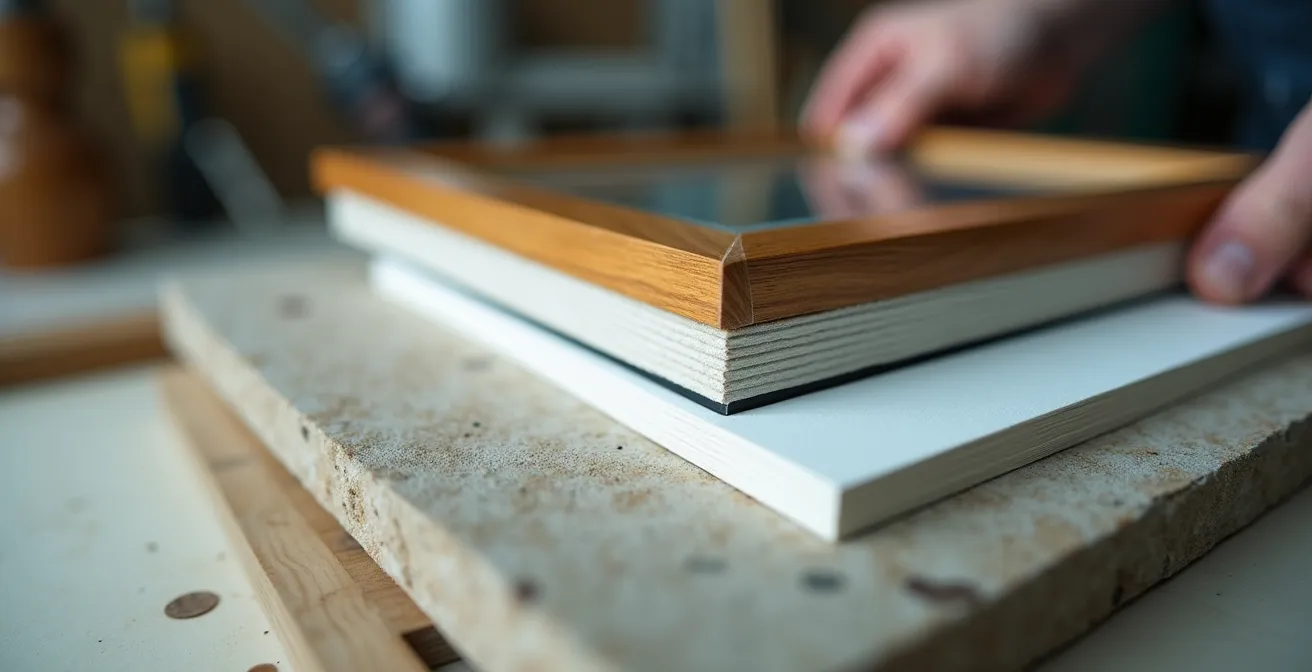
As the image above details, the quality is in the layers. Each component, from the anti-reflective glass to the acid-free matting, works in concert to create a stable micro-environment for the art. This professional presentation does more than just protect the work; it also directly impacts its financial worth.
Case Study: The Value Multiplication Effect of Professional Framing
The financial benefit of proper framing is well-documented. Maddox Gallery reports that properly framed works with archival materials command 15-20% higher resale prices than unframed pieces. A case study of emerging artist prints showed that investing 30% of the artwork cost into conservation framing resulted in faster sales and better preservation over a 5-year period, particularly for works on paper which are most vulnerable to environmental damage. This turns the framing cost into a direct contributor to your return on investment.
Degree Shows: How to Spot Future Talent at Art School Exhibitions?
For the budget-conscious new investor, the single greatest opportunity for high-upside returns is to acquire work from an artist *before* they are represented by a gallery. The best place to do this is at art school graduate exhibitions, often called degree shows. These events are the culmination of years of study for MFA (Master of Fine Arts) students, and they showcase the most promising new voices in the art world. Here, you can often purchase significant works for under $1,000, directly from the artist, before any gallery commission is added.
This isn’t a blind gamble. The emerging artist market is surprisingly robust. A recent report highlighted a staggering 96.5% sell-through rate for 1,343 debut artists at auction in 2024, indicating strong demand for new talent. The key is developing an eye for potential. When visiting a degree show, look beyond what is merely aesthetically pleasing. Look for artists who have a unique conceptual framework, a consistent style across multiple pieces, and a high level of technical skill. Don’t be afraid to talk to the artists; ask them about their process and what they plan to do after graduation. Their ambition and clarity of vision are often strong indicators of future success.
Spotting talent is a skill you can develop. Pay attention to which pieces gallerists and curators are looking at. Note which artists have already won school awards or have been mentioned in local art blogs. An artist who has already secured a post-graduation residency or has been included in a group show at an established gallery is a very strong signal. By doing this homework, you move from being a passive buyer to an active, informed investor.
Action Plan: Vetting an Art School Graduate
- Track post-graduation residency acceptances within 6 months of the show.
- Monitor for inclusion in group shows at established commercial galleries.
- Check for early critical coverage in respected art publications like Artforum or Frieze.
- Look for a body of work that balances strong technical skill with a unique and clear conceptual framework.
- Observe which pieces established gallery representatives and critics spend time viewing at opening nights.
Capital Gains on Art: What Happens When You Sell for a Profit?
As an art investor, the long-term goal is appreciation. But what happens when you successfully sell a piece for more than you paid? This is where the financial discipline of an asset manager becomes paramount. Any profit you make from selling art is subject to taxes, and the rules are different from those for stocks or real estate. Understanding this from day one is crucial for calculating your true return on investment and avoiding unpleasant surprises from the IRS.
Art is classified by the IRS as a “collectible.” This means that when you sell it for a profit after holding it for more than a year, the gain is taxed at a special, higher rate. While long-term capital gains on stocks are typically taxed at 15% or 20%, the maximum federal tax rate for collectibles is 28%. This significantly impacts your net profit. Forgetting to factor in this tax liability is a common rookie error that can turn a perceived gain into a much smaller one, or even a loss, once all costs are accounted for.
Therefore, meticulous record-keeping is non-negotiable. From the moment you purchase the work, you must maintain a file containing all documentation related to its cost basis and eventual sale. This includes the initial purchase receipt, framing costs, insurance premiums, appraisal fees, and the seller’s commission paid upon sale. Your true, taxable profit is the sale price minus the sum of all these expenses. Treating your collection with this level of administrative rigor is the hallmark of a serious investor, regardless of the price point.
Natural Fibers vs. Synthetics: Which Material Holds Resale Value Better?
When evaluating a piece for under $1,000, the physical materials of the artwork are a key—and often overlooked—driver of long-term value. An artist’s choice of medium has profound implications for the work’s stability, conservation needs, and, ultimately, its resale potential. While contemporary artists experiment with a vast array of materials, from traditional oil on canvas to digital prints and synthetic polymers, a hierarchy of durability and market preference exists.
Historically, traditional materials have proven to hold their value best due to their established track record of longevity. A 2024 auction data analysis revealed that traditional oil on canvas works maintain their value approximately 30% better than digital prints over a 10-year period. Works on natural-fiber paper, such as cotton rag, also have a long history of stability when properly cared for. The key factor is “archival quality.” An archival pigment print on museum-quality paper, for example, showed only a 5% depreciation compared to an oil painting in the same study, demonstrating that quality within a category matters immensely.
Synthetics and more experimental materials introduce a higher degree of risk. Plastics can become brittle, certain resins can yellow, and digital media can face obsolescence. This doesn’t mean they are poor investments, but it does mean their conservation needs are more complex and potentially costly. As an art advisor, I always stress the importance of considering the hidden costs associated with a material.
The conservation cost of materials should be factored into initial investment calculations. A fragile work on paper may require $200-500 annually in climate-controlled storage, while a properly varnished oil painting needs minimal maintenance.
– Karen Taylor, Art advisor interviewed by CNBC
When you’re starting out, choosing works made with time-tested, archival-quality materials—whether it’s oil on linen, or an archival print on cotton paper—is a safer bet. It minimizes your risk and reduces the long-term “structural costs” of conservation, protecting the core value of your investment.
How to Evaluate the Resale Potential of Logo Collaborations Before Buying?
In the contemporary art market, you’ll frequently encounter works that incorporate or appropriate famous brand logos and commercial imagery. From Andy Warhol’s Campbell’s Soup Cans to artists today collaborating with luxury brands, this intersection of art and commerce can be a lucrative but volatile investment area. For a new collector, it’s essential to distinguish between a work that offers insightful cultural commentary and one that is merely a decorative use of a popular logo. The former has resale potential; the latter often does not.
The key is to determine if the artist is adding conceptual value beyond simple brand recognition. Does the work transform or critique the logo’s meaning, or does it just borrow its “cool factor”? Artists who successfully build a career on this type of work, like the late Jean-Michel Basquiat, did so by infusing commercial symbols with powerful social and political commentary. Their work wasn’t just about the logo; it was a critique of consumer culture itself, which is why it continues to command high prices.
When considering such a piece, your due diligence is critical. First, research the artist’s broader practice. Do they have an established career and exhibition history beyond these logo-centric works? An artist with a strong, independent conceptual practice is a much safer investment. Second, verify the edition size. For prints and multiples, editions under 50 are far more likely to hold value than mass-produced runs. Finally, ensure proper documentation exists to prove authenticity and clarify whether the work is an official collaboration or an act of “fair use” appropriation. Without this, you risk future legal and authentication issues that can render the piece worthless. In short, invest in the artist’s vision, not just the brand’s visibility.
Key Takeaways
- Treat every purchase, regardless of price, as an entry in an asset ledger, demanding strategic thought.
- Factor in “structural costs” like archival framing and specialized insurance from the beginning, as they are investments in the work’s future value.
- Focus on high-potential entry points like art school degree shows, where you can acquire work from emerging talent before market markups.
The Psychology of Money: How to Stop Emotions from Ruining Your Portfolio?
We’ve covered the markets, the costs, and the materials. But the final, and perhaps most difficult, hurdle in art investing is mastering your own psychology. Art is an emotional asset; we are drawn to it for personal and aesthetic reasons. However, allowing those emotions—whether it’s the fear of missing out (FOMO) on a trending artist or the impulse to buy something purely for decoration—to dictate your investment strategy is the quickest way to build a disjointed and underperforming collection.
The most successful collectors operate with portfolio discipline. They establish a clear collecting thesis—a focus, whether it’s on a specific medium like female printmakers, a particular art movement, or artists from a certain region—and they stick to it. This focus allows them to develop deep expertise and make informed, rational decisions rather than scattered, impulsive purchases. The financial benefits of this approach are significant. A 2025 UBS survey found that collectors who maintained a focused collecting thesis achieved 22% better returns than those who bought impulsively across different categories. This demonstrates that a disciplined, strategic approach yields tangible financial rewards.
This requires patience. The art market, especially for contemporary art, is not a “get rich quick” scheme. Flipping a work for a quick profit is generally frowned upon and can damage your reputation with galleries. The value of an emerging artist’s work is built over years, through consistent exhibitions, critical recognition, and institutional acquisition. As an investor, your role is to identify potential early, acquire the work, and be prepared to hold it for the long term—at least 5 to 10 years. This patient, disciplined approach allows the artist’s career to mature and the work’s value to compound, turning your initial emotional connection into a sound and profitable long-term investment.
Now that you have the strategic framework, the next step is to begin your research with confidence. Start visiting local galleries, mark your calendar for the next university’s MFA degree show, and begin building your asset ledger, one smart, informed purchase at a time.
Frequently Asked Questions on Art Investment
What is the collectibles tax rate for art sales?
Art is taxed as a collectible at a maximum federal rate of 28%, higher than the typical long-term capital gains rate of 15-20% for stocks.
How do I calculate my true profit when selling art?
True Profit = Sale Price – (Purchase Price + Framing Costs + Insurance Premiums + Storage Fees + Seller’s Commission + Capital Gains Tax)
What records should I maintain from day one?
Keep all purchase receipts, appraisal documents, insurance records, exhibition history, conservation reports, and any correspondence about the artwork’s value or authenticity.