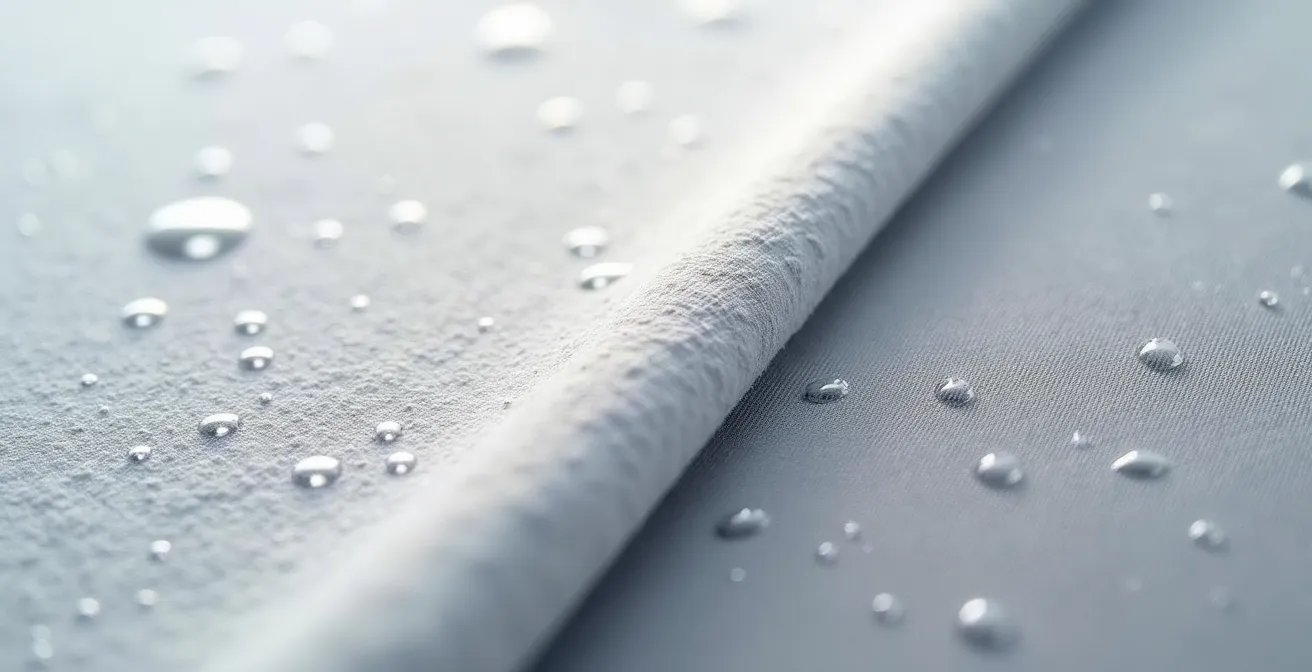
Contrary to popular belief, not all recycled polyester is created equal, and its real-world performance for athletes often involves critical trade-offs.
- Mechanically recycled polyester (from PET bottles) has a weaker molecular structure, which can lead to lower durability and increased odor retention.
- Chemically recycled polyester, while less common, breaks the plastic down to its original monomers, resulting in a fiber identical in quality to virgin material.
Recommendation: Scrutinize the type of recycled material and prioritize proper care protocols, like enzymatic soaks, to manage performance and extend the life of your gear.
As an athlete, you face a constant dilemma: you want to make environmentally conscious choices, but you can’t afford to sacrifice performance. The rise of recycled polyester, often marketed as “eco-friendly,” sits at the heart of this conflict. You see the labels celebrating a new life for plastic bottles and feel good about the purchase. But a nagging question remains, especially after a tough workout: does this recycled gear feel as good, wick sweat as effectively, and resist odor as well as its virgin counterpart?
The common narrative suggests a simple win-win, where sustainability comes with no performance penalty. Many brands will tell you the fibers are identical. But as sports product developers, we operate in a world of technical trade-offs, not marketing absolutes. The truth is far more nuanced and lies deep within the molecular structure of the fibers themselves. The journey from a plastic bottle to a high-performance shirt is not always a seamless one, and it fundamentally alters the material’s properties.
This article will not rehash the basic environmental benefits. Instead, we will take a product developer’s perspective, breaking down the science behind how recycled fibers are made and why that process directly impacts the durability, breathability, odor buildup, and even the safety of your activewear. We will move beyond the green labels to give you the honest, technical data you need to assess whether recycled gear truly meets the demands of high-intensity activity.
This guide provides a detailed technical comparison, exploring everything from microplastic shedding during washing to the molecular differences that affect breathability and odor. By understanding the ‘why’ behind the performance, you can make smarter, more informed decisions about the gear you invest in.
Summary: The Athlete’s Guide to Recycled vs. Virgin Fabric Performance
- Why Washing Recycled Fleece Is Dangerous for Marine Ecosystems?
- How to Turn Plastic Bottles into Fabric Without Losing Durability?
- Nylon or Polyester: Which Recycled Fabric Breathes Better in Humid Weather?
- The “Downcycling” Trap: Why Your Recycled Shoes Cannot Be Recycled Again
- Preventing Odor Buildup: The 3 Soaking Methods for Synthetic Fabrics
- Vest or Handheld: Which Hydration System Won’t Chafe on Long Runs?
- Repair vs. Replace: The Environmental Cost of Manufacturing a New Smartphone?
- Investment Pieces: Calculating the Real ROI of a Capsule Wardrobe Over 5 Years
Why Washing Recycled Fleece Is Dangerous for Marine Ecosystems?
The first hidden performance trade-off of recycled polyester (rPET) appears not on the trail, but in your washing machine. While you may feel good about keeping plastic out of landfills, washing these garments releases microscopic plastic fragments. The core issue is that mechanically recycled polyester fibers often have lower polymer integrity than their virgin counterparts. This makes them more brittle and prone to breaking during the agitation of a wash cycle. The consequences are significant.
Research consistently shows that recycled fabrics are a primary culprit. According to a study highlighted by the Changing Markets Foundation, fabrics made from recycled polyester can release 55% more microplastic particles than those made from virgin polyester. This shedding isn’t just a minor issue; it’s a torrent of pollution. An investigation into major sportswear brands found that some garments from Nike made with recycled polyester had the highest shedding rates, releasing over 30,000 fibers per gram of fabric. This is a direct consequence of the material’s compromised structure.
For the conscientious athlete, this creates a dilemma. Fortunately, technology offers solutions to mitigate this impact. While no method is perfect, several options can drastically reduce the number of microfibers entering our waterways. The table below outlines the effectiveness of current technologies.
| Technology | Effectiveness | Usage Context |
|---|---|---|
| Hand Washing | 90% reduction vs machine washing | Small loads, delicate items |
| External Filters (PlanetCare) | Up to 90% capture | Permanent installation |
| Wash Bags (Guppyfriend) | 50-75% capture | Regular washing loads |
| In-drum Balls (Cora Ball) | 26% capture | Easy to use, all loads |
Ultimately, managing the environmental impact of your gear extends to its entire lifecycle, including how you care for it. Choosing a capture method is a critical step in responsible ownership of synthetic activewear.
How to Turn Plastic Bottles into Fabric Without Losing Durability?
To understand the performance differences in recycled polyester, we must look at how it’s made. The vast majority of rPET on the market is produced through mechanical recycling. This process involves cleaning, shredding, and melting down used PET plastic bottles to extrude new fibers. While this method is popular because it offers a 60-70% CO₂ reduction and 50% energy savings compared to producing virgin polyester, it comes at a significant cost to the material’s quality.
The problem is that mechanical recycling degrades the polymer chains. Each time the plastic is melted and re-extruded, the long, strong molecular chains that give polyester its durability are shortened. This process is like making a photocopy of a photocopy; each generation loses a bit of clarity and integrity. This polymer degradation results in a weaker, more brittle fiber that is more susceptible to pilling, shedding, and tearing. The illustration below visualizes this critical difference in molecular structure.

The alternative is chemical recycling. This advanced process breaks the polyester back down to its fundamental chemical building blocks, or monomers. These purified monomers are then used to create new polymer chains that are chemically indistinguishable from virgin polyester. This method avoids the degradation seen in mechanical recycling, resulting in a fiber that retains 100% of its original performance and durability. It creates a truly circular material that can be recycled infinitely without a loss in quality.
While more expensive and less common, chemical recycling is the only current path to creating a recycled fabric that doesn’t compromise on the technical performance and longevity that athletes demand.
Nylon or Polyester: Which Recycled Fabric Breathes Better in Humid Weather?
For athletes training in humid conditions, breathability isn’t a luxury; it’s a critical performance metric. While polyester is often the default choice, recycled nylon (polyamide) presents a compelling alternative, particularly when moisture vapor transfer is a priority. The choice between these two synthetics can have a greater impact on your comfort than the distinction between virgin and recycled versions.
As a product developer, we analyze fabrics based on a matrix of performance characteristics. Recycled polyester excels in moisture-wicking, meaning it pulls liquid sweat away from the skin very effectively and dries extremely quickly. This makes it ideal for high-sweat, arid environments. However, recycled nylon, such as ECONYL®, often has a superior Moisture Vapor Transmission Rate (MVTR), which measures how well a fabric allows water vapor (the gas form of sweat) to escape. In sticky, humid weather, where the air is already saturated, this enhanced breathability can make a significant difference in preventing that clammy, “greenhouse” feeling.
Furthermore, recycled nylon generally offers better durability and abrasion resistance than mechanically recycled polyester, making it a stronger choice for gear that sees a lot of friction, like leggings or pack straps. The following table breaks down the key performance trade-offs between these two leading recycled materials for activewear.
| Performance Metric | Recycled Polyester | Recycled Nylon (ECONYL) | Best Use Case |
|---|---|---|---|
| Moisture Wicking | Excellent | Good | High-sweat activities |
| Breathability (MVTR) | Good | Excellent | Humid conditions |
| Quick Dry Time | Very Fast | Fast | Trail running |
| Durability | Good | Excellent | High-abrasion sports |
| Odor Resistance | Moderate | Good | Multi-day wear |
Ultimately, the best fabric choice depends on your specific activity and environment. For a hot and humid marathon, recycled nylon’s superior breathability may be the winning factor. For a desert trail run, recycled polyester’s rapid drying time might be more beneficial.
The “Downcycling” Trap: Why Your Recycled Shoes Cannot Be Recycled Again
The term “recycled” often evokes an image of a perfect, infinite loop. The reality, especially with mechanically recycled materials, is what’s known as the downcycling trap. Because mechanical recycling shortens and weakens polymer chains, a fabric made from old water bottles cannot typically be recycled back into a high-quality fabric. Instead, it’s often turned into a lower-grade product like insulation, carpeting, or fill—items that are themselves destined for the landfill. Your recycled running shoes cannot be turned into another pair of running shoes; their next life is a final, one-way trip down the value chain.
This linear path disguised as a circle is a fundamental flaw in the sustainability story of most recycled activewear. It postpones landfill, but it doesn’t prevent it. The only way to achieve true circularity for synthetic textiles is through advanced recycling processes that restore the material to its original, virgin-quality state. This is where chemical recycling, specifically enzymatic depolymerization, represents a major technological leap forward.
A key breakthrough in this field demonstrates the potential for a truly circular economy. As a case study, the French company Carbios has pioneered a method using enzymes to break down PET plastic. In 2023, Carbios proved its enzymatic process could recycle 97% of PET in just 16 hours at a low temperature of 70°C. The resulting monomers were indistinguishable from those used to make virgin polyester, proving that infinite, quality-neutral recycling is possible. This technology effectively escapes the downcycling trap, paving the way for old running shirts to be reborn as new, high-performance running shirts, again and again.
Case Study: Carbios’ Enzymatic Breakthrough for Infinite Recycling
In a milestone for textile circularity, Carbios demonstrated that its enzymatic depolymerization technology could reclaim the building blocks from complex PET waste, including colored bottles and textiles. This process creates a purified monomer (PTA) that can be used to produce new PET fibers with the same quality and performance as virgin material. According to a report on innovations in polyester manufacturing, this represents a viable path to closing the loop, turning post-consumer textiles from a waste problem into a valuable resource for new high-performance garments.
While not yet at a mass-market scale, this innovation shows that the future of sustainable activewear lies not just in using recycled content, but in creating systems that preserve material value indefinitely.
Preventing Odor Buildup: The 3 Soaking Methods for Synthetic Fabrics
If you’ve ever noticed that your recycled polyester gear seems to hold onto odor more than other fabrics, you’re not imagining it. The reason is, once again, rooted in the material’s physical structure. The mechanical recycling process can create microscopic roughness and pits on the fiber’s surface. This surface micro-pitting creates more surface area for bacteria to colonize and form a stubborn, odor-causing biofilm that regular washing can’t fully remove.
This issue is exacerbated by the very nature of the fiber. Research published in PLOS One on fiber degradation demonstrates that mechanically treated polyesters can exhibit a 6-fold higher fiber shedding rate, an indicator of the surface damage that contributes to this problem. This textured surface becomes a perfect breeding ground for the bacteria that feed on your sweat, leading to a persistent smell that seems to return the moment the garment warms up with body heat.

Standard laundry detergents are often ineffective against this embedded biofilm buildup. To truly reset your activewear and eliminate the source of the odor, you need a multi-step approach that breaks down the biofilm and kills the underlying bacteria. A simple wash and dry won’t cut it. The following protocol provides a systematic way to deep clean and restore your synthetic gear.
Your Action Plan: The Biofilm Reset Protocol for Synthetic Activewear
- Pre-Rinse: Thoroughly rinse the garment in cold water immediately after use to wash away loose sweat, skin cells, and surface bacteria before they can set.
- Enzymatic Soak: Submerge the garment for at least 30 minutes in a solution of water and a sport-specific enzyme detergent. These enzymes are designed to break down the complex organic matrix of the biofilm.
- Sanitizing Soak: After rinsing out the enzyme solution, perform a second 15-minute soak in a diluted white vinegar solution (one part vinegar to four parts water). The acidity kills the bacteria exposed after the biofilm has been broken down.
- Final Rinse & Optional Scent: Rinse the garment thoroughly in cold water to remove any vinegar residue. You can add a few drops of a naturally antibacterial essential oil like tea tree or eucalyptus for a final fresh scent.
- Air Dry: Hang the garment to dry completely, preferably in direct sunlight. The UV rays provide an additional layer of natural sanitization, killing any remaining microbes.
By integrating this routine every few washes, you can prevent permanent odor buildup and significantly extend the functional life of your high-performance recycled gear.
Vest or Handheld: Which Hydration System Won’t Chafe on Long Runs?
Chafing is the bane of every endurance athlete’s existence, and the interaction between your clothing and your gear is a primary cause. When selecting a hydration system, the material of the vest or pack is just as important as the material of your shirt. For athletes wearing recycled polyester or nylon tops, understanding the friction coefficient between different fabric pairings is key to a chafe-free run.
From a product development standpoint, we test these interactions extensively. A hydration vest made of a rough, open-weave recycled polyester mesh might feel lightweight, but when paired with a recycled polyester shirt, the similar materials can cause significant friction, especially when wet with sweat. Conversely, pairing a vest made of a smoother recycled nylon mesh with that same polyester shirt can drastically reduce the friction coefficient and the risk of irritation over long distances.
The table below provides a simplified matrix of friction potential between common hydration vest materials and high-performance shirt fabrics. “Low” friction indicates the best pairing for chafe prevention.
| Vest Material | vs. Merino Wool Shirt | vs. Recycled Polyester Shirt | vs. Recycled Nylon Shirt |
|---|---|---|---|
| Recycled Polyester Mesh | High friction when wet | Moderate (similar materials) | Low-moderate |
| Recycled Nylon Mesh | Moderate | Low-moderate | Low (best match) |
| Virgin Polyester | High friction | Moderate | Moderate |
However, technical data is only part of the story. Human perception adds another layer of complexity. As a study published by Taylor & Francis on sportswear perception notes, the sensory experience is highly subjective. Researchers found that while technical differences exist, the reality of in-use comfort can be more nuanced.
Participants struggled to perceive a difference between the different types of polyester t-shirts, and none of the t-shirt materials was significantly preferred over another.
– Taylor & Francis Research Team, Recycled versus virgin polyester sportswear – can a difference be perceived in actual use?
This finding doesn’t negate the friction data, but it does emphasize that the best system is personal. Use the data as a guide, but always test your full gear combination on a shorter run before committing to it for a marathon or ultra.
Repair vs. Replace: The Environmental Cost of Manufacturing a New Smartphone?
While the title references smartphones, the principle of “repair vs. replace” is even more critical in the world of high-performance activewear, where gear is subjected to extreme stress. Given that mechanically recycled fabrics can have compromised durability, adopting a repair-first mindset is the most effective strategy to maximize both the lifespan of your gear and its sustainability. Replacing a jacket because of a small tear or a broken zipper pull creates unnecessary waste and consumes significant resources.
Leading brands in the outdoor and athletic space are increasingly building their business models around this concept. They recognize that true sustainability isn’t just about using recycled materials; it’s about keeping products in use for as long as possible. A prime example is the partnership between brands like Patagonia and Decathlon with the United Repair Center in Amsterdam. This facility is dedicated to repairing damaged clothing on a large scale, turning what would have been waste into functional, high-value gear once more.
Case Study: Patagonia’s Worn Wear and the United Repair Center
Patagonia’s Worn Wear program has long been a benchmark for product longevity. By offering repair services and tutorials, they empower customers to extend the life of their garments. Their collaboration with the United Repair Center institutionalizes this ethos, creating a scalable system for high-quality repairs. This model not only reduces landfill waste but also decreases the demand for new manufacturing, which is the single largest source of environmental impact in a product’s lifecycle.
For an athlete, most common failures in activewear are surprisingly simple to fix. Rather than discarding a piece of gear, learning a few basic repair techniques can save money and reduce your environmental footprint. The three most common repairs for technical outerwear are patching small tears with specialized seam tape, replacing broken zipper pulls with universal kits, and reapplying DWR (Durable Water Repellent) coatings to restore water resistance.
By choosing brands that support repair and learning basic maintenance skills, you transform from a simple consumer into a steward of your equipment, ensuring every piece performs to its maximum potential for as long as possible.
Key Takeaways
- Mechanical recycling degrades polyester’s polymer chains, which can negatively affect durability and increase microplastic shedding compared to virgin or chemically recycled fibers.
- The rougher surface texture (micro-pitting) of some mechanically recycled polyester can trap more odor-causing bacteria, requiring specialized cleaning protocols like enzymatic soaks.
- Advanced chemical recycling is the key to true circularity, as it restores polyester to its original molecular state, allowing for infinite recycling without quality loss.
Investment Pieces: Calculating the Real ROI of a Capsule Wardrobe Over 5 Years
In activewear, as in a capsule wardrobe, the concept of “Return on Investment” (ROI) goes beyond the initial price tag. It’s about calculating the true cost per use and factoring in performance, satisfaction, and longevity. Athletes often fall into the trap of buying cheaper, “fast fashion” fitness apparel, only to see it stretch, lose its shape, or retain odor after just a few months. A high-quality investment piece, whether made from premium virgin or chemically recycled material, almost always proves more economical in the long run.
Let’s analyze the numbers. A low-cost item might seem like a bargain, but if its poor performance leads to discomfort or it needs to be replaced annually, its true cost skyrockets. In contrast, a technically advanced garment, while more expensive upfront, is engineered for thousands of hours of use, maintains its performance features (like compression and wicking), and is often repairable. This drastically lowers its cost per high-performance use and reduces the number of items sent to the landfill.
The following 5-year cost analysis compares the financial and environmental toll of relying on disposable activewear versus investing in a curated collection of sustainable, high-performance pieces. The data clearly shows that while the initial outlay for performance gear is higher, the total cost over time is comparable, with far superior performance and a fraction of the environmental impact.
| Factor | Fast Fashion Fitness | Sustainable Performance |
|---|---|---|
| Initial Cost (10 pieces) | $300 | $800 |
| Replacement Rate | Annual (5x) | Every 2.5 years (2x) |
| Total 5-Year Cost | $1,500 | $1,600 |
| Items to Landfill | 40 pieces | 10 pieces |
| Repair Costs | N/A (not durable) | $100 |
| Performance Satisfaction | 60% | 90% |
| Cost Per High-Performance Use | $0.82 | $0.35 |
Armed with a technical understanding of materials and a long-term value mindset, you can move beyond simple marketing claims. The next step is to scrutinize product details, favor chemically recycled or high-quality materials, and adopt a care-and-repair philosophy to build a high-performance, long-lasting activewear collection that truly serves both you and the planet.