
Turning your art into a viable career requires a fundamental shift from an artist’s mindset to a creative entrepreneur’s strategy.
- Price your work based on the value and results you deliver, not just the hours you spend.
- Strategically choose platforms that help you build a long-term brand, not just make one-off sales.
Recommendation: Start today by auditing one of your creative services and repackaging it based on the tangible outcomes it provides for a client, not your time investment.
The dream of quitting a day job to pursue a creative passion is powerful. For many artists, designers, and creators, it represents the ultimate alignment of work and life. Yet, that dream is often overshadowed by a more pressing reality: the fear of financial instability. How do you turn drawings, designs, or films into a reliable income stream without succumbing to the “starving artist” trope?
The common advice often feels generic and unhelpful. You’re told to build a portfolio, use social media, and sell your work on popular marketplaces. Many artists start by charging a simple hourly rate, believing it’s the fairest way to price their time. But this approach is a trap. It commoditizes your talent and punishes the very efficiency that comes with experience.
But what if the key wasn’t simply *selling* your art, but building a sustainable *business* around it? This requires a crucial mindset shift: from an “artist who sells” to a “creative entrepreneur.” It’s about understanding that your true product isn’t just the final piece, but the value, vision, and solutions you provide. This perspective changes everything—from how you price your work and choose your sales platforms to how you protect your intellectual property and create scalable income.
This guide provides a realistic, business-minded roadmap to help you make that shift. We will deconstruct common mistakes and provide strategic frameworks for pricing, brand building, legal protection, and scaling your creative work into a profitable venture. By adopting the mindset of a creative entrepreneur, you can build a career that is not only fulfilling but also financially secure.
To help you navigate this journey, we have broken down the essential strategies into clear, actionable sections. This structure will guide you from foundational pricing decisions to long-term asset management, providing the tools you need to build a resilient creative business.
Summary: A Business-Minded Guide to Monetizing Creative Skills
- Why Charging Hourly Rates Punishes Efficiency in Creative Work?
- Etsy or Shopify: Which Platform Builds a Brand vs Just Sales?
- The Copyright Mistake That Can Get Your Shop Banned Instantly
- How to Say “No” to Exposure Gigs Without Burning Bridges?
- Passive Income for Artists: Selling Digital Assets While You Sleep
- The Format Obsolescence Risk: Will Your Art Be Viewable in 10 Years?
- Short Film Markets: How to Sell Your 15-Minute Movie to Distributors?
- Understanding Digital Art: How to Evaluate Quality Beyond the Screen?
Why Charging Hourly Rates Punishes Efficiency in Creative Work?
For many new freelance artists, charging by the hour seems like the most logical and fair approach. You track your time, you bill for it, and the client pays for your labor. However, this model has a fundamental flaw: it directly punishes you for your own expertise and efficiency. As you get better and faster at your craft, you make less money for the same—or better—results. This creates a perverse incentive to work slower, not smarter, and places a hard cap on your earning potential. You’re selling time, which is finite, instead of value, which is scalable.
The core issue is that clients don’t buy your time; they buy an outcome. They want a logo that elevates their brand, an illustration that tells a story, or a design that converts customers. The number of hours it takes you to achieve that result is irrelevant to them. A value-based pricing model aligns your compensation with the result you deliver, not the time you clock. This shift is central to thinking like a creative entrepreneur. It reframes the conversation from “How long will this take?” to “What is this solution worth to your business?”
Case Study: The Paradox of Experience in Hourly Billing
Consider the real-world example of an experienced freelancer who was asked to complete a project. Because of their years of experience, they finished the job in just three hours. At a respectable rate of $75 per hour, their invoice came to only $225. However, the true market value of the delivered project was at least $1,500. By billing hourly, the freelancer was penalized for their efficiency and expertise, earning a fraction of what their work was actually worth to the client. This scenario, detailed in an analysis of creative service pricing models, perfectly illustrates how hourly rates fail to capture the true value of experienced creative work.
Transitioning away from hourly rates requires a new way of packaging your services. Instead of offering an open-ended block of time, you create structured packages with clear deliverables and fixed prices based on the value they provide. This gives clients clarity and budget certainty while allowing you to price your work based on its impact, not your stopwatch. It’s the first and most critical step in building a profitable and scalable creative business.
Action Plan: Transitioning to Value-Based Pricing
- Identify Value Points: For each service you offer, stop listing tasks and start documenting the tangible results and benefits it brings to a client (e.g., “increases social media engagement,” “creates a professional brand identity”).
- Package Your Services: Using your value points, create structured packages (e.g., “Basic Logo Package,” “Premium Branding Suite”) instead of offering open-ended hourly work. Define clear deliverables for each.
- Reframe the Conversation: In client discussions, shift the focus from time to outcomes. Ask about their business goals and explain how your service helps achieve them. This anchors your price to the value you create.
- Implement Tiered Options: Offer 2-3 tiered packages (e.g., Basic, Standard, Premium) at different price points. This provides clients with choices and makes your higher-tier services seem more valuable in comparison.
- Set Your Price Anchor: When a potential client asks for your hourly rate, politely decline and respond with your standard rate card showing your value-based packages. This immediately reframes the negotiation around value, not time.
Etsy or Shopify: Which Platform Builds a Brand vs Just Sales?
Once you’ve determined your pricing, the next question is where to sell. For many artists, the choice boils down to two giants: Etsy and Shopify. On the surface, they both let you sell products online, but their underlying philosophies are fundamentally different. Understanding this difference is crucial for a creative entrepreneur. The choice isn’t just about fees; it’s a strategic decision between leveraging a marketplace for quick sales versus building a long-term, independent brand.
Etsy is a massive, bustling marketplace. Its greatest strength is its built-in audience; the platform attracts approximately 400 million monthly visitors actively looking to buy unique, handcrafted goods. This is an incredible advantage for discoverability. However, you are essentially a stall in a giant digital bazaar. You’re competing directly with thousands of other sellers on the same page, your branding options are limited, and Etsy ultimately owns the customer relationship. It’s a fantastic platform for generating sales and testing product ideas, but it can be challenging to build a distinct brand identity.

Shopify, on the other hand, gives you the keys to your own standalone store. You are responsible for bringing in your own traffic, which is a significant challenge. However, you have complete control over your branding, the customer experience, and the customer data. You’re not just a seller; you’re building a brand destination. This is a long-term asset. You can create a unique universe around your products, tell your story without constraints, and build a direct relationship with your audience through email lists and targeted marketing. It requires more upfront effort in marketing but offers a much higher ceiling for brand growth and customer loyalty.
The financial structures of these platforms also reflect their different models. Etsy’s fee structure is designed for low-barrier entry, while Shopify operates on a subscription model that assumes you’re building a more substantial business.
| Fee Type | Etsy | Shopify |
|---|---|---|
| Monthly Subscription | $0 (Standard) / $10 (Plus) | $39-$399 |
| Listing Fees | $0.20 per listing | None |
| Transaction Fees | 6.5% of sale price | 0% with Shopify Payments |
| Payment Processing | 3% + $0.25 | 2.4-2.9% + $0.30 |
Ultimately, the “right” choice depends on your goals. Are you looking for immediate sales and market validation? Etsy is a powerful engine for that. Are you focused on building a lasting brand and owning your customer relationships for the long haul? Shopify provides the foundation. A savvy creative entrepreneur might even use both: leveraging Etsy for initial traffic and funneling happy customers to a more robust Shopify experience.
The Copyright Mistake That Can Get Your Shop Banned Instantly
As a creative entrepreneur, your intellectual property (IP) is your most valuable asset. Yet, it’s alarmingly easy to infringe on someone else’s copyright without even realizing it, leading to devastating consequences like DMCA (Digital Millennium Copyright Act) takedown notices, permanent shop bans, and even legal action. In a world where “borrowing” and “remixing” are common, understanding the hard lines of copyright law isn’t just good practice—it’s essential for survival. Ignoring this can wipe out your business overnight.
One of the most common pitfalls is the use of unlicensed assets. This can be as subtle as using a font in your commercial design that was only licensed for “personal use,” or incorporating a “free” texture you downloaded from an unverified website. Many platforms like Etsy and Redbubble use automated systems to detect infringement. If an asset in your design is flagged, your listing can be removed instantly without warning. The sheer volume of copyright claims is staggering; back in March 2016, Google received just over 75 million takedown requests in that month alone, highlighting the scale of automated enforcement.
Another major danger zone is fan art. While it may seem like a harmless tribute, creating and selling art that features trademarked characters from movies, video games, or comics is a form of infringement. The rights holders of these massive franchises are highly protective of their IP and actively police online marketplaces. Arguing that your work is “transformative” is a complex legal defense that rarely holds up for commercial sales and can land you in serious legal trouble.
Building an IP fortress around your work means being meticulously diligent about your sources. Use only assets you have created yourself or for which you have a clear commercial license. Document everything. When in doubt, err on the side of caution. Your creative business is built on the originality and integrity of your work; protecting it starts with respecting the work of others. A single copyright mistake can erase all your hard work in an instant.
How to Say “No” to Exposure Gigs Without Burning Bridges?
Every creative professional has received the dreaded request: “We can’t pay you, but it will be great exposure!” While it can be tempting for an emerging artist to accept unpaid work in the hope of getting noticed, it’s a practice that devalues your work and the entire creative industry. A key part of the transition to a creative entrepreneur is learning to confidently decline these offers while maintaining professional relationships. Saying “no” isn’t about being difficult; it’s a strategic act of self-respect and business positioning.
The problem with “exposure” is that it’s an unquantifiable and often empty promise. It rarely translates into tangible, paying work. More importantly, when you work for free, you set a precedent that your skills are not worth paying for. This can damage your reputation and attract more clients looking for freebies, not fewer. Your goal is to build a business, and businesses require revenue. Your time and talent are your inventory, and you cannot afford to give them away indefinitely.
However, a blunt “no” can feel confrontational and might close the door on a future paid opportunity. The art is in the delivery. You need a way to decline the unpaid request while keeping the conversation open and reinforcing your professionalism. The key is to be polite, firm, and to frame your response in a business context. This demonstrates that you take your work seriously and operate as a professional, not a hobbyist.
Having prepared responses can help you handle these situations with grace and confidence. Here are a few templates you can adapt:
- The Polite Decline: “Thank you so much for thinking of me for this project. I appreciate the opportunity. At this time, my schedule only allows me to take on paid engagements, but I wish you the best of luck with your project.”
- The Pivot to a Proposal: “This sounds like a fascinating project, and I’d love to explore how I can help. My standard rate card is attached. Let me know what package might fit within your budget, and we can discuss a scope of work.”
- The Alternative Collaboration: “While I’m not in a position to take on unpaid work, I’m sometimes open to a skill or service exchange of equal value if that’s something your business can offer. Let me know if that’s an option you’d like to discuss.”
By using these approaches, you are not just rejecting an offer; you are educating the client about your value and professionalism. You turn a potentially awkward moment into an opportunity to reinforce your brand as a serious creative entrepreneur who deserves to be paid for their work.
Passive Income for Artists: Selling Digital Assets While You Sleep
The traditional model of a creative career—trading time for money—has a ceiling. You can only work so many hours in a day. To truly build a scalable and resilient business, creative entrepreneurs must explore avenues for passive income. This doesn’t mean “getting rich for doing nothing.” It means creating assets that can be sold over and over again with minimal ongoing effort. For digital artists, this represents a massive opportunity to decouple income from time, allowing you to literally make money while you sleep.
The core idea is to productize your skills. Instead of creating a single custom illustration for one client, what if you created a set of high-quality illustration brushes, a pack of unique textures, a font, a set of social media templates, or a Procreate color palette that could be sold to hundreds or thousands of customers? Each of these is a digital asset. You invest the time to create it once, and it can generate revenue indefinitely. This creates a diversified income stream that complements your client work and provides a financial cushion during slower periods.
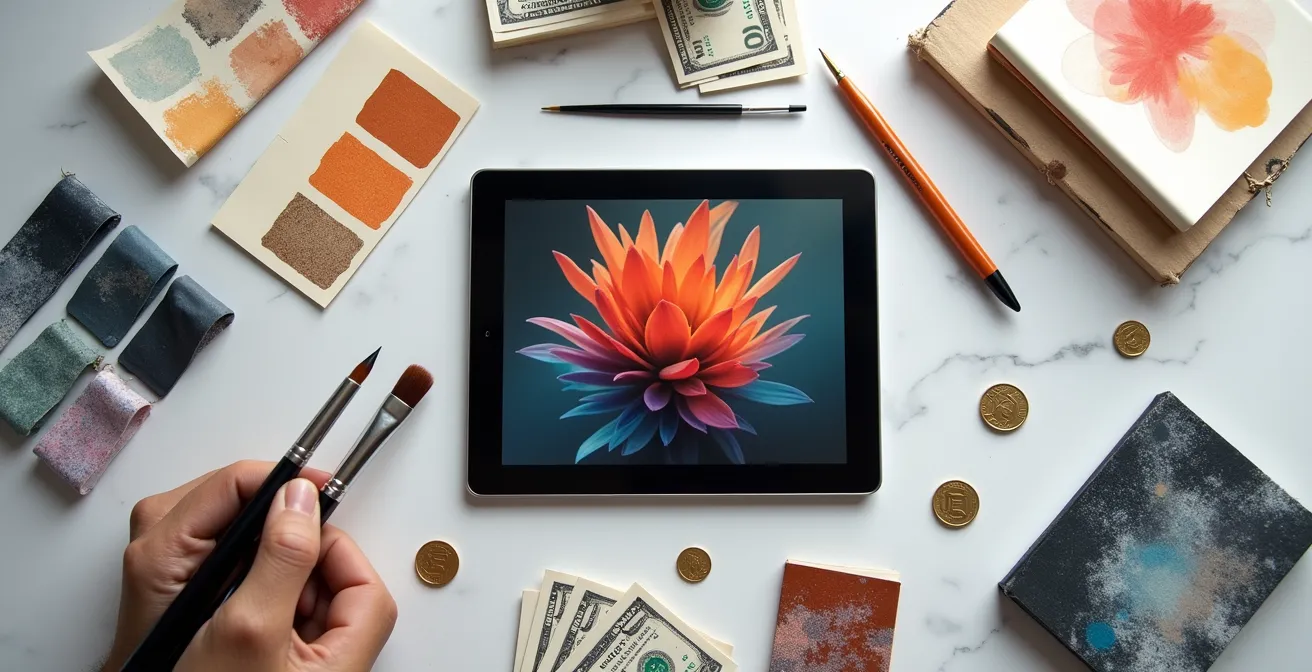
Building a digital asset ecosystem is a powerful strategy. It positions you not just as a service provider but as a resource for other creatives. This enhances your authority in your niche and creates multiple entry points for customers into your world. A customer who buys your cheap template pack today might hire you for a high-ticket custom project tomorrow. The potential is significant; while figures vary wildly, some analyses show that the average content creator can earn between $67,000 to $100,000 annually, often through a mix of active and passive income streams.
Numerous platforms are designed to facilitate the sale of digital products, each with its own model. Marketplaces like Creative Market are excellent for discoverability but take a higher commission. All-in-one platforms like Gumroad or Podia give you more control and a direct relationship with your customers for a monthly or small transaction fee. Choosing the right platform depends on your goals, but the strategy remains the same: create once, sell many times. By investing in a portfolio of digital assets, you are building a more robust, scalable, and ultimately more profitable creative business.
The Format Obsolescence Risk: Will Your Art Be Viewable in 10 Years?
As a digital artist, you’re creating work that exists as a collection of ones and zeros. While this offers incredible flexibility, it also comes with a hidden, long-term risk: format obsolescence. The software and file formats we use today may become unreadable in the future. A creative entrepreneur must not only think about creating and selling art now but also about preserving its value for the long term. If your masterpiece can’t be opened in ten years, its value effectively drops to zero.
This isn’t a theoretical problem. The history of technology is littered with dead formats. Anyone who worked with Macromedia Flash in the early 2000s knows this pain. The once-ubiquitous `.swf` file, used for countless animations and websites, is now largely unreadable by modern browsers and devices. An entire generation of digital art and interactive media became inaccessible, a cautionary tale for today’s creators.
Case Study: The Cautionary Tale of Flash and Proprietary Formats
The demise of Flash serves as a stark reminder of format risk. An entire ecosystem built around the `.swf` format became obsolete as technology moved on, rendering years of creative work unviewable. This same risk applies to modern proprietary formats. While files like `.procreate` (from Procreate) or `.fig` (from Figma) are incredibly powerful for creation, relying solely on them for archival is dangerous. If these companies go out of business or fundamentally change their software, your source files could become digital fossils. This ongoing challenge is even recognized by bodies like the U.S. Copyright Office, which continually adapts regulations to address technological shifts and preservation issues.
So how do you protect your work? The key is a proactive digital conservation strategy. This involves future-proofing your art by saving it in stable, open-source, or universal formats alongside your proprietary working files. You don’t have to stop using your favorite creative software, but you must make a habit of exporting archival versions of your finished pieces. This ensures that your work remains accessible and usable, regardless of what happens to any single piece of software.
A simple but effective strategy includes these steps:
- For Raster Art: Always export a final, full-resolution version as a TIFF (`.tif`). This is a lossless, high-quality archival standard in the print and art world.
- For Vector Art: Save a version as an SVG (`.svg`) or PDF (`.pdf`). These are open standards that ensure your artwork remains scalable and editable across a wide range of applications.
- Document Everything: Keep a simple text file (`.txt`) in each project folder detailing the software versions, fonts, and color profiles used. This information can be invaluable for future restoration.
- Diversify Backups: Store these archival files in multiple locations (e.g., a local hard drive, a cloud service, and perhaps even a decentralized storage solution like IPFS for ultimate long-term security).
Thinking like an archivist is part of being a creative entrepreneur. By taking these simple steps, you are protecting the long-term value of your most important assets: your creative works.
Short Film Markets: How to Sell Your 15-Minute Movie to Distributors?
For filmmakers, monetization can seem even more opaque than for visual artists. While a 15-minute short film is a powerful creative statement, how do you turn it into revenue? The answer lies in navigating the professional world of film festivals and distribution markets. Unlike simply uploading to YouTube, a strategic approach involves treating your short film as a product and a calling card, designed to be sold to distributors or to attract funding for larger projects.
The first step is to understand the value chain. Short films are rarely profitable in and of themselves through direct sales to the public. Instead, their value lies in their ability to win festival awards (which often come with cash prizes) and to be sold as part of a package to distributors, streaming platforms, or television networks. These platforms are constantly looking for content to fill their schedules or to bundle into anthologies. The creative work is financially viable; for example, a recent report shows that creative freelancers in UK film and video production earned an average day rate of £397, demonstrating the professional economy that exists around high-quality video content.
To successfully sell your film, you need more than just a great movie. You need a professional sales package, often called an Electronic Press Kit (EPK). This is your business tool for pitching to festival programmers and distributors. It demonstrates that you are a serious filmmaker who understands the business side of the industry. A weak or incomplete EPK can get your film dismissed before it’s even watched.
Your sales package must be comprehensive and polished. It’s your primary marketing tool and should include everything a potential buyer needs to evaluate and promote your film:
- A Professional EPK: This should contain a compelling synopsis, a director’s statement explaining your vision, cast and crew bios, and contact information.
- High-Resolution Stills: Prepare a selection of at least 5-10 striking images from the film at a minimum of 300 DPI, suitable for print and web promotion.
- Poster and Artwork: Design a professional and festival-ready poster in various formats (vertical, horizontal) that captures the essence of your film.
- Documentation: Compile a list of any festival selections, laurels, and awards your film has already received. Social proof is powerful.
- Clean “Chain of Title”: This is absolutely critical. You must have legal documentation proving you have the rights to everything in your film, including all music, stock footage, and talent releases from every actor. Without a clean chain of title, your film is legally unsellable.
By preparing this package before you even begin submitting to festivals, you position yourself as a professional creative entrepreneur, ready to do business. You show distributors that you are not just an artist, but a reliable partner, dramatically increasing your chances of making a sale.
Key Takeaways
- Shift your mindset from “artist” to “creative entrepreneur” to build a sustainable business.
- Price your work based on the value it delivers to the client, not the hours it takes you to create.
- Treat your intellectual property as your most valuable business asset and protect it proactively.
- Develop passive income streams by creating digital assets to decouple your earnings from your time.
Understanding Digital Art: How to Evaluate Quality Beyond the Screen?
In the digital realm, what separates amateur work from professional, high-value art? As a creative entrepreneur, understanding the markers of quality is essential for two reasons. First, it allows you to critically evaluate and improve your own work to command higher prices. Second, it gives you the language to articulate the value of your work to clients who may not understand the difference. Quality isn’t just a subjective feeling; it’s a combination of tangible technical skill and intangible conceptual strength.
On the technical side, quality is about execution and craftsmanship. It’s the digital equivalent of clean brushstrokes or a perfectly constructed sculpture. This includes factors like resolution—is the image crisp and clear, suitable for print at 300 DPI, or is it a pixelated mess? It involves color depth and accuracy, clean line work, and well-organized files with logical layers that make the work easy to use for a client. These technical elements demonstrate a level of professionalism and care that justifies a premium price. Data shows that quality creative work commands premium rates, with freelance designers in the UK earning £49 per hour on average, and the top 10% earning as much as £89 per hour.
However, technical perfection alone does not make great art. Conceptual quality is the other half of the equation. This is the “why” behind the work—the idea, the story, and the emotion it conveys. Does the piece show an original and unique perspective, or is it a generic copy of a popular trend? Does it have a strong narrative or evoke a specific feeling in the viewer? This is where true artistry lies. A technically simple piece with a powerful, resonant concept can be far more valuable than a photorealistic rendering that says nothing.
A truly high-quality piece of digital art excels on both fronts. It combines flawless technical execution with a compelling, original concept. As you develop your skills, it’s crucial to assess your work against both sets of criteria.
| Technical Criteria | Conceptual Criteria |
|---|---|
| Resolution (300+ DPI for print) | Originality and unique perspective |
| Color depth and accuracy | Narrative strength and storytelling |
| Line quality and precision | Emotional impact and resonance |
| File organization and layers | Stylistic consistency throughout |
| Export format compatibility | Cultural relevance and context |
By mastering both the technical craft and the conceptual storytelling of your art, you elevate your work from a simple commodity to a high-value creative solution. This dual focus is the key to not only creating better art but also to building a more profitable and respected creative business.
Start today by taking one piece of your art—a design, an illustration, a photograph—and defining its value beyond the time it took to create. This is your first, most important step on the path to becoming a successful creative entrepreneur.
Frequently Asked Questions on Monetizing Creative Work
What happens if I use a font with a personal-use-only license in commercial work?
Using fonts without the proper commercial licensing is a common but serious copyright violation. It can trigger automated DMCA takedown notices from the font creator and result in immediate shop bans on platforms like Etsy, effectively shutting down your sales channel without warning.
Can I create and sell fan art of popular characters?
Selling fan art is legally risky. It often violates the trademark rights of the character’s owner, not just their copyright. Even if you believe your work is “transformative,” rights holders of major franchises actively police online marketplaces and can take legal action, leading to shop closures and potential lawsuits.
What about using ‘free’ design elements from the internet in my work for sale?
Many so-called “free” resources found on unreliable websites may contain unlicensed or stolen assets. Incorporating these into your commercial work, even unknowingly, can lead to automated DMCA takedowns and platform bans when the original creator’s work is detected. Always source your assets from reputable sites with clear commercial licensing terms.