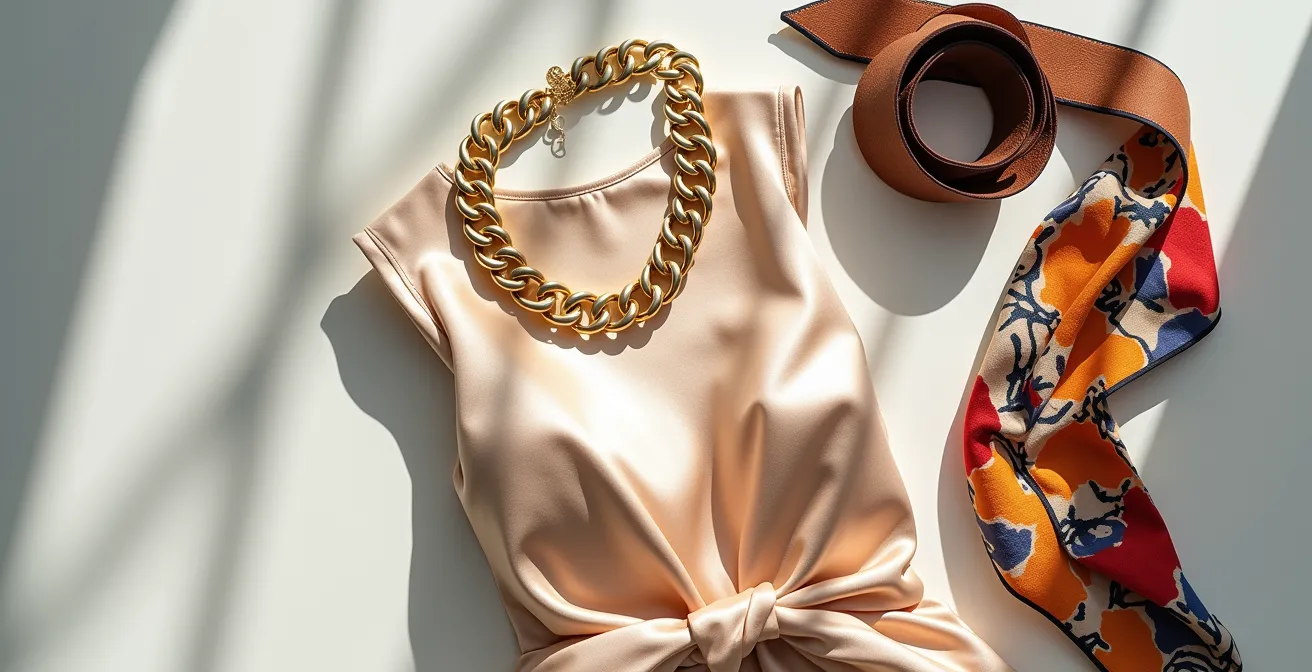
The secret to elevating a minimalist wardrobe isn’t buying more clothes; it’s mastering the visual engineering of accessories.
- Transform neutral outfits by using chunky gold jewelry to strategically manipulate light and add warmth.
- Apply design principles like the 60-30-10 rule to use bags and shoes as precise color punctuation, not random pops of color.
Recommendation: Stop thinking of accessories as afterthoughts. Start treating them as architectural tools to reshape, recolor, and redefine the core pieces you already own.
Your closet is a testament to minimalist elegance: a curated collection of high-quality basics in serene, neutral tones. It’s functional, timeless, and easy. Yet, some days, it feels less like a choice and more like a uniform. The common advice is to “add a statement piece” or “buy a colorful bag,” but this often leads to impulse buys that clash with your carefully built capsule wardrobe. This approach treats accessories as mere decoration, a sprinkle of something extra on top.
As an accessory designer, I see things differently. The true power of accessories lies not in what they are, but in what they do. They are not just additions; they are multipliers. They can alter the perception of an entire outfit, shifting its mood, its silhouette, and its sophistication. This is about more than just adding flair; it’s an exercise in visual engineering. It’s about understanding how to use specific pieces to manipulate light, form, and color to breathe new life into the garments you already love and own.
Forget the generic rules. We are going to explore the mechanics of transformation. We’ll delve into how the right jewelry can become a light source, how color theory turns bags and shoes into strategic tools, and how the choice between a scarf and a belt is a decision about creating fluidity versus structure. This guide is about empowering you to see your wardrobe not as a finite collection of items, but as an infinite canvas for creative expression.
For those who prefer a visual masterclass, the following video showcases many of these principles in action, offering a wealth of inspiration on how experienced women use accessories to define their signature style.
This article provides a blueprint for mastering this art. By understanding the core principles of visual engineering through accessories, you can unlock countless new looks from your existing wardrobe. The following sections break down the specific techniques and tools you need.
Summary: A Designer’s Blueprint for Accessory Alchemy
- Why Chunky Gold Jewelry Is the Best Investment for a Neutral Wardrobe
- How to Use Complementary Colors in Bags and Shoes to Pop a Monochromatic Look
- Silk Scarves or Statement Belts: Which Accessory Offers More Styling Options?
- The “Christmas Tree” Effect: Signs You Are Wearing Too Many Statement Pieces
- Storing Structured Bags: The 5 Steps to Prevent Deforming the Leather
- Digital Frames or Projectors: How to Display NFT Art in a Physical Home?
- How to Identify the “Core 5” Items Your Wardrobe Is Missing
- True Sustainability or Marketing Hype: How to Spot Greenwashing in Fashion Brands?
Why Chunky Gold Jewelry Is the Best Investment for a Neutral Wardrobe
For a minimalist wardrobe dominated by black, white, beige, and grey, chunky gold jewelry is not just an accessory; it’s a utility. These neutrals are a perfect canvas, but they can sometimes appear flat or cool under certain lighting. Gold’s primary function here is light manipulation. Its warm, reflective surface literally bounces light onto your face and décolletage, infusing your skin and the fabric with a warmth and richness that elevates the entire look from stark to sophisticated. It acts as a personal, portable source of golden-hour light.
Beyond aesthetics, there’s a psychological component. As an accessory designer, I know that the weight and substance of a chunky piece provide a satisfying tactile presence. Furthermore, research from Fashion Is Psychology shows that jewelry reinforces power and signals a certain status and self-assurance. For a minimalist, this isn’t about showing off wealth, but about projecting an image of quiet confidence and deliberate choice. A single, high-quality gold piece communicates intention more effectively than a dozen fleeting trends.
Investing in the right piece is crucial. The term “gold” can be misleading, and for a piece to be a true long-term asset, understanding its composition is key. This is where the distinction between solid gold, vermeil, and plated jewelry becomes a critical factor in your investment strategy.
This comparative analysis from a recent guide breaks down the key differences, helping you decide where to invest for longevity versus experimenting with trends.
| Gold Type | Durability | Investment Value | Best For |
|---|---|---|---|
| Solid Gold (14k-18k) | Excellent | High – retains/increases value | Long-term investment pieces |
| Gold Vermeil | Good | Moderate | Quality fashion jewelry |
| Gold Plated | Fair | Low | Trend experimentation |
Choosing a piece of solid 14k or 18k gold is an investment in permanence. Unlike plated jewelry, it won’t tarnish or fade, making it a true “wear forever” item that perfectly aligns with the minimalist ethos of buying better, less often. It becomes a signature piece that grows with you.
How to Use Complementary Colors in Bags and Shoes to Pop a Monochromatic Look
A monochromatic outfit is the height of minimalist chic, but it can easily feel one-dimensional. The common advice to “add a pop of color” is imprecise and often results in a look that feels disjointed. A more effective approach is to think like a designer and practice strategic color punctuation. This means using accessories not as random splashes of color, but as deliberate marks that guide the eye and create a sophisticated visual narrative. The most powerful way to do this is by leveraging complementary colors—opposites on the color wheel, like blue and orange, or red and green.
The key to avoiding a jarring effect is balance, which is perfectly encapsulated in the 60-30-10 rule, a classic interior design principle that applies flawlessly to fashion. Your monochromatic outfit is the 60% dominant color. Your bag or shoes become the 30% secondary color, and a smaller accessory, like a scarf or jewelry, serves as the 10% accent. This formula ensures your complementary color feels intentional and integrated, not like an accident.
For example, with a navy blue dress (60%), a pair of orange-tan leather loafers (30%) and a delicate gold pendant (10%) creates a harmonious yet dynamic look. The complementary colors generate a subtle visual vibration that brings the entire outfit to life.
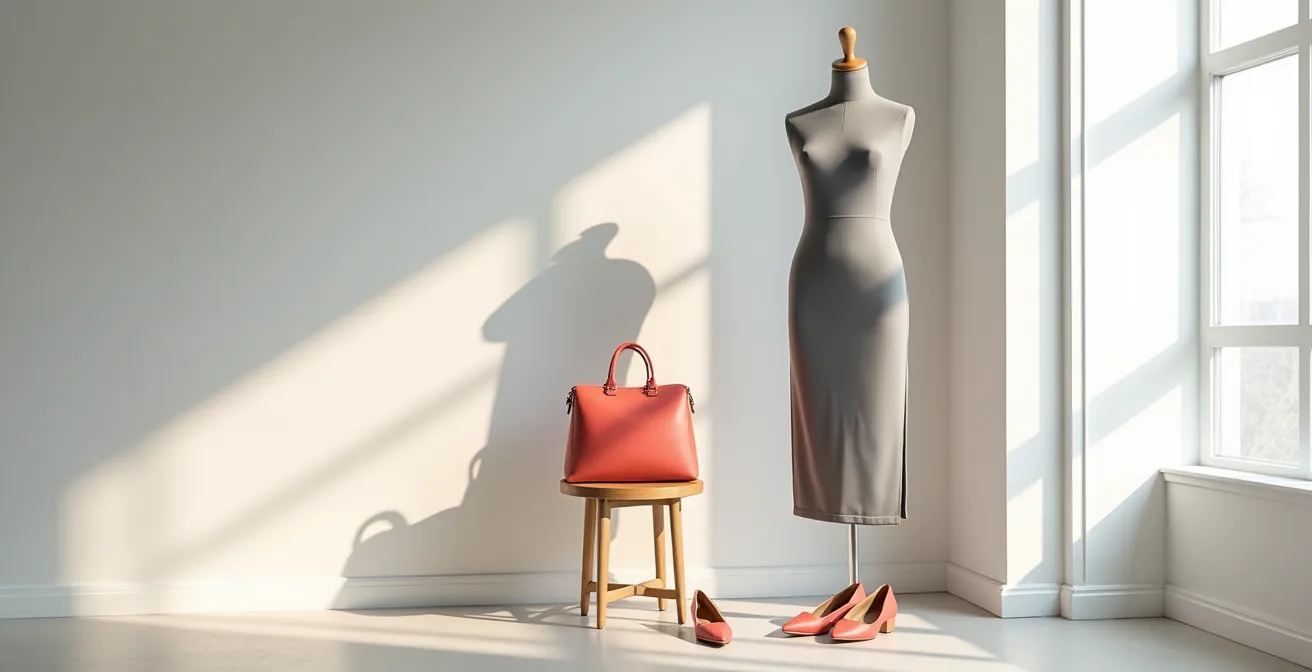
This image perfectly demonstrates the principle. The cool, dominant grey of the outfit provides a neutral base, while the coral bag and shoes act as a unified, 30% block of complementary warmth. The effect is striking yet feels completely balanced and intentional. This is visual engineering in its purest form.
Experimenting is key. Start with a neutral base and introduce one complementary color through your two main leather accessories (bag and shoes). This creates a powerful, confident statement that feels curated and deeply personal, proving you don’t need a loud print to make a big impact.
Silk Scarves or Statement Belts: Which Accessory Offers More Styling Options?
In the world of accessories, versatility is the ultimate currency, especially for a minimalist. Both silk scarves and statement belts are powerful tools, but they serve fundamentally different purposes in visual engineering. A belt is a tool of structure and definition. It cinches, it creates a waistline, and it breaks up the vertical line of an outfit. A scarf, by contrast, is a tool of fluidity and transformation. It adds movement, introduces color and pattern, and can be molded into entirely new forms.
While a belt can define a silhouette, its function is relatively fixed. A scarf, particularly a large silk square, is a true chameleon. It doesn’t just accessorize an outfit; it can become a part of it. Worn as a headband, it frames the face. Tied to a handbag, it adds a touch of personality. Worn around the neck, it adds a classic Parisian flair. But its true potential is unlocked when it becomes a garment itself—a halter top, a bandeau, or a sarong.
This superior versatility is not just theoretical; it’s been proven in practice. The following case study highlights just how much more mileage a single scarf can offer compared to other accessories, especially in a constrained wardrobe context like travel.
Case Study: The Ultimate Versatility Test
In a documented year-long experiment, a fashion blogger analyzed the versatility of different accessories for a travel wardrobe. The results were clear: a single vintage Liberty silk scarf offered over seven distinct styling options, including being worn as a headband, bracelet, hair tie, belt, bag charm, neck scarf, and even a top. In contrast, a statement belt, while impactful, offered only three to four variations. The scarf’s lightweight, adaptable nature made it the undisputed champion for creating dramatically different looks from a limited selection of clothes.
For the minimalist seeking maximum impact from a single purchase, the silk scarf is the clear winner. A statement belt is a powerful tool for shaping, but a quality silk scarf is a tool for complete reinvention. It offers an unparalleled return on investment in terms of pure styling potential.
The “Christmas Tree” Effect: Signs You Are Wearing Too Many Statement Pieces
There’s a fine line between a well-accessorized outfit and one that’s simply over-decorated. This is the “Christmas Tree” effect: a look so laden with competing focal points that the eye doesn’t know where to land, and the overall effect is chaotic rather than chic. For a minimalist, whose style is built on clarity and intention, avoiding this is paramount. The goal is not to eliminate statement pieces, but to orchestrate them into a clear focal hierarchy.
An outfit should have a “hero” accessory—one piece that takes center stage. This could be your chunky gold necklace, your brightly colored bag, or an ornate belt. All other accessories should play a supporting role. They should be quieter, smaller, or more neutral, existing to complement the hero piece, not compete with it. When every accessory is shouting for attention, the result is just noise.
A leading fashion editorial team offers a simple, intuitive test to check if you’ve crossed the line from stylish to overdone. Their advice focuses on the immediate visual impact and the concept of “breathing room.”
If your eye bounces around trying to take in all your accessories, you’ve likely crossed the line from stylish to overdone. Remove one piece and notice how the remaining accessories suddenly have more visual impact and breathing room.
– Mvraki Fashion Editorial Team, Accessorizing Guide: 10 Golden Rules to Transform Outfits
To put this into practice, you can use a simple checklist to audit your look before you walk out the door. This ensures you’re creating a clear visual story.
- Identify your ‘hero’ accessory: This should be your most statement-making piece.
- Check for visual hierarchy: Supporting accessories should be about 50% less bold than your hero piece.
- Apply the ‘squint test’: Squint at your reflection. Only one area should immediately draw your attention.
- Monitor sensory overload: Avoid wearing more than one ‘noisy’ accessory, such as multiple jangling bracelets.
- Use the arm’s length rule: Step back. If you can distinctly count every individual accessory from an arm’s length away, it’s a sign you may need to simplify.
By consciously choosing a single star performer and letting other pieces play a quieter role, you create a look that is confident, powerful, and impeccably edited. It’s the difference between a curated gallery and a cluttered antique shop.
Storing Structured Bags: The 5 Steps to Prevent Deforming the Leather
A beautifully structured handbag is a cornerstone of an elevated minimalist wardrobe. It provides a powerful structural counterpoint to the softer lines of a knit sweater or silk blouse. Its clean angles and defined shape are its primary assets. However, that architectural integrity is fragile. Improper storage can cause the leather to crease, slump, and permanently lose the very shape that makes it so impactful. Protecting this investment is a non-negotiable part of owning it.
Leather is a natural material that responds to its environment, particularly to humidity and pressure. It needs to breathe, but it also needs support. Storing a bag in a plastic container can trap moisture and lead to mold, while hanging it by its straps can cause stretching and distortion at the stress points. The goal is to create a stable, supportive, and climate-controlled environment that mimics a state of rest for the leather. Maintaining the right conditions is a science; research confirms that maintaining around 55% relative humidity at a stable temperature is ideal for long-term leather preservation.
To preserve the shape and finish of your structured bags, following a precise protocol is essential. It’s not just about putting it on a shelf; it’s about preparing it for hibernation.
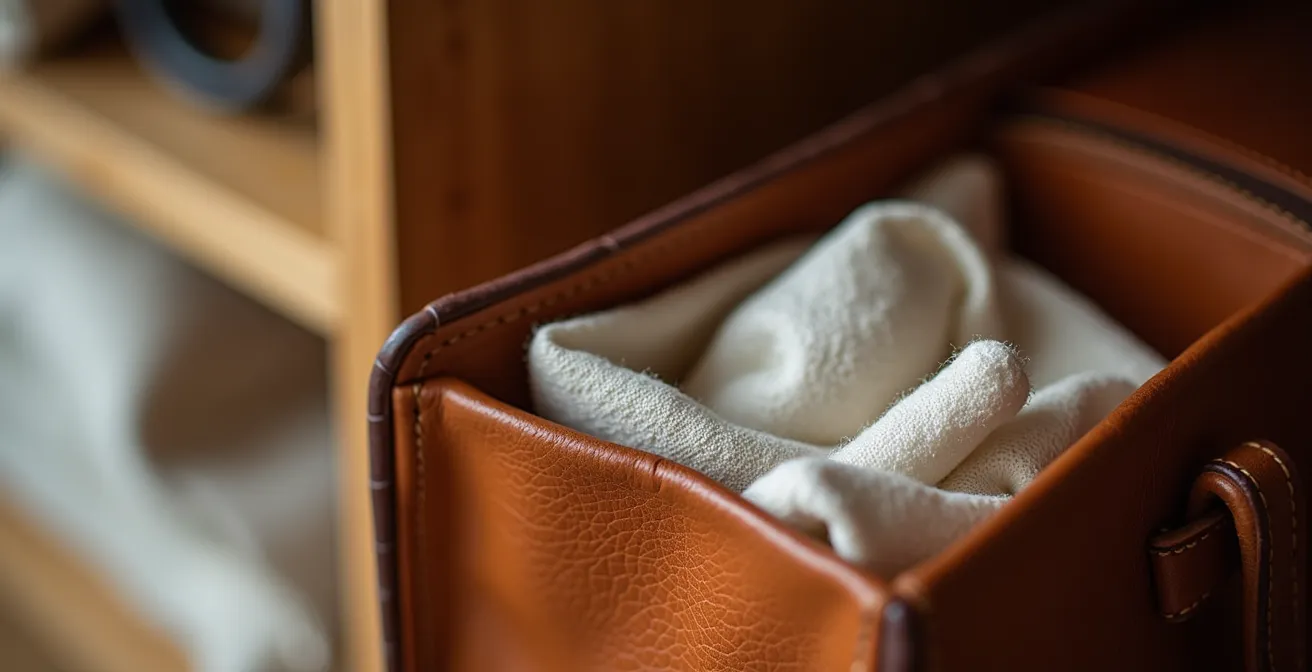
The image above illustrates a key step: proper stuffing. Using acid-free tissue paper provides internal support that prevents the bag’s structure from collapsing under its own weight over time. This single step is crucial in fighting gravity and maintaining those crisp lines.
Action Plan: The Leather Bag Preservation Protocol
- Clean and Condition: Before storage, wipe down the bag with a leather-specific cleaner and apply a conditioner. This prevents trapped dirt and oils from degrading the material over time.
- Stuff for Shape: Fill the bag with acid-free tissue paper or old scarves. Ensure it’s full enough to hold its natural shape but not overstuffed, which could strain the seams. Never use newspaper, as the ink can transfer.
- Use a Breathable Cover: Place the bag in the breathable cotton dust bag it came with. If you don’t have one, a simple cotton pillowcase works perfectly. This protects it from dust and scratches while allowing air to circulate.
- Control Moisture: Tuck a few silica gel packets inside the bag to absorb any excess humidity. Remember to replace these every few months as they become saturated.
- Store Upright: Place the bag upright on a flat shelf in a climate-controlled closet, away from direct sunlight or heat sources. Never hang a structured bag by its handles, as this will cause stretching and damage.
By treating the storage of your bag with the same care as wearing it, you ensure that this key piece of visual engineering retains its power and value for years to come.
Digital Frames or Projectors: How to Display NFT Art in a Physical Home?
At first glance, a question about displaying digital art seems out of place in a discussion about fashion. But as a designer, I see a powerful metaphor here that gets to the very heart of styling. An NFT, no matter how valuable or brilliant, is just a file until it’s displayed. It needs a high-resolution digital frame or a perfectly calibrated projector to be seen and appreciated. The display method provides the context, the scale, and the presence. Without the right “frame,” the art’s potential is lost. The same is true for your clothing.
Think of your core wardrobe pieces—your perfect black dress, your favorite cashmere sweater, your classic white shirt—as your collection of fine art. On their own, they are beautiful and full of potential. But without the right “frame,” they may not command the attention they deserve. Accessories are the frames for your clothes. A basic t-shirt is just a t-shirt. But frame it with a sharp, structured blazer, and it becomes the canvas for a powerful, professional look. A simple slip dress is lovely, but frame it with a chunky gold chain and a statement belt, and it transforms into an intentional, evening-ready ensemble.
This “Frame Effect” is a core principle of visual engineering. It’s about using accessories to provide the context that dictates how a garment is perceived. A wide leather belt doesn’t just sit on a dress; it reframes it, giving it a new silhouette and a focal point. A silk scarf tied at the neck doesn’t just add color; it frames the face and draws the eye upward. The accessory provides the necessary context to complete the picture.
So, the next time you get dressed, don’t just think about what to wear. Think about how you’re going to display it. Which “frame” will best showcase the art you’ve chosen for the day? This simple shift in perspective is the key to unlocking the hidden potential in every piece you own.
How to Identify the “Core 5” Items Your Wardrobe Is Missing
Even the most perfectly curated minimalist wardrobe can have hidden gaps. You might find yourself constantly reaching for the same “good enough” item or feeling like you can’t quite complete a specific type of look. This is often because you’re missing a few foundational “Core 5” pieces—versatile workhorses that bridge the gaps between your other garments. The challenge is that these missing items are rarely the exciting, trend-driven pieces you’re drawn to. They are the quiet, functional heroes you don’t realize you need until you have them.
Instead of guessing, you can use a diagnostic method to let your real-life behavior reveal what’s missing. One of the most effective techniques is the “Outfit Repeater” diagnostic. It forces you to look at what you actually wear, not what you aspire to wear, and identify the true needs of your lifestyle.
- Document your outfits: For two weeks, take a quick photo of your outfit every day. Aim for at least 10 different outfits.
- Identify recurring patterns: Look at the photos as a collection. Is there one blazer, pair of jeans, or top that appears in over 70% of your looks? This is a core piece, but also a potential point of overuse.
- Note functional gaps: When did you feel your outfit was a compromise? Did you need a layering piece that wasn’t a bulky sweater? A shoe that was more polished than a sneaker but more comfortable than a heel?
- Define needs by verbs, not nouns: Instead of thinking “I need a new blazer,” think “I need something to layer over my silk tops that feels structured.” This opens up possibilities beyond your usual go-to items.
- Map actual vs. aspirational activities: Be honest. If your life is 80% working from home and 20% social outings, build your wardrobe for that reality, not the other way around.
This process transforms your perspective from wanting new things to solving practical problems. This shift in focus is what leads to truly transformative additions to a wardrobe, as one prominent style influencer discovered.
YouTuber Dearly Bethany documented how identifying her core missing items transformed her style. Instead of buying trend pieces, she focused on versatile basics that worked with multiple outfits. Her investment in quality basics like a white camisole, well-fitted jeans, and a structured blazer meant each new piece could help create up to 27 different outfit combinations when properly accessorized.
– Dearly Bethany, via Preview.ph
Once you’ve identified a true need—like a versatile layering piece or the perfect flat shoe—you can invest with confidence, knowing it will be a multiplier for your entire wardrobe, not just another piece taking up space.
Key Takeaways
- Treat accessories as tools for visual engineering to strategically alter your outfits, not just as decoration.
- Use chunky gold jewelry to actively manipulate light, adding essential warmth and dimension to neutral color palettes.
- Apply the 60-30-10 rule for strategic color punctuation with bags and shoes, creating a balanced and intentional look.
True Sustainability or Marketing Hype: How to Spot Greenwashing in Fashion Brands?
For the minimalist, sustainability isn’t a trend; it’s an inherent part of the ethos. The philosophy of “buy less, choose well, make it last” is the very definition of conscious consumption. However, as sustainability has become a powerful marketing tool, the landscape is now filled with “greenwashing”—vague claims and misleading language designed to make a brand appear more ethical than it is. Words like “eco-friendly,” “conscious,” and “green” are often used without any verifiable meaning, making it difficult to discern true commitment from clever hype.
A truly sustainable brand’s commitment doesn’t end when you purchase an item. In fact, that’s where it begins. One of the most telling indicators of a brand’s genuine investment in sustainability is its approach to the post-purchase lifecycle of its products. While marketing focuses on materials (like “organic cotton” or “recycled polyester”), true sustainability is about extending the life of the product and taking responsibility for it long after the sale.
This is where you, the consumer, can become a savvy detective. Instead of being swayed by buzzwords on a label, investigate a brand’s policies. Do they offer repairs? Can you purchase spare parts, like a lost button or a broken strap? Do they have a buy-back or trade-in program to facilitate a circular economy? These services are costly and complex to implement, and their existence is a strong signal that the brand is genuinely committed to longevity, not just marketing.
Case Study: Beyond Materials in Sustainable Jewelry
An analysis of the chunky gold jewelry trend reveals how true sustainability is demonstrated. While the material itself is durable, the real test of a brand’s ethos lies elsewhere. Leading sustainable jewelers build their reputation not just on using recycled gold, but on offering lifetime warranties, professional cleaning and repair services, and buy-back programs that ensure the piece can be resold or melted down responsibly. These post-purchase commitments are the hallmark of a circular business model, moving far beyond simple marketing claims about sourcing.
Frequently Asked Questions on Transforming a Basic Outfit
What makes an accessory truly versatile?
Versatility depends on three factors: Material flexibility (can it be shaped or folded differently, like a silk scarf), Size adaptability (does it work with various outfit proportions), and Hardware limitations (fewer fixed elements, like zippers or clasps, often mean more styling freedom).
How do body proportions affect accessory choice?
Accessories are powerful tools for shaping your silhouette. Belts excel at creating horizontal lines that define a waistline, which is ideal for adding or emphasizing curves. Scarves, when worn long, draw the eye vertically and add movement, making them perfect for elongating the body.
Can accessories serve as actual garments?
Absolutely. This is where you can unlock maximum creativity. Large silk scarves can easily be transformed into halter tops, bandeau tops, or even skirts and sarongs for resort wear. Similarly, wide, corset-style belts can be worn over blazers to cinch them into a new shape or layered over an oversized shirt to create a dress silhouette.
By shifting your focus from marketing claims to evidence of circularity, you can make choices that truly align with your minimalist values and build a collection of accessories that are not only beautiful and functional, but also genuinely sustainable.