The pilling on your new cashmere sweater isn’t a flaw—it’s an initial sign of its high quality, but only if you know how to manage it correctly.
- Initial fuzzing, or “blooming,” is a natural process where the finest fibers soften; it’s different from the structural pilling caused by friction.
- Proper care, including using the right tools and washing techniques, is not about avoiding pilling entirely but about preserving the garment’s long-term fiber integrity.
Recommendation: Shift your mindset from fighting pilling to actively preserving your garment. Mastering the correct folding, washing, and de-pilling techniques will maximize your investment and extend the life of your luxury knitwear for years.
You’ve invested in a beautiful, expensive cashmere sweater. It feels impossibly soft, a cloud of luxury against your skin. But after just a few wears, you see them: those frustrating, messy little balls of fuzz, particularly under the arms and along the sides. The immediate thought is one of betrayal. Why is a $300 sweater performing like a cheap imitation? It’s a common frustration that leads many to question the very value of their purchase.
The conventional wisdom is often contradictory. Some say pilling is normal, while others insist it’s a sign of poor quality. You’re told to use a special comb or a fabric shaver, but the fear of accidentally tearing a hole in your prized possession is very real. The cycle of confusion and disappointment leaves you treating your luxury knitwear with a hesitant, almost fearful, touch.
But what if the entire premise is wrong? What if pilling, especially in the beginning, isn’t a defect but a natural, manageable characteristic of a superior natural fiber? The key to preserving your investment isn’t found in a magic cure, but in adopting the mindset of a knitwear care specialist. It’s about understanding the “why” behind the “how”—the science of the fibers, the physics of storage, and the real return on investment (ROI) of proper care.
This guide will move beyond the generic advice. We will explore the crucial difference between high-quality “blooming” and damaging pilling, master the professional techniques for garment care without causing harm, and re-evaluate the concept of clothing as a long-term asset. Prepare to transform your approach to luxury care.
To navigate this expert guide, we’ve structured the information to build your knowledge from the foundational science of the fibers to the practical strategies for long-term preservation. Explore the topics below to become a true custodian of your wardrobe.
Summary: An Expert’s Guide to Preserving Luxury Cashmere
- Why Short Fibers Cause More Pilling Than Long-Staple Yarns?
- How to Use a Fabric Shaver Without Cutting a Hole in Your Sweater?
- Hanging vs. Folding: Which Method Prevents Shoulder Bumps Permanently?
- The Temperature Shock That Felts Wool Instantly
- Cedar Balls or Lavender: Which Natural Repellent Actually Works for storage?
- Conservation Framing: Why Spending $200 on a Frame Saves Your Investment?
- Why a $200 Coat Is Cheaper Than a $50 Coat After Two Winters?
- Investment Pieces: Calculating the Real ROI of a Capsule Wardrobe Over 5 Years
Why Short Fibers Cause More Pilling Than Long-Staple Yarns?
The root cause of pilling lies in the microscopic structure of the yarn itself. All pilling happens when fibers on the surface of the fabric rub against each other or another surface, causing them to tangle into small knots. However, the quality and length of these fibers determine how and why this happens. Lower-quality cashmere uses shorter, coarser fibers. These short fibers have many more ends exposed on the yarn’s surface, which easily break free and tangle, leading to significant and persistent pilling.
Conversely, high-quality cashmere, such as Mongolian cashmere, is prized for its long-staple fibers. These fibers are longer, finer, and stronger. Because they are securely twisted into the yarn, fewer ends are exposed. This inherent fiber integrity is the primary reason why premium garments pill significantly less over their lifetime. What is often mistaken for pilling on a new luxury sweater is actually a desirable process known as “the bloom.”
This initial light fuzzing is the garment settling. The very finest surface fibers rise and soften, creating the signature, buttery-soft feel that defines elite cashmere. This blooming phase occurs in the first few wears and then subsides. It’s a hallmark of quality, not a flaw. Understanding this distinction is the first step toward appreciating your investment. Knowing how to spot quality before you even make a purchase is the next.
Your Checklist for Assessing Knit Quality Before Purchase
- Hold the garment up to natural light to check yarn density – tighter knits show less light passing through.
- Gently stretch a small area between your fingers – quality cashmere bounces back immediately without distortion.
- Look for consistent stitch size across the garment – irregular stitches indicate lower quality construction.
- Check the inside seams for neat finishing – poorly finished seams suggest overall poor construction.
- Feel the weight – quality cashmere has a substantial heft despite being lightweight.
How to Use a Fabric Shaver Without Cutting a Hole in Your Sweater?
The fear of damaging an expensive sweater keeps many from properly maintaining it. While a fabric shaver can be a powerful tool, using it incorrectly is a fast track to disaster. The secret to safe and effective de-pilling isn’t the tool itself, but the technique. The most critical error is using a shaver on a loose, rumpled surface, which allows the blades to catch and cut the yarn.
The professional approach is the tension method. Lay the garment on a firm, flat surface. Then, use one hand to gently but firmly stretch the area you are about to treat, creating a smooth, taut canvas. With your other hand, hold the shaver at a slight angle and pass it lightly over the surface in a single, consistent direction. Don’t press down; let the shaver’s motor do the work. This tension prevents the blades from snagging the primary knit structure, allowing them to shear off only the surface pills.
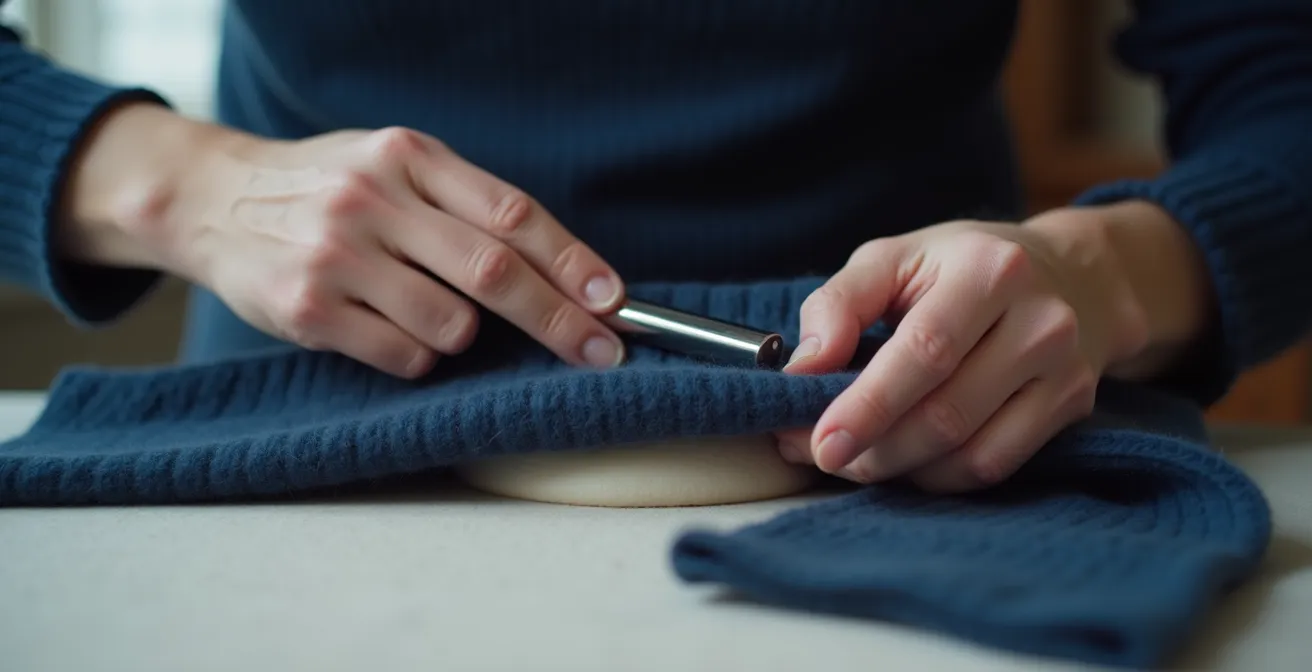
Furthermore, not all tools are created equal, and choosing the right one for the job is crucial. A powerful rotary shaver is excellent for large areas of diffuse fuzz on a fine-gauge knit, but a delicate cashmere comb is far safer for light pills on a cherished, delicate garment. Understanding this nuance moves you from amateur care to expert preservation.
This decision matrix clarifies which tool is best suited for your specific garment and type of pilling, minimizing risk and maximizing results.
| Tool Type | Best For | Knit Type | Pill Type | Risk Level |
|---|---|---|---|---|
| Rotary Shaver (Steamery Pilo) | Large surface areas | Fine-gauge | Diffuse fuzz | Medium (with guard) |
| Cashmere Comb | Delicate garments | All types | Light to medium pills | Low |
| Pilling Stone | Heavy knits | Chunky gauge | Large bobbles | Low-Medium |
| Manual Razor | Small areas only | Dense weaves | Individual pills | High |
Hanging vs. Folding: Which Method Prevents Shoulder Bumps Permanently?
The debate between hanging and folding sweaters is often oversimplified. The unequivocal answer for any knitwear, especially heavy or delicate fibers like cashmere, is to fold, never hang. The reason lies in physics. Hanging a sweater places the entire weight of the garment on a small area—the shoulders. Over time, gravity creates immense structural stress on the knit, stretching the fibers downwards.
This constant tension leads to the dreaded “shoulder bumps,” a form of permanent distortion. Research on fiber behavior shows that natural fibers like wool lose their shape and stretch once gravity has done its work, causing irreversible damage. Folding, by contrast, distributes the garment’s weight evenly across a larger surface area, completely eliminating this stress point and preserving the original silhouette.
However, even folding can be improved with professional techniques. High-end boutiques and Savile Row tailors use specific methods to prevent creases and friction during storage. One such method is the professional fold-over hang, where cashmere garments are folded in half over the horizontal bar of a substantial padded hanger, often with acid-free tissue paper between the folds. For drawer storage, a specific fold is even better:
- Lay the sweater face-down on a clean, flat surface with the arms spread wide.
- Fold the sleeves across the back, creating an ‘X’ shape.
- Fold the bottom third of the sweater up toward the center.
- Place a sheet of acid-free tissue paper on the fold to prevent fiber-to-fiber friction and creasing.
- Fold the top third down, overlapping with the bottom fold to create a neat rectangle ready for stacking.
The Temperature Shock That Felts Wool Instantly
Felting is the single most catastrophic and irreversible damage that can happen to a cashmere or wool sweater. It occurs when the microscopic scales on the surface of the wool fibers interlock and bind together, shrinking and hardening the fabric permanently. While agitation contributes, the primary culprit is temperature shock—the sudden change from one temperature to another, especially from hot to cold or warm to cool.
Many well-intentioned owners wash their cashmere in warm water, believing it cleans better, and then rinse it in cold water. This act is precisely what causes the fibers’ scales to open up in the heat and then abruptly seize and lock together in the cold rinse. The garment that went into the water soft and pliable comes out stiff, shrunken, and ruined. There is no magic cure for felting; once the scales have locked, the process cannot be reversed.
The only solution is prevention. To avoid felting, you must maintain a consistent water temperature throughout the entire washing and rinsing process. Textile care experts recommend maintaining a stable corridor of cool, tepid water (25-30°C) for both washing and rinsing. Use your hand to gauge the temperature; it should feel neutral, neither warm nor cold to the touch. This simple discipline is the most critical element of safe hand-washing and is far more important than the specific brand of detergent used.
Cedar Balls or Lavender: Which Natural Repellent Actually Works for storage?
Proper storage is an active defense against the silent destroyer of cashmere: the clothes moth. While many turn to natural repellents, there’s a common misunderstanding about how they work. Cedar and lavender are not interchangeable; they perform two distinct and complementary roles in a robust active preservation strategy.
The key difference is their mode of action. Lavender’s fragrance primarily acts as a repellent. It deters adult moths, discouraging them from entering a storage area and laying their eggs in the first place. It creates a hostile environment. Cedar, on the other hand, is an insecticide. The aromatic oils in cedarwood are toxic to clothes moth larvae, the creatures that actually do the damage by eating through the fibers. Cedar can actively kill the pest if it’s already present.

Therefore, a truly effective strategy uses both. Think of it as a tiered defense system. First, and most importantly, always clean garments before storage, as moths are attracted to body oils and food stains. Then, store them in breathable cotton bags or sealed containers. Inside the container, place cedar blocks directly with the garments as your last line of active defense. Around the closet or storage area, use lavender sachets as a perimeter deterrent. For cedar to remain effective, its power must be renewed; the blocks should be lightly sanded every 6-12 months to expose fresh wood and release the potent oils.
- Primary Defense: Clean garments thoroughly before storage.
- Secondary Defense: Store in airtight containers or breathable cotton garment bags.
- Tertiary Defense (Kill Agent): Place cedar blocks inside the container with the garments.
- Quaternary Defense (Repellent): Position lavender sachets around the general storage area.
Conservation Framing: Why Spending $200 on a Frame Saves Your Investment?
To fully grasp the “investment” mindset for clothing, it’s useful to look at a parallel world that luxury buyers understand: art conservation. When you buy a piece of art, you don’t just hang it on the wall with a thumbtack. You protect it. The difference between a $50 standard frame and a $200 conservation frame is not in the visible wood or metal, but in the invisible materials designed for long-term preservation.
A conservation frame uses 99% UV-protective glass, acid-free matting, and reversible archival mounting. A standard frame uses regular glass, acidic wood-pulp matting, and permanent glue. The first preserves the art; the second actively destroys it over time through light damage, acid burns, and irreversible staining. Paying more upfront prevents a total loss of the asset’s value. This principle is directly applicable to garment care.
As a Museum Conservation Specialist from the International Institute for Conservation Guidelines notes:
Conservation framing is like a breathable garment bag in a climate-controlled closet – it protects while allowing the piece to maintain its integrity.
– Museum Conservation Specialist, International Institute for Conservation Guidelines
Your $300 cashmere sweater is a functional asset. Using acid-free tissue paper during folding is the equivalent of using an acid-free mat board. Storing it away from direct sunlight is the equivalent of UV-protective glass. Choosing to hand-wash carefully instead of machine washing is the equivalent of choosing reversible mounting over permanent glue. The initial “cost” of proper care is the premium you pay to protect the future value of your investment.
| Component | Conservation Grade ($200) | Standard ($50) | Damage Risk |
|---|---|---|---|
| Glass | 99% UV-protective museum glass | Regular glass (no UV protection) | Fading within 6-12 months |
| Matting | Acid-free, lignin-free mat board | Standard wood pulp mat | Yellow ‘mat burn’ discoloration |
| Mounting | Reversible archival mounting | Permanent adhesive | Irreversible glue damage |
| Backing | Archival corrugated board | Standard cardboard | Acid migration staining |
Why a $200 Coat Is Cheaper Than a $50 Coat After Two Winters?
The concept of “cheap” is often misunderstood, equated only with the initial purchase price. A true understanding of value requires calculating the cost-per-wear and factoring in total cost of ownership over time. When analyzed through this lens, a high-quality investment piece is almost always less expensive than its fast-fashion counterpart.
Consider a two-year analysis of a $200 premium wool coat versus a $50 fast-fashion version. The $50 coat, often made from shorter fibers or synthetic blends like acrylic, shows significant pilling and loss of shape after one season. Textile durability research confirms that synthetic materials like acrylic may look nice on the hanger but do not age with dignity. It likely requires replacement after the first winter, and during its short life, it might incur repair costs for cheap zippers or buttons. Its total cost over two years could easily reach $100-130, for a garment that looks worn for most of its life.
The $200 coat, made with longer, stronger fibers, maintains its appearance and structure. It requires minimal maintenance and, thanks to its quality, retains significant resale value—often 30-40%. If sold after two years, its effective cost might be closer to $120. Over a longer period, the cost-per-wear plummets, while the $50 coat has been replaced multiple times. A study on ownership costs found that longer, stronger fibers in luxury cashmere pill significantly less, drastically reducing maintenance and replacement needs. The expensive coat wasn’t just a better experience to wear; it was the more financially sound decision.
Key Takeaways
- The quality of cashmere is defined by fiber length; long-staple fibers pill less and indicate a true investment piece.
- Proper care is about technique, not just tools. Mastering the tension method for shaving and consistent temperatures for washing prevents damage.
- Active preservation through correct folding and a tiered moth-defense strategy (cedar and lavender) is essential for long-term garment health.
Investment Pieces: Calculating the Real ROI of a Capsule Wardrobe Over 5 Years
Viewing high-quality garments as investment pieces completely reframes their value. The return on investment (ROI) of a well-curated capsule wardrobe extends far beyond simple cost-per-wear. It encompasses avoided purchases, retained resale value, and even the quantifiable value of time saved from constant shopping and wardrobe dissatisfaction.
A classic, well-made cashmere sweater experiences almost zero style depreciation. Its design is timeless, and with the care techniques we’ve discussed, its physical condition can be maintained for a decade or more. A trendy, synthetic piece, by contrast, can experience 90% style depreciation in a single season, becoming sartorially obsolete long before it physically wears out. Its value plummets to near zero almost immediately.
To calculate the true ROI, one must adopt a more holistic formula. Start with the initial investment in quality pieces. Add the minimal maintenance costs over five years. Then, on the returns side, add the estimated resale value (a tangible asset), the total cost of fast-fashion items you *avoided* buying, and the value of your time saved from the endless cycle of trend-chasing. For most professionals, the time saved alone can justify the initial premium.
Ultimately, investing in quality is a strategic decision to buy an asset that retains value, rather than an expense that depreciates to zero. High-quality cashmere pills only slightly, and this is easily managed as a natural part of the fiber’s life. This manageable trait is a small price to pay for a garment that delivers years of satisfaction and proves to be the more economical choice in the long run.
Begin applying these expert principles today. Treat your luxury knitwear not as a fragile liability, but as a valuable asset worthy of knowledgeable care, and you will be rewarded with years of unparalleled comfort, timeless style, and a smarter, more sustainable wardrobe.
Frequently Asked Questions about Why Does Expensive Cashmere Pill and How to Prevent It Effectively?
Can hair conditioner really ‘relax’ felted cashmere fibers?
No, once wool fibers have felted through heat and agitation, the scales have permanently interlocked. Conditioner may make the fabric feel softer temporarily but cannot reverse the structural damage.
Will freezing cashmere prevent felting?
Some suggest freezing cashmere might help with pilling, but this has no scientific basis for preventing felting. Felting is caused by the combination of heat, moisture, and agitation, not by cold temperatures.
Is machine washing safe if I use cold water only?
Even in cold water, the agitation from machine washing can cause felting. The mechanical action of the drum tumbling the garment creates friction and stress on the fibers, which poses a significant risk of them interlocking, especially during the spin cycle.