
For a petite frame, the key to wearing baggy jeans isn’t avoiding volume—it’s strategically engineering it to create an illusion of height and a powerful silhouette.
- The right high-rise and inseam combination creates a longer vertical axis, making you appear taller.
- Fabric matters: rigid denim provides architectural structure, while stretch denim can cling and distort proportions.
Recommendation: Focus on creating ‘proportional anchor points’—a defined waist, structured shoulders, and elongated footwear—to ground the volume of the jeans and command the look.
For any woman under 5’4″, the resurgence of wide-leg and baggy jeans can feel more like a challenge than a trend. The common fear is of being swallowed by fabric, of losing your shape in a sea of denim. The internet is filled with simple advice: wear a fitted top, add heels, choose a high waist. While not incorrect, these tips barely scratch the surface. They address the symptom—excess volume—but not the root cause: a misunderstanding of proportional science.
The struggle is real because most baggy styles are designed for a taller baseline. When scaled down, the proportions often fail, leading to a frumpy, overwhelmed look. But what if the solution wasn’t to shrink away from the trend, but to master its physics? What if you could manipulate the very volume you fear to your advantage?
This guide moves beyond the platitudes. It reframes the conversation from “can I wear this?” to “how do I engineer this to work for me?” We will break down the technical elements—from the structural integrity of the denim itself to the visual counterweight of your top—that allow a petite frame to not just wear baggy jeans, but to look powerful, intentional, and even taller in them. It’s time to stop fighting the fabric and start making it work for you.
This article provides a detailed roadmap for petite women to master voluminous denim. We’ll explore the principles of illusion, the technical details of tailoring, and the strategic choices that transform a difficult trend into a flattering statement.
Summary: A Petite Woman’s Technical Guide to Wide-Leg Denim
- Why Baggy Jeans Can Make You Look Taller If Styled Correctly?
- How to Hem Wide-Leg Jeans Without Ruining the Original Wash?
- Sneakers or Heels: What Shoes Prevent Dragging Hems on City Streets?
- The “Double Baggy” Mistake That Hides Your Shape Completely
- When to Choose Rigid Denim Over Stretch for Structuring a Baggy Fit
- Mixing Nike and Adidas: The 3 Rules of Brand Loyalty You Can Break
- Double-Lined Hoods: The Detail That define a Premium Silhouette
- Why Are Heritage Streetwear Logos Resurging in Luxury Collections This Season?
Why Baggy Jeans Can Make You Look Taller If Styled Correctly?
The idea that more fabric can create an illusion of height seems counterintuitive, but it’s a core principle of silhouette engineering. For a petite frame, the goal is not to minimize your form, but to lengthen it visually. Baggy jeans, when chosen correctly, achieve this by creating a long, unbroken vertical axis that tricks the eye.
The single most important element is the rise. A high-waisted style that sits at your natural waistline instantly redefines your proportions. It visually “moves” your waist up, dedicating more of your total height to your legs. Petite fashion experts confirm that a 10-11 inch rise is ideal for petite frames to achieve this optimal leg-lengthening effect. This isn’t just about comfort; it’s a calculated move to redraw your body’s midpoint.
Once the waist is established, the wide leg creates a continuous column of color and shape from your waist to the floor. As fashion blogger Pumps & Push Ups, who stands at 4’10”, demonstrates, wide-leg jeans with a close fit through the hips are key. This combination balances the look, preventing the fabric from creating a shapeless block. The final step is to draw the eye upward. This can be done through a V-neckline, a statement necklace, or even bright lipstick. By pulling focus to the upper body, you encourage a vertical scan, reinforcing the illusion of height you’ve so carefully constructed.
Ultimately, making baggy jeans work is not about the volume of the fabric itself, but about how and where that volume is anchored on your frame.
How to Hem Wide-Leg Jeans Without Ruining the Original Wash?
Finding the perfect baggy jeans is only half the battle; the other half is achieving the correct length without sacrificing the design details you paid for. A hem that drags on the ground looks sloppy and can be a safety hazard, while a hem that’s too short can disrupt the intended silhouette. For wide-leg jeans, where the hem’s finish contributes significantly to the style, a standard chop-and-sew job by a tailor can be disastrous, removing the original distressing, fading, and thread color.
The gold standard solution is the “original hem” or “Euro hem” method. A skilled tailor will carefully detach the entire original factory hem, cut the excess length from the leg, and then precisely reattach the original hem to the new, shorter length. This preserves every detail of the original wash and stitching, making the alteration virtually invisible. It’s a game-changer for premium or distressed denim where the hem is a key feature.
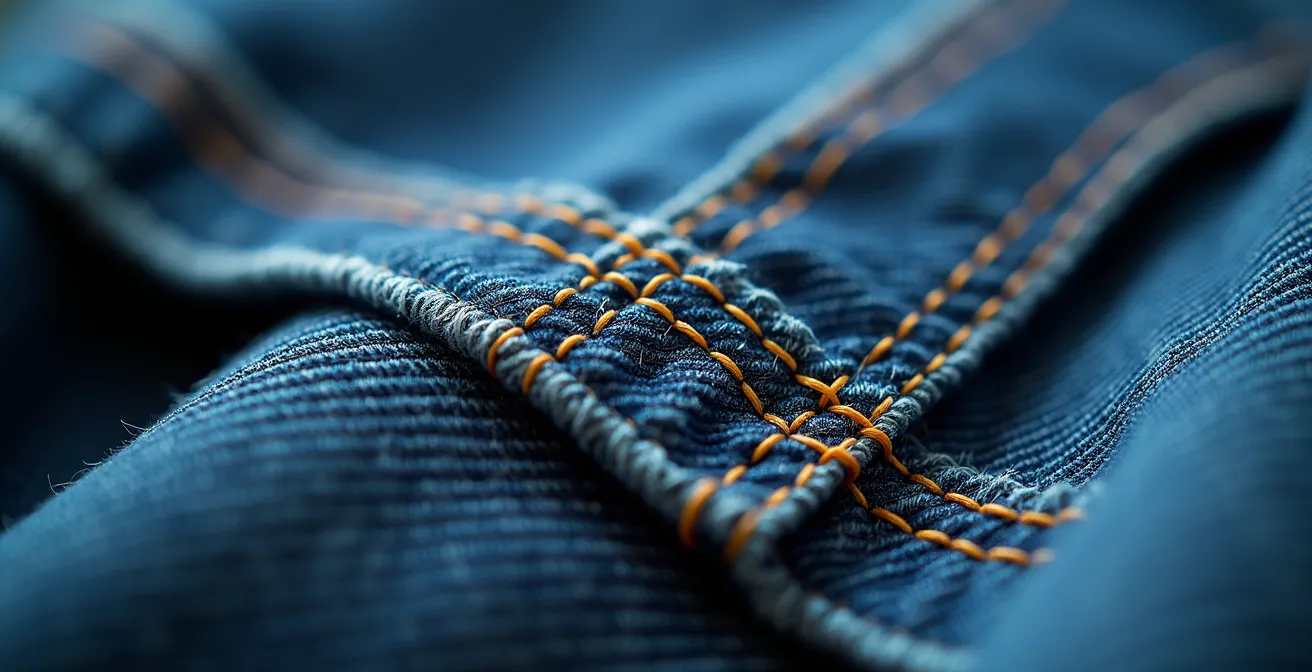
As you can see from the texture and stitching, the factory finish is complex. For a DIY approach, you can create a controlled frayed edge. First, cut the jeans to your desired length. Then, gently pull at the horizontal threads to create a soft fray. To prevent this from unraveling uncontrollably in the wash, add a single, discreet horizontal stitch on the inside of the leg, about a quarter-inch from the new edge. This acts as a barrier, keeping the fray stylishly contained. For reference, petite styling experts often recommend an inseam of 27-28 inches for wearing with flats and around 25 inches for a cropped look.
This attention to detail ensures your investment in a great pair of jeans isn’t compromised by a poor alteration, maintaining the integrity of the design from waist to ankle.
Sneakers or Heels: What Shoes Prevent Dragging Hems on City Streets?
Even a kitten heel can make a huge difference. A small heel elongates your legs and gives you a taller, slimmer appearance, which is key when styling wide-leg jeans.
– Heather Anderson, So Heather Fashion Blog – Viral Wide-Leg Jeans Video
The shoe you choose to pair with wide-leg or baggy jeans is not just an accessory; it’s a functional tool that dictates the entire proportion of your lower half. For petites, the primary goal is to create an elongated leg line and ensure the hem grazes the top of the shoe without dragging. The choice between sneakers and heels depends entirely on the specific silhouette you want to engineer and the environment you’ll be in.
Heels are the most direct way to add height and prevent dragging. However, not all heels are created equal. A pointed-toe heel is particularly effective because the sharp point extends visually from under the hem, creating a longer line even if the heel itself is modest. Block heels are excellent for grounding the volume of very wide jeans, providing a substantial base that balances the fabric. As the following table shows, even a small lift can have a significant impact.
This table, based on an analysis from petite styling experts, breaks down how different shoe types impact your silhouette.
| Shoe Type | Visual Effect | Best For | Height Added |
|---|---|---|---|
| Pointed-toe flats | Elongates leg line with sharp endpoint | Casual daily wear | 0-0.5″ |
| Platform sneakers | Provides height without instability | Comfort & style balance | 1-2″ |
| Kitten heels | Subtle lift with elegance | Professional settings | 1.5-2″ |
| Block heels | Grounds volume of baggy jeans | All-day wear | 2-3″ |
For city streets where comfort is paramount, the platform sneaker is an unbeatable choice. It provides 1-2 inches of clean, uniform height without the instability of a traditional heel. This lift is often just enough to get the hem off the pavement while maintaining a modern, casual aesthetic. The key is to choose a sneaker with a clean, relatively simple profile to avoid adding unnecessary bulk at your feet.
Ultimately, hem your jeans for the type of shoe you wear most often. Having two pairs of the same style—one hemmed for flats, one for heels—is a pro-level move for true denim lovers.
The “Double Baggy” Mistake That Hides Your Shape Completely
The single most common error that causes a petite frame to look “drowned” in baggy jeans is what’s known as the “double baggy” or “baggy on baggy” silhouette. This happens when voluminous jeans are paired with an equally oversized, unstructured top. As fashion editor Heather Anderson, at 5’4″, emphasizes, this combination “can make you look sloppy and frumpy.” The issue is that it erases all your proportional anchor points—your waist, your shoulders, and your hips—leaving a single, shapeless column of fabric.
The solution isn’t necessarily to wear a skin-tight top, but to create balance and reintroduce shape. A fitted top is the simplest way to do this, clearly defining your waist and torso as a counterpoint to the volume below. However, you can also successfully layer with looser tops if you follow specific rules. The key is structure. A cropped jacket or blazer that hits at the hip maintains that crucial waist definition. Similarly, an oversized shirt can work wonders if you use a front-tuck or half-tuck to hint at the waistline beneath.
If you opt for a looser top, fabric choice becomes critical. A top made from a fluid, draping material like silk or Tencel will follow the lines of your body, suggesting your shape without clinging to it. This is far more effective than a bulky fabric like a heavy fleece sweatshirt, which adds its own volume to the equation. The goal is to create a dialogue between the structured volume of the jeans and the defined or fluid shape of your top, proving that one part of the outfit is in charge of the silhouette.
By ensuring your top either has its own structure or is styled to define your waist, you create a balanced, intentional look that feels powerful, not lost.
When to Choose Rigid Denim Over Stretch for Structuring a Baggy Fit
The fabric of your jeans is just as important as the cut, especially for a petite frame. The choice between rigid, 100% cotton denim and a blend with stretch determines the entire drape and structure of the silhouette. While stretch denim offers immediate comfort, it can be a hidden enemy for petites wearing baggy styles. It often lacks the structural integrity to hold a defined shape, causing it to cling in some places and collapse in others, resulting in a shapeless “tent” effect.
Rigid denim, on the other hand, is architectural. Made from 100% cotton (or a very high cotton content), it holds its shape away from the body. For a wide-leg or A-line cut, this is a major advantage. The fabric creates a clean, sweeping line from the hip to the hem, maintaining the intended silhouette without collapsing around your legs. Style experts suggest that for a truly structured look, you should opt for denim with a 90% or higher cotton content. This type of denim molds to your body over time, creating a personalized fit that only gets better with wear.
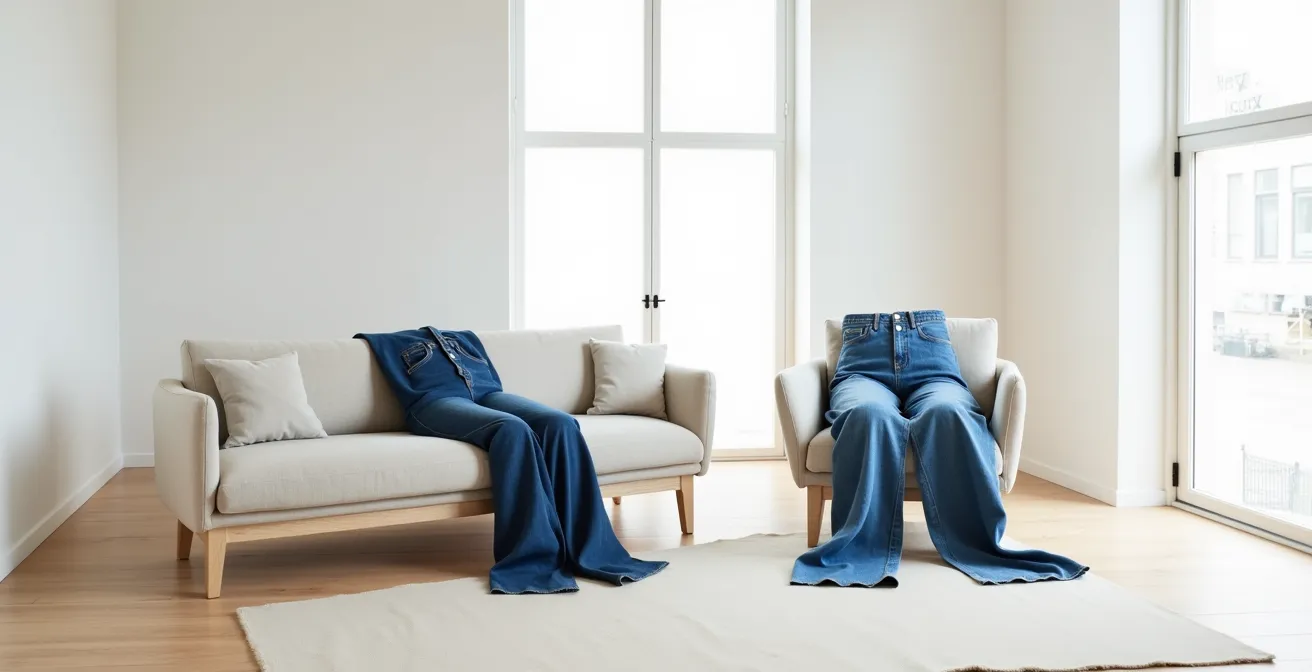
This doesn’t mean stretch is always bad. For petite curvy figures or for achieving a ’90s-style baggy fit that’s more body-skimming, a small amount of stretch (1-2%) can provide a better drape and prevent the fabric from looking too stiff. The key is understanding the effect you want to achieve.
This comparative table breaks down the ideal uses for each denim type, helping you make a more informed choice based on your body and style goals.
| Denim Type | Best For | Silhouette Effect | Break-in Period |
|---|---|---|---|
| 100% Cotton Rigid | Classic wide-leg, A-line shapes | Holds architectural shape, creates structured drape | Molds to body over 2-3 weeks |
| 1-2% Stretch | Petite curvy figures, ’90s baggy styles | Body-skimming drape, prevents ‘tent’ effect | Comfortable immediately |
| No Stretch | Tailored trouser-style wide legs | Maintains crisp, polished look | Softens with wear |
Choosing rigid denim is a conscious decision to prioritize silhouette and structure over instant comfort—a trade-off that often pays huge dividends in creating a powerful and flattering look.
Mixing Nike and Adidas: The 3 Rules of Brand Loyalty You Can Break
In the world of streetwear, brand loyalty can feel like an unwritten rule. But when styling baggy jeans on a petite frame, blindly adhering to one brand can limit your options and compromise your proportions. The truth is, you can and should mix brands like Nike and Adidas. The key is to follow a higher set of principles where silhouette, color, and aesthetic harmony trump the logo on the side of the shoe.
For petites, the shape of the sneaker is paramount. A slim, low-profile sneaker creates a different leg line than a chunky sneaker. The silhouette, not the brand, dictates the proportion.
– Fashion Editorial Team, Tops for Days Petite Fashion Guide
The first and most important rule is to prioritize silhouette over swoosh. A slim, low-profile sneaker like an Adidas Gazelle will create a sleek, elongated foot that extends the leg line. A chunkier sneaker like a Nike Air Force 1 provides more height but also adds visual weight, which can be used to balance very wide jeans. Your choice should be based on the leg line you want to engineer, not brand allegiance.
Secondly, use color-blocking to unify brands. If you’re wearing Nike sneakers and an Adidas top, creating a deliberate color story can make the mix feel intentional. An all-black or all-white look shifts the focus from the competing logos to the cohesive color palette. The contrast becomes about the texture and shape, not the branding. Finally, apply the ‘Aesthetic Harmony’ principle. Mix brands that share a common design DNA or era. Pairing classic ’90s-era baggy jeans with any iconic ’90s sneaker, regardless of brand, creates a look that is stylistically coherent because it references the same cultural moment.
By focusing on these higher-level styling concepts, you can build a more versatile and proportionally sound wardrobe that serves your frame first.
Double-Lined Hoods: The Detail That define a Premium Silhouette
When balancing the volume of baggy jeans, the top you choose does more than just cover your torso; it acts as a visual counterweight. While a simple fitted tee works, a more advanced technique is to use a top with its own inherent structure. A premium, double-lined hoodie is a perfect example of this. The difference between a flimsy, single-layer hood and a substantial, double-lined one is stark. The latter has weight and form, allowing it to stand up on its own and frame your head and shoulders, creating a powerful anchor point for the entire outfit.
Personal stylist Samantha Dawn notes that while wide-leg jeans “can elongate the legs,” this effect is amplified when paired with structured upper body pieces. The double-lined hood provides that structure, defining the top of your torso and preventing the eye from seeing one continuous, shapeless form. It signals quality and intention, elevating the entire look from casual-sloppy to considered-streetwear. This is especially crucial for a petite frame, as it adds necessary visual interest and structure to the upper body, balancing the volume below.
To effectively use a structured top like a premium hoodie, think of it as a piece of architecture for your outfit. The goal is to build shape and create defined zones within your silhouette.
Your Action Plan: Creating Shape with Structured Tops
- Establish an Anchor Point: Position the hood as a ‘shape anchor’ at the top of the torso. This defines the upper body and prevents the outfit from reading as one shapeless column.
- Define the Waist: Choose cropped hoodies that hit at the hip. This maintains the crucial waist definition needed when wearing voluminous bottoms, even if the hoodie itself is relaxed.
- Add Architectural Interest: Layer the structured hoodie under a blazer or denim jacket. This adds another layer of architectural detail to the shoulder line, enhancing the counterweight effect.
- Assess the Weight: Select hoodies with substantial, double-lined construction. The added weight and structure are what signal quality and elevate baggy jeans from sloppy to intentional.
- Check the Silhouette: Step back and ensure the hoodie creates a clear shape on your upper body that balances, rather than competes with, the volume of the jeans.
By investing in pieces with this kind of built-in structure, you gain a powerful tool for controlling your silhouette and mastering voluminous trends with confidence.
Key Takeaways
- Mastering baggy jeans on a petite frame is about silhouette engineering, not avoiding volume.
- Fabric is crucial: rigid denim provides structure, while stretch can create a “tent” effect.
- Create “proportional anchor points” at the waist, shoulders, and feet to ground the look and prevent being overwhelmed by fabric.
Why Are Heritage Streetwear Logos Resurging in Luxury Collections This Season?
The resurgence of heritage streetwear logos in high-fashion collections is more than just nostalgia; it’s a strategic design choice that has a direct benefit for petite styling. As celebrity stylists Danielle and Alix note, “Wide-leg pants demand a top that either defines your waist or provides a structured counterpoint.” A heritage logo, placed strategically on a sweatshirt or t-shirt, can serve as that counterpoint by acting as a powerful upward focal point.
For a petite frame wearing voluminous bottoms, the visual challenge is to prevent the eye from being drawn downward by the mass of fabric. A recognizable logo on the chest or a graphic across the shoulders immediately captures attention and pulls the gaze upward, away from the wide legs of the jeans. This subtly but effectively elongates the torso and balances the overall proportion. It’s a simple trick of visual direction that makes a significant difference.
This technique is particularly effective when the top itself is well-fitting. As fashion editor Emily Dawes found when testing a pair of viral wide-leg jeans, a style with a “slimmer fit at the hip and bum” creates a flattering silhouette. When this is paired with a logo top, the defined hip acts as a stable base, and the logo acts as the visual destination. The result is a look that feels balanced, intentional, and perfectly proportioned. The logo is no longer just branding; it’s a functional component of your silhouette engineering.
So, the next time you choose a top to go with your baggy jeans, consider the power of a well-placed logo. It’s a simple, on-trend way to take control of your silhouette and direct attention exactly where you want it to go, proving that great style is all in the details.