
The resurgence of heritage logos is not just nostalgia; it’s the calculated transformation of brand history into a tradable financial asset.
- Luxury houses are mining their archives for “semiotic capital”—recognizable symbols—to create instant value and cultural relevance.
- Collaborations and limited drops are engineered scarcity, turning cotton T-shirts into investment pieces with measurable resale potential.
Recommendation: Evaluate these pieces not as clothing, but as assets. Analyze brand archaeology, collaboration rarity, and secondary market data before investing.
The sudden dominance of heritage streetwear logos in high-fashion collections is far more than a fleeting trend or a simple nod to 90s nostalgia. While many see a cyclical return of logomania, a deeper analysis reveals a sophisticated economic strategy at play. For the modern fashion investor and enthusiast, understanding this phenomenon requires moving beyond surface aesthetics. The conventional wisdom focuses on brand visibility and hype, but it often misses the core mechanism: the deliberate “assetization” of nostalgia. Luxury houses are not just selling clothes; they are weaponizing their semiotic capital—the cultural meaning embedded in a logo—to create a new class of tangible, high-velocity assets.
This isn’t merely about putting an old logo on a new hoodie. It’s an act of brand archaeology, where forgotten symbols are excavated and reintroduced to a market primed for authenticity and historical narrative. The result is a powerful fusion of hype culture and high finance, where a screen-printed T-shirt can command a price reflecting not its material cost, but its value as a cultural artifact and a financial instrument. This article will deconstruct the economic and cultural engine driving this resurgence. We will move beyond the “why” of nostalgia to the “how” of value creation, exploring how to evaluate these pieces as investments, identify true value from manufactured hype, and calculate their real return over time.
This guide provides an analytical framework for investors and collectors navigating the intersection of luxury and streetwear. We will dissect the strategies behind pricing, the indicators of resale potential, and the material factors that determine long-term value, offering a clear roadmap for making informed decisions in this dynamic market.
Summary: Deconstructing the Value of Heritage Streetwear Logos
- Why Do We Pay 300% More for a Screen-Printed Cotton T-Shirt?
- How to Evaluate the Resale Potential of Logo Collaborations Before Buying?
- Minimalist Branding vs. Logomania: Which Retains Value Better Over Time?
- The Font Spacing Error That Gives Away Fake Designer Hoodies
- Mixing Nike and Adidas: The 3 Rules of Brand Loyalty You Can Break
- Primary vs. Secondary Market: Where Should Beginners Shop?
- Natural Fibers vs. Synthetics: Which Material Holds Resale Value Better?
- Investment Pieces: Calculating the Real ROI of a Capsule Wardrobe Over 5 Years
Why Do We Pay 300% More for a Screen-Printed Cotton T-Shirt?
The premium paid for a logo-emblazoned T-shirt is a direct function of “perceived value engineering,” a strategy where brand narrative and cultural capital are substituted for material worth. A plain cotton T-shirt’s production cost is minimal, but the addition of a heritage logo from a brand like Supreme or a luxury house like Louis Vuitton transforms it from a commodity into a cultural signifier. This value is not arbitrary; it is meticulously constructed. Brands leverage decades of history, cultural associations, and carefully managed scarcity to justify the price differential. The logo acts as a certificate of authenticity for the wearer’s inclusion in a specific cultural tribe.
Economically, this is a masterclass in leveraging intangible assets. The streetwear market’s immense scale— the global streetwear market reached $347.14 billion in 2024—provides the financial foundation for this model. When a luxury brand collaborates with a streetwear icon, as seen in the landmark Supreme x Louis Vuitton collection, it creates a moment of manufactured cultural importance. The resulting products become artifacts of that moment, their value tied to the event’s historical significance rather than their physical composition. The price, therefore, represents the cost of acquiring a piece of that history.
This “assetization of nostalgia” means you are not buying cotton; you are buying a share in a brand’s story. The 300% markup is the market’s consensus on the value of that share. For an investor, the key is to differentiate between logos that represent a deep, resonant history and those that are merely a fleeting marketing tactic. The former holds its value because the story is timeless, while the latter fades as soon as the next trend emerges.
How to Evaluate the Resale Potential of Logo Collaborations Before Buying?
Evaluating the resale potential of a logo collaboration requires a shift from a consumer mindset to that of a market analyst. The value is not in the aesthetics but in a confluence of measurable factors: rarity, brand momentum, and narrative strength. Before a release, the most crucial data comes from monitoring pre-release buzz. Niche Instagram archivists and dedicated online communities are the canaries in the coal mine; their level of engagement is a direct indicator of post-release demand. A collaboration that generates organic, expert-led discussion is far more likely to appreciate in value than one driven solely by a mainstream marketing budget.
The brand’s historical performance on secondary markets like StockX and GOAT provides a quantitative baseline. Analyze the trajectory of past collaborations. Did they peak and crash, or have they shown sustained growth? A brand with a consistent track record of appreciating assets, like early Off-White or specific Palace drops, signals a stable investment. Furthermore, the rarity of the collaboration is paramount. This isn’t just about limited production numbers but also the uniqueness of the partnership. A first-ever-of-its-kind pairing (e.g., luxury x skate) inherently carries more narrative weight and, therefore, more potential value than a predictable annual release.
Finally, a counterintuitive but highly effective indicator is the speed and quality of counterfeit production. When high-quality fakes appear quickly, it signals that counterfeiters, who have their own sophisticated market analysis, have identified massive demand. While the existence of fakes presents a risk, with some reports suggesting that in 2024 two out of every 40 authenticated items are fake, their rapid emergence is a powerful, if unconventional, validation of an item’s desirability and future resale value.
Minimalist Branding vs. Logomania: Which Retains Value Better Over Time?
The debate between minimalism and logomania in terms of value retention is not about which aesthetic is “better,” but which strategy aligns with different market cycles and investment horizons. Logomania-driven pieces, or “hype assets,” often exhibit high short-term volatility. Their value is tied to the cultural moment, peaking quickly after release and then either stabilizing if the item becomes iconic or crashing if the trend fades. These pieces function like high-risk, high-reward stocks, offering significant gains for investors who can time the market correctly. They are bets on the endurance of a specific trend or collaboration.
Minimalist pieces from brands known for “quiet luxury,” on the other hand, behave more like blue-chip investments. Their value is rooted in craftsmanship, material quality, and the enduring prestige of the brand itself, rather than a transient logo. Think of a perfectly tailored Loro Piana sweater or a classic Brunello Cucinelli jacket. These items typically see a slower, more stable appreciation in value. Their appeal is timeless and less susceptible to the whims of fashion cycles, making them a safer long-term hold. Their resale value is underwritten by the brand’s reputation for quality, not by the loudness of its branding.

The broader luxury streetwear market is projected to expand significantly, with an expected CAGR of 7.9% from 2025 to 2033, indicating that both strategies have room to thrive. For an investor, the optimal approach is a diversified portfolio. Logomania pieces offer the potential for rapid capital appreciation, while minimalist items provide a stable store of value and a hedge against trend volatility. The choice depends entirely on your risk tolerance and investment timeline. Logomania is an arbitrage on cultural relevance; minimalism is an investment in enduring quality.
The Font Spacing Error That Gives Away Fake Designer Hoodies
While a subtle font spacing error—known as poor kerning—can indeed be a tell-tale sign of a counterfeit hoodie, relying on such simple visual cues alone is a dangerously outdated authentication strategy. As the counterfeit market becomes more sophisticated, so too must the methods of verification. Professional authenticators now operate on a forensic level, looking far beyond logos. The game has moved from visual inspection to material science and data analysis. For an investor, understanding these deeper layers of authentication is non-negotiable for protecting capital.
True authentication involves a multi-point inspection process. Stitching is a primary focus: authentic luxury items have a high, consistent stitch-per-inch count, and the pattern is uniform, even on the interior seams. Counterfeiters often cut corners on interior construction where it’s less visible. Material composition is another critical area. As Sarah Davis, founder of Fashionphile, noted, authenticators use advanced tools like X-rays and metal alloy detectors to verify the precise material makeup of items like Cartier bracelets. This same principle applies to textiles, where the weight, weave, and feel of a fabric are compared against a baseline of known authentic examples.
The prevalence of high-quality fakes is staggering. In 2024, authentication service Entrupy found that 8.4% of products scanned were unidentifiable or fake, representing millions in fraudulent value. Therefore, the most reliable method for an individual investor is to rely on verifiable provenance and third-party authentication services. Always demand proof of original purchase and, for high-value items, invest in a professional authentication service that uses both expert knowledge and technological tools. The small fee is an insurance policy against a total loss.
Mixing Nike and Adidas: The 3 Rules of Brand Loyalty You Can Break
The old, unspoken rule of streetwear—absolute brand allegiance, where mixing Nike and Adidas was seen as a sartorial sin—has been rendered obsolete by the very evolution of luxury streetwear. The modern wardrobe is built on a principle of curation, not blind loyalty. As observed by Caroline Stevenson, Programme Director at London College of Fashion, the contemporary consumer is encouraged to “mix and match their looks, sampling from across a wide range of different cultural references.” This shift empowers the wearer, turning them from a brand disciple into a stylist. For the savvy investor and collector, this means the old rules no longer apply. Here are the three you can confidently break:
- The Rule of Rival Allegiance: The idea that rival brands (like Nike and Adidas, or Palace and Supreme) cannot coexist in one outfit is dead. Today, value is derived from the strength of individual pieces, not the coherence of a single brand’s ecosystem. A well-curated look that pairs iconic Adidas sneakers with a rare Nike ACG jacket demonstrates a higher level of connoisseurship than a head-to-toe single-brand uniform. It shows you appreciate design and history, not just logos.
- The High-Low Segregation Rule: The barrier between luxury and mass-market streetwear has completely dissolved. The data below shows that while the mass market is larger, the premium/luxury segment is growing faster, indicating a convergence. Pairing a Uniqlo T-shirt with a Dior B23 sneaker is no longer a fashion faux pas; it’s a statement of financial and stylistic intelligence, showing you know where to save and where to invest.
- The “One Logo” Rule: The fear of “logo-clashing” is a relic. In the post-collaboration era, combining logos is a way of signaling your awareness of different cultural spheres. Pairing a Kith logo with a Moncler piece, for example, tells a story about the convergence of New York street culture and Alpine luxury. The key is intentionality: the combination should feel deliberate and curated, not random.
This table illustrates the market dynamics fueling this shift. The premium segment’s faster growth rate highlights the increasing appetite for high-low mixing, where consumers invest in luxury pieces and pair them with mass-market staples.
| Segment | Market Share 2024 | Growth Rate |
|---|---|---|
| Premium/Luxury | 33.67% | 4.25% CAGR |
| Mass Market | 66.33% | 3.8% CAGR |
Primary vs. Secondary Market: Where Should Beginners Shop?
For a beginner entering the world of luxury streetwear investment, the primary market—official brand stores and authorized retailers—should be your first port of call. This is not about finding the best price, but about establishing a crucial baseline. Purchasing directly from the source allows you to experience the authentic product firsthand: the precise weight of the fabric, the quality of the stitching, the feel of the materials, and the specifics of the packaging. This tactile knowledge is your most valuable tool for future authentication. It provides a mental and physical reference point against which all future secondary market purchases can be judged. Without this foundational experience, you are navigating the secondary market blind.
Once you have built this baseline, you can strategically enter the secondary market, which is where the true investment opportunities lie. The global luxury resale market is booming, with projections showing it will reach $68.53 billion by 2028. This growth is powered by platforms like StockX, Grailed, and END Clothing, which have professionalized the resale process by offering authentication and escrow services. For a beginner, sticking to these reputable platforms is non-negotiable. They act as a crucial buffer, mitigating the high risk of fraud present on unregulated channels like Instagram shops or TikTok ads.
When operating on these platforms, a disciplined approach is still required. Always scrutinize seller ratings and reviews, and prioritize those who provide detailed histories and proof of purchase. Never hesitate to request additional, high-resolution photos, especially of interior tags, wash labels, and seam construction. These are the details counterfeiters are most likely to get wrong. The primary market is your education; the secondary market is where you apply that knowledge to generate returns.
Action Plan: Your First Foray into the Secondary Market
- Establish a Baseline: Make at least one primary market purchase from an official retailer to understand true quality standards.
- Platform Selection: Limit initial secondary market purchases to highly reputable platforms with buyer protection and authentication services (e.g., StockX, Grailed).
- Seller Vetting: Scrutinize seller profiles. Prioritize sellers with extensive transaction histories, high positive feedback ratings, and detailed item descriptions.
- Documentation Audit: Always request and verify original receipts, authentication certificates, and any accompanying packaging or tags. Cross-reference these with known authentic examples online.
- Image Forensics: Request detailed, high-resolution photos of key authentication points: interior construction, material texture, wash tags, and logo stitching. Be wary of sellers using stock photos.
Natural Fibers vs. Synthetics: Which Material Holds Resale Value Better?
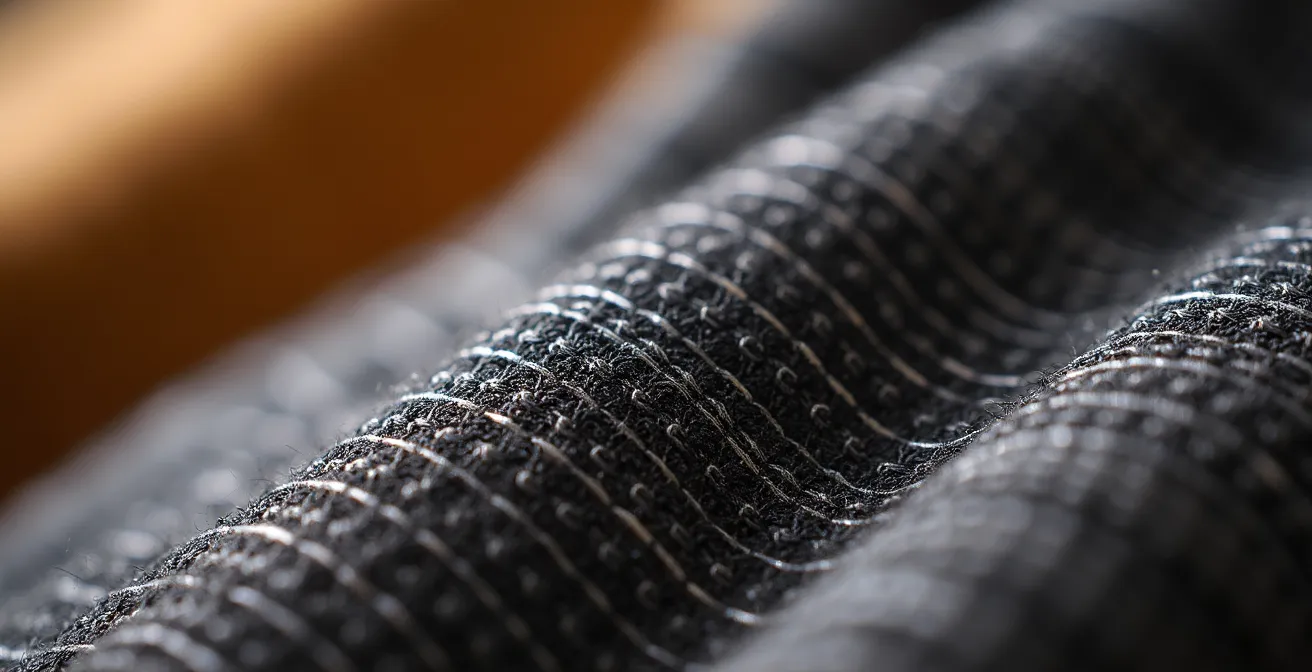
In the luxury streetwear market, natural fibers—particularly high-quality cotton, wool, and cashmere—consistently hold their resale value better than their synthetic counterparts. The reason is twofold: durability and perceived quality. A heavy, well-constructed cotton hoodie or a premium wool overshirt not only feels more substantial but also ages better. Natural fibers develop a patina over time that is often seen as desirable, whereas synthetics like polyester and nylon can show wear in less appealing ways, such as pilling or losing their shape. For collectors and investors, an item’s ability to withstand the test of time is a direct indicator of its long-term value. The material is the foundation of the investment.
However, this is not a blanket rule. Performance-oriented synthetics used by brands like Arc’teryx, Stone Island, and Nike ACG are a major exception. In this context, the synthetic material (e.g., GORE-TEX, technical nylon) is the core value proposition. These materials are chosen for their functional properties—waterproofing, breathability, durability—and the innovation they represent. For these “techwear” pieces, the brand’s reputation for material innovation underwrites the item’s value. A vintage Stone Island jacket made from a now-discontinued experimental nylon is a collector’s item precisely because of its synthetic nature.
Furthermore, the growing influence of sustainability is adding another layer to the equation. As noted by Global Growth Insights, collections featuring a high percentage of recycled materials can drive significant consumer engagement. A piece made from recycled polyester or organic cotton can carry a narrative of environmental responsibility, adding to its desirability. The choice of material is increasingly a statement of values. Ultimately, whether natural or synthetic, the materials that hold value best are those that are either of the highest intrinsic quality or are central to the item’s unique story and function.
Key takeaways
- The value of a logo is not in the design itself, but in the decades of cultural narrative and brand history it represents—its “semiotic capital.”
- Evaluate logo-driven pieces as financial assets, analyzing rarity, collaboration uniqueness, and secondary market data, not just aesthetics.
- Authentication has moved beyond visual checks. True verification involves forensic analysis of materials, stitching, and data, making third-party services essential for high-value items.
Investment Pieces: Calculating the Real ROI of a Capsule Wardrobe Over 5 Years
Calculating the real Return on Investment (ROI) of a capsule wardrobe of investment pieces requires a more nuanced formula than a simple `(Sale Price – Purchase Price) / Purchase Price` calculation. A true analysis must factor in holding costs, platform fees, and the non-financial dividend of wearability. A piece might appreciate 200% on paper, but if it’s unwearable or requires costly specialized storage, its real return diminishes. The goal is to build a collection of assets that not only grow in value but also provide utility.
The first step is to track all associated costs. This includes the initial purchase price, taxes, shipping, and any authentication fees. For the sale, you must subtract platform commissions (which can range from 8% to 15%), payment processing fees, and shipping costs. This gives you the Net Financial ROI. Next, factor in the “Wearable Dividend.” Assign a conservative cost-per-wear value by dividing the purchase price by the number of times you’ve worn the item. This represents the utility value you’ve extracted. A truly successful investment piece is one that has both a high Net Financial ROI and a low final cost-per-wear.
The market is volatile, and even iconic brands see corrections. Supreme’s valuation, for instance, dropped from a $2.1 billion acquisition in 2020 to $1.5 billion in 2024, highlighting market fluctuations. In contrast, enduring collaborations like Yeezy and Adidas consistently generated massive revenue. A diversified capsule wardrobe should contain both high-growth “hype” assets and stable, timeless pieces. The ROI of the portfolio is a weighted average of these different asset types. Over a 5-year period, a well-curated collection should not only beat inflation but also provide significant utility, making it a far more dynamic and engaging asset class than traditional stocks or bonds.
For investors ready to move beyond simple collecting and apply a rigorous, data-driven approach, the next logical step is to build a personalized tracking system. Begin by cataloging your current pieces and calculating their real-time market value to establish a baseline for your portfolio’s performance.